


“The Menu” is a darkly satirical horror that serves up a critique of the power dynamics that sustain luxury at the expense of the vulnerable.
No time to read? Click the button below to listen to this post.
EDITOR'S NOTE
The following article contains an in-depth analysis of the film The Menu. As a result, you are strongly encouraged to watch the film, which is currently available to watch on Prime Video or rent on VOD, before reading this analysis to avoid any significant plot spoilers.
In The Menu, director Mark Mylod serves up a disturbing feast that explores the grotesque power imbalance between the elite and the exploited. At first glance, it may appear as a darkly comic thriller about food, but beneath the surface lies a biting critique of wealth, privilege, and the often invisible labor of service workers.
The film masterfully blends social commentary with horror, exposing how the upper class consumes not just gourmet meals but also the lives of those who serve them. Through its meticulously crafted narrative, The Menu challenges viewers to confront the systems of exploitation that fuel luxury and entitlement, making it a chilling and timely reflection of today’s world.
The Guests
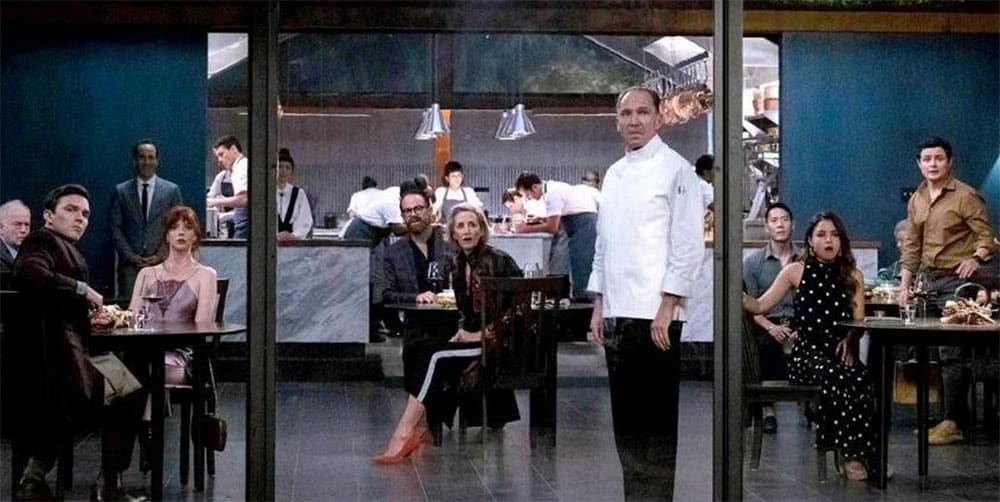
With a crazy price tag ($1250 a head) to eat on this gorgeous island, divisions immediately appear between normal folks and the filthy rich. This island is home to the kind of beauty only the rich get to see but never appreciate because they see that sort of scenery all the time; without struggle, life is meaningless, but the rich amuse themselves endlessly from one expensive thing to another.
Our guests are Tyler (Nicholas Hoult) and Margot (Anya Taylor-Joy), an influential food critic and her yes-man, an aging actor (John Leguizamo) and his resentful assistant, three puerile rich boys who work for the restaurant’s owner, and a married couple who hate each other.
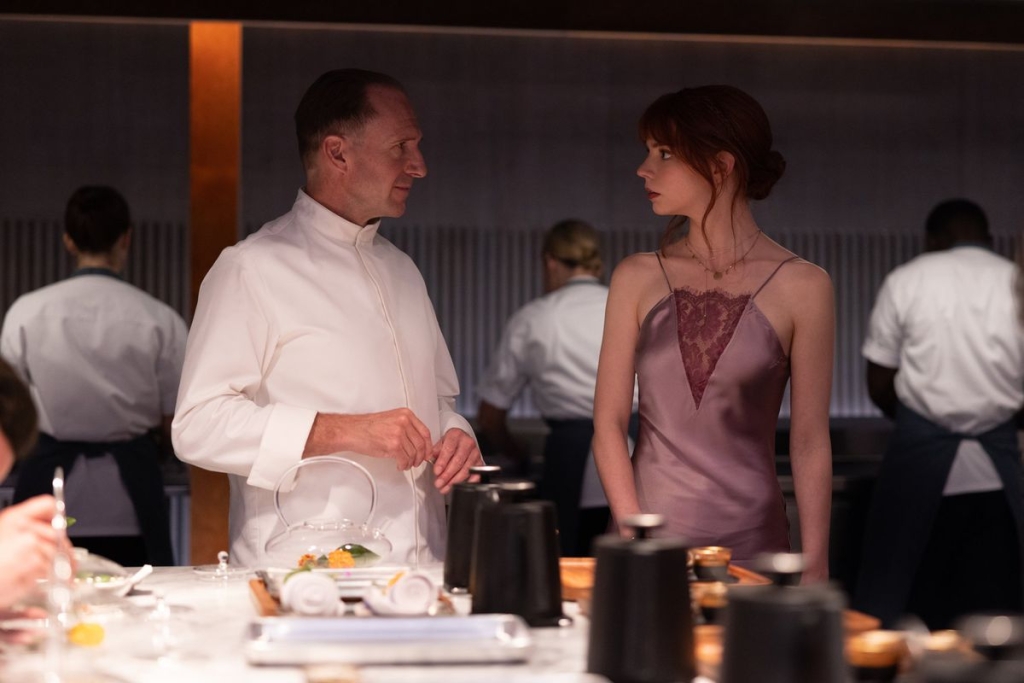
Tyler is merely a worshipful asshole of this exclusive world. He reveres Chef Slowik because critics like Lillian Bloom(Janet McTeer) told the world he was great. Tyler knows nothing about cooking but pretends to be a culinary expert. He is an entitled rich boy who doesn’t mind dying for this “once-in-a-lifetime experience” nor dragging an innocent girl into it just to make sure he doesn’t lose the reservation.
This man cares about nothing except the food and the chef; he doesn’t know or care to know the names of the other workers because no one else exists. His greed to have more becomes clear when he clumsily takes Margot’s appetizer and accidentally breaks a glass. He is orgasmic over the arty breadless bread plate but not smart enough to see that he’s being insulted by it, even when the much more astute Margot points it out.
When Tyler looks at Chef Slowik (Ralph Fiennes), he sees him as a kind of Jesus figure, with the juxtaposition of a line about one’s daily bread. Parasocial relationships are really weird.
Tyler continually chastises and controls Margot because she doesn’t fit in with this group of wealthy socialites.

Her hair and dress are lovely, but her shoes, jewelry, and jacket communicate outright defiance at this glitzy event, where others wear designer clothes and heels. Meanwhile, Tyler is a rich boy footing the bill, which he later throws in her face.
To be clear, Margot doesn’t let people tell her what to do or let people treat her like crap, but it’s coming from a different place than the people who buy respect. Margot demands it, most likely because the world looks down on her. She sees all of this performative “art” as too much and the utterly ridiculous price tag as ludicrous. What kind of people have so much money that they throw it around like confetti?
Lillian Bloom, the celebrated food critic, is pretentious at best, and the guy with her is just there as a prop for her; he’s not even allowed to have his own thoughts.
It is enough to stand in her immense shadow and firmly place his lips on her butt for eternity. Lillian also openly insults the food by drawing attention to a broken emulsion, which she proudly states shouldn’t be seen in a restaurant of their caliber. The kitchen staff, who she neither notices nor acknowledges, brings her an entire bowl of broken emulsion, mocking her careless comments.
Why does she presume that the emulsion wasn’t done this way on purpose? Everything in that kitchen has a purpose.
Lillian’s sins are also brought to the forefront when various restaurants her reviews shuttered are laser-printed with her tortillas, highlighting how she took away other people’s dreams and livelihoods with a flourish of her pen, propelled by her inflated sense of self-importance.
Felicity (Aimee Carrero) is the young, pretty assistant who is deeply tired of her boss, former famous movie star Georgie Diaz. Yet, she is closer to him than his wife, with keys even to the apartment his wife doesn’t know about. She’s proud that she’s moving on to bigger and better things while her boss shuts down her dreams selfishly. He loves the limelight but pretends he doesn’t, name-drops, and struggles to feel important.
Diaz’s one shining moment is when he tries to get Slowik to let Felicity go, but she dies because she went to Brown University and has no student loans. These two pieces of information alone mean that she is not from the working class and hails from money.
The other ridiculous little rich boys are Ted, Soren, and Bryce.
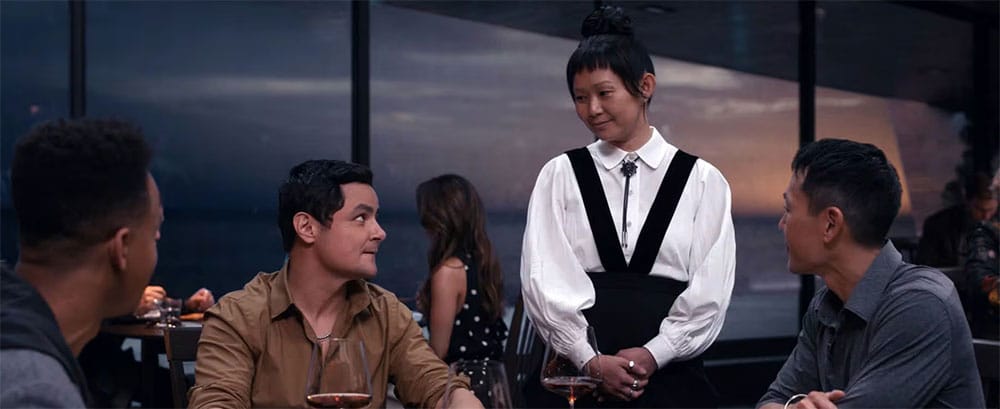
They spend the duration of the meal insulting the restaurant while in it and claiming their personal chef does it better because they aren’t smart enough to understand the genius of what the chefs are cultivating.
They act like children, boasting about their bad behavior like it’s something to be admired and wanting to keep things surface-level even with their buddies. These men represent the little boys with too much money who were never forced to grow up; they are weak-willed and lack the ability to be fully formed human beings. Surface is all that exists with them; there is nothing beneath it, even with each other.
They think their money buys them the world while they quietly launder it in other countries.
The regulars are an older couple with more money than they know what to do with. Anne (Judith Light) is a woman with sad eyes who only seems happy when talking about her daughter, but her husband, Richard (Reed Birney), hacks at even her slices of happiness with a machete. He also cheats on her repeatedly with escorts.
She notices Margot watching them and thinks she has the same look as their daughter. We find out later that Richard hired her in the past to jerk off in front of her, asking her to tell him he’s a good man and a good father because a defining trait of the rich is how weird they are. Like Diaz, his one redeeming act is asking them to let his wife go when the insanity begins.
The only other character in the room is Julian Slowik’s mother, comatose in the corner and increasingly drunker as the night goes on. She is not acknowledged until Slowik shares a traumatic experience about his father and is asleep before the night is over, slumped over the table.
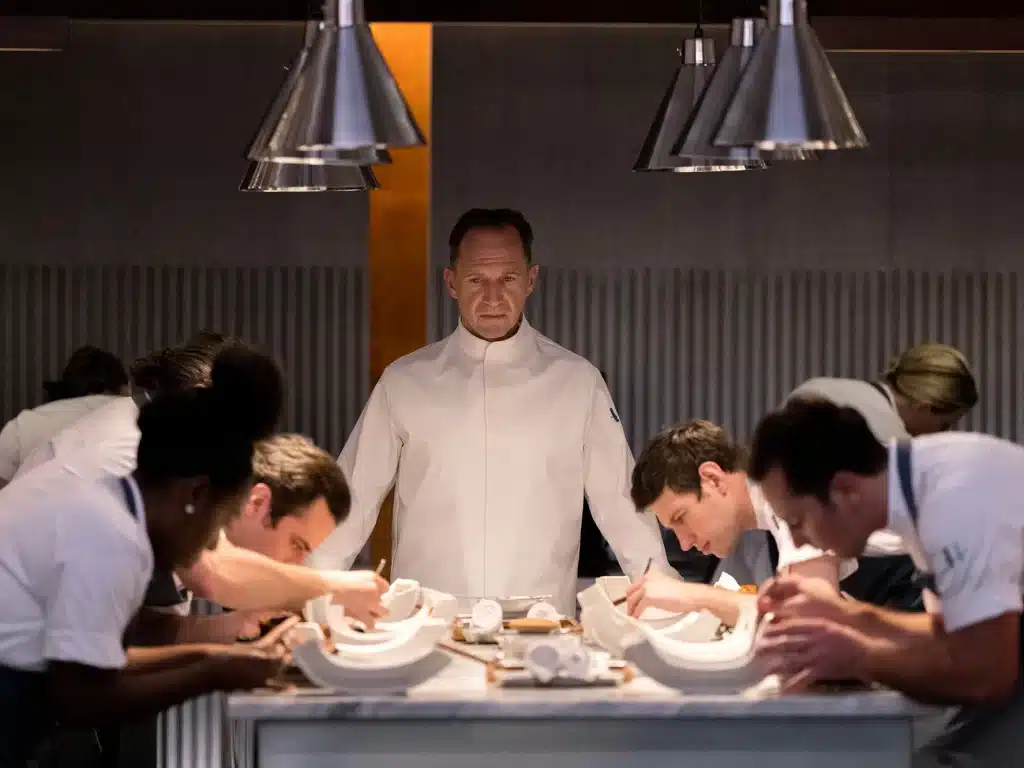
The kitchen staff is uniform in movement, with a rhythm that never loses a beat; they are cells working in unison to complete Chef’s dream while he evaluates their efforts. They stand to the side, not breathing until he passes judgment.
Elsa (Hong Chau), the hostess, is a smiling yet unyielding woman who doesn’t take kindly to people mocking her lifestyle or beloved chef.
I do love that she is unyielding to these people who think they can have anything they want because of money.
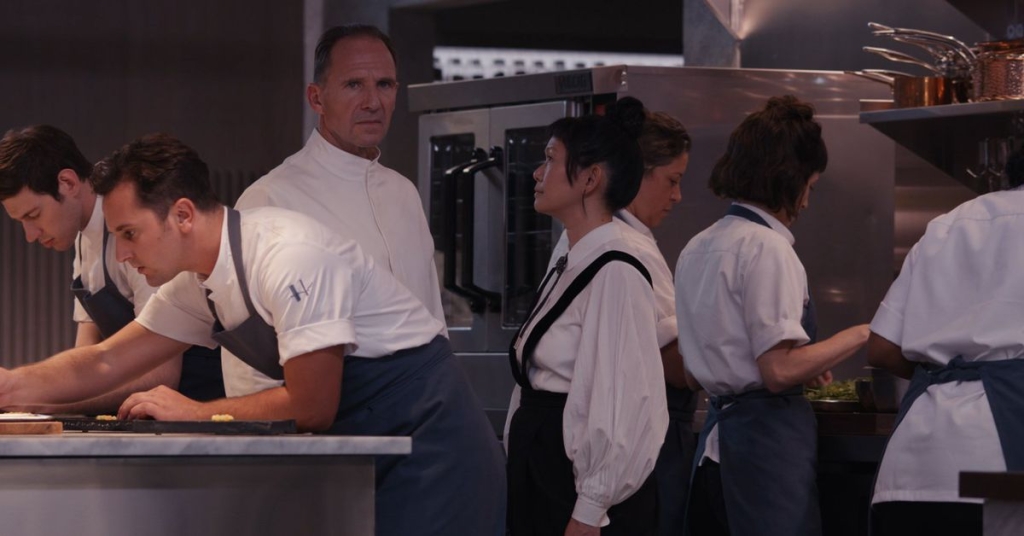
What they don’t understand about her or anyone in that restaurant is that money does not drive them. Her tone is polite, but her words are firm to people unused to hearing no. Elsa effectively unnerves Soren just when he starts getting blustery and entitled cause she told him she wasn’t going to bring him bread.
The chef is immovable, bound by rage, and how he interprets his purpose: this menu is the culmination of his life’s work. He is an obsessed man without love for what he does.
Slowik has given his life and, in some ways, sold it to have this beautifully industrious restaurant that only the richest of the rich can afford.
These rich people are the problem. They represent much of what is wrong with society, with the 1% of billionaires destroying our planet, our livelihoods, and our art with their greed that cannot be satiated. This fact makes it insanely satisfying to watch them spiral into despair when they realize their money nor their influence can save them against insanity or death, when it’s thrown at them like the meaningless pieces of paper it is.
We see similar ideas in Titanic (1997) and The Dark Knight (2008); in times of crisis, money buys nothing, and not everyone is motivated by something as baseless as riches.
Obsession & Accountability
The rich are a bunch of soul-sucking fools who think money fixes everything when, really, it just robs us of our souls when we let them buy us and allow them to take what they want in return; the rich do not know how to save themselves when there is a true crisis.
It is Margot (as we know her, though her real name is Erin) who almost saves them. She is a girl not used to padding her problems with money. She is resourceful and smart because she’s had to be in this life.
Lillian Bloom and her ilk, Tyler and his bullshit, the actor without passion/his rich girl assistant, entitled rich boys who don’t understand consequences, the regulars who don’t savor anything — it is these people who have ruined what should have been a good thing for Julian. Instead, he became lost in their soul-sucking vapid vortex.
There is this theme of accountability for those in power, including Chef, who repeatedly tried to sleep with one of his female employees but was rejected.
Another theme concerns obsession with one’s work, even when love has faded. Margot gave Chef a gift by letting him rekindle his joy for cooking, even if it was just for one final meal. Outside of this moment of pure joy, Slowik is an insane man who wants to watch the world burn, the chef world’s Joker who has lost his purpose, passion, and reason for being. That is a truly sad thing; worse, he can pinpoint exactly the people who poisoned his well. Thus, he is holding them all accountable for their sins.
Customer Service

I work in customer service and have been a “fellow shit-shoveler” for many years. I have dealt with unimaginable rudeness, depersonalization, and even danger. Recently, I experienced a horrible burnout. Then, randomly, I was restored, and I remembered why I had chosen this kind of work: I actually love people.
I’m not glamourizing customer service. It is often a thankless job, but there are interactions with lovely people. During those interactions, I feel the sunshine and sweetness in my personality come back, reminding me that I still love to help people.
This experience gave me a deep understanding of what Margot did for Julian.
Seeing his inner sanctum and the smile on his face from a 1987 photo gave her new insight into the mad genius. He was once a fry cook at a hamburger joint, and it was probably the happiest part of his life. As his success and his empire grew, his smile faded. He starts to appear visibly uncomfortable in photos, and we realize he essentially sold his soul for his notoriety.
He lost his will to live because his passion died within him. Like a charming cult leader, he brought all the employees down with him.












Follow Us!