


Kaufman’s wildly creative meta-narrative “Adaptation” is essential viewing, with Nicolas Cage delivering a career standout in dual roles.
No time to read? Click the button below to listen to this post.
IN THIS CORNER: KELLY MINTZER
The Lowdown
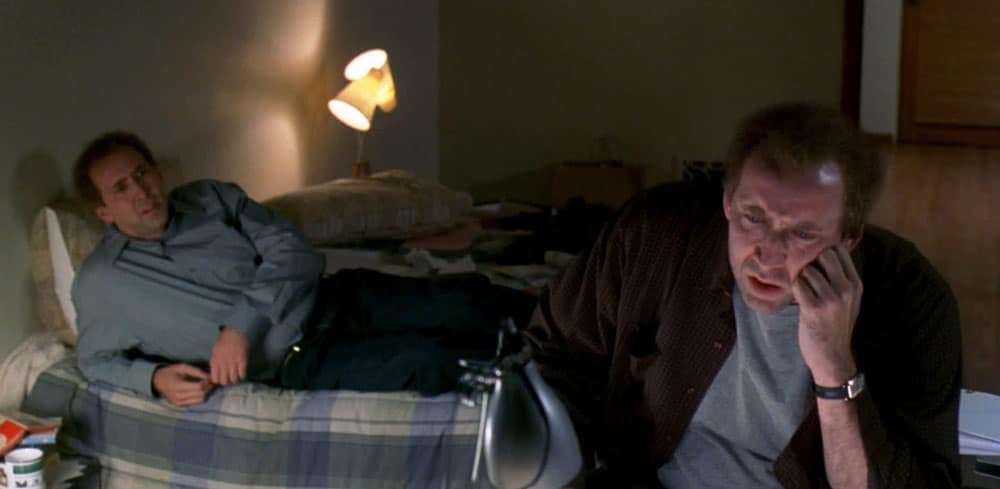
I cannot imagine the unspeakable shock and absolute confusion Susan Orlean must have felt the first time she watched Charlie Kaufman’s inspired adaptation of her book The Orchid Thief.
Perhaps she felt honored to have one of the greatest screenwriters of all time put his absolutely gonzo spin on her work; maybe she was appalled to see him recast her as vaguely murderous, vaguely pathetic, and infinitely sad. It’s impossible to say because, as is a given with Kaufman, he went OFF with Adaptation.
Adaptation is perhaps the most meta-story ever told. Nicolas Cage plays both Charlie Kaufman and his fictional twin Donald in a movie so wildly committed to its authenticity and concept that it actually credits the screenplay to both Charlie and Donald (again, I remind any gentle readers who haven’t seen the movie or aren’t aware of Kaufman… Donald does not exist.)
There is nothing simple about the concept behind the movie, though it may seem so on the tin.
Kaufman has been hired to adapt the very real Susan Orlean book The Orchid Thief. He struggles to find a narrative that he can anchor the screenplay to, while Donald also begins to pursue screenwriting. Donald is the easier twin: charming, goofy, and easy-going. And as is often the case with siblings in these situations, things just come to him.
Donald’s screenplay is patently absurd. Everything about it sounds ridiculous and nonsensical, and also like it might be a hit. And indeed, it is. Charlie’s agent is able to sell Donald’s screenplay for seven figures; Charlie, distraught and hopeless, decides to ask Donald for help in cracking The Orchid Thief.
Alongside all of this is the story of Susan Orlean—or a version of Susan Orlean—becoming closer and closer with John Larouche, the titular gentleman botanist criminal. She is simultaneously disdainful of and drawn to him, which makes her day-to-day life unbearable.
There’s so goddamn much more, but to simply synopsize it is to do it a grave injustice.
Adaptation deserves to be seen and savored.
Of particular note, however, is the insanely beautiful meta trick Kaufman plays in crediting the screenplay to both himself and Donald.
The first part of the movie feels like a Kaufman movie—which, if you know, you know. It’s cerebral and sad and funny and genius, with very little plot structure. However, after Charlie asks Donald to help him write the screenplay for The Orchid Thief, the screenplay for Adaptation gets more bonkers and more action-packed, as if Donald has taken over the writing.
It’s a masterpiece. It’s probably not everyone’s cup of tea, but for those who love it, it’s indispensable.
The Cage Factor:
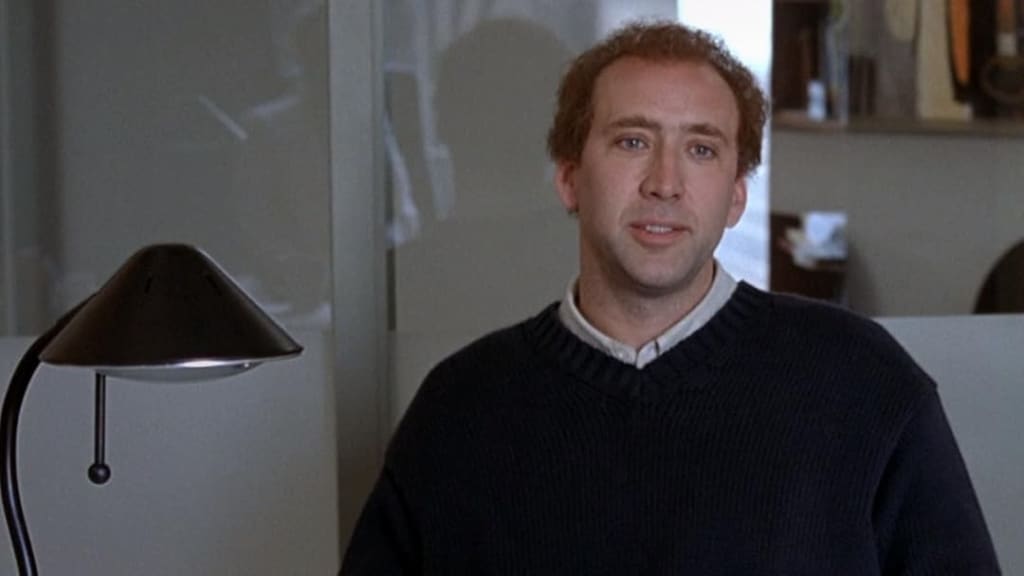
This is absolutely essential, whether you enjoy the movie or not. It turns out Nicolas Cage’s best scene partner is… Nicolas Cage. His Charlie is neurotic and sad and flawed. He’s caustic and sympathetic without necessarily being likable. Whereas Donald is sweet and instantly charming. There are moments when Charlie is curt with Donald, and Donald apologizes so sweetly and sincerely that it truly breaks the heart. I don’t think anyone BUT Nic Cage could have done this role. It is absolutely fucking gorgeous.
AND IN THIS CORNER: STEPHANIE MALONE
The Lowdown
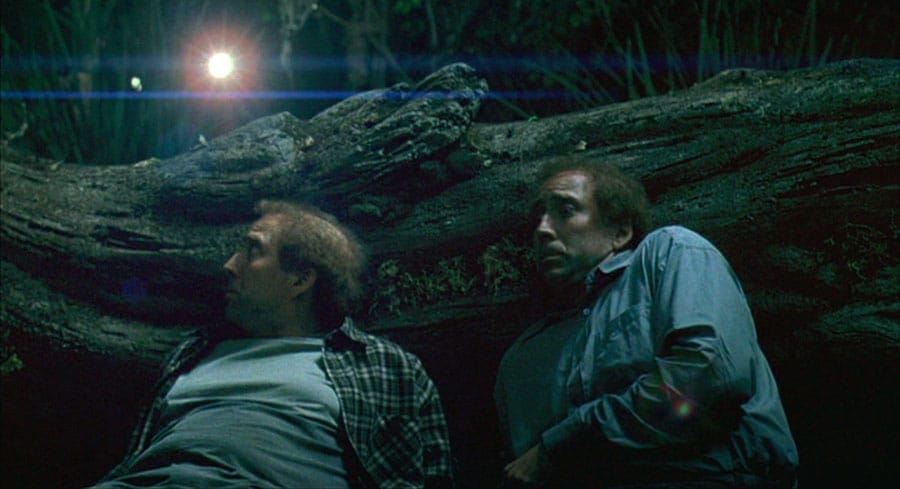
Adaptation is a richly layered film about the creative process—and so much more. At once funny, deeply poignant, and thought-provoking, it blurs the lines between fact and fiction while walking that fine line between genius and madness.
Cage’s Charlie Kaufman is a screenwriter tasked with adapting a popular novel for film. The only problem is that it’s the kind of lyrical novel often described as entirely “unadaptable” — a book about flowers and the pursuit of beauty. Charlie desperately wants to honor the integrity of the source material, but he’s struggling with intense writer’s block and creative frustration.
How can he thrill audiences without resorting to cheap Hollywood tactics? Must everything be about romance and action and some unrealistic hero’s journey?
Charlie’s twin brother, Donald (also played by Cage), is also an aspiring screenwriter. But unlike Charlie, Donald possesses a carefree and optimistic approach to the craft. He’s also happy to indulge in the kind of formulaic shlock Charlie despises. While Charlie searches for meaning and artistic integrity, Donald just wants to entertain.
The two brothers’ diametrically opposed philosophies create crackling tension in the film, especially as we watch everything come so easily to Donald while Charlie endures the foibles and failures of an insecure, tortured artist.
Kaufman’s creative script succeeds on many levels, primarily because of how personal it feels.
It becomes a commentary on Kaufman’s creative process while also exploring the nature of adaptation itself—whether the act of creative interpretation or the universal need to adapt to life’s unpredictability and ever-changing landscape.
Nicolas Cage is the center of this cinematic universe, and his dual role tour de force is widely hailed as one of the best of his career. Of course, he’s in excellent company. The impressive cast reads like a “who’s who” of powerhouse performers, including Tilda Swinton, Doug Jones, Judy Greer, Maggie Gyllenhaal, Ron Livingston, and Brian Cox. Then there’s the queen herself, Meryl Streep, in a pivotal role, and the incredible Chris Cooper (who won an Academy Award for Best Supporting Actor for his work in this film).
Adaptation has more than earned its place in the hallowed halls of cinema because of its willingness to make bold choices and challenge the traditional narrative structure. More importantly, however, the film speaks to anyone who has ever struggled with self-doubt, fear of failure, or the frustrating inability to reach the heights they aspire to.
Unequivocably essential viewing, Adaptation is wickedly intelligent and entirely unforgettable.
The Cage Factor:
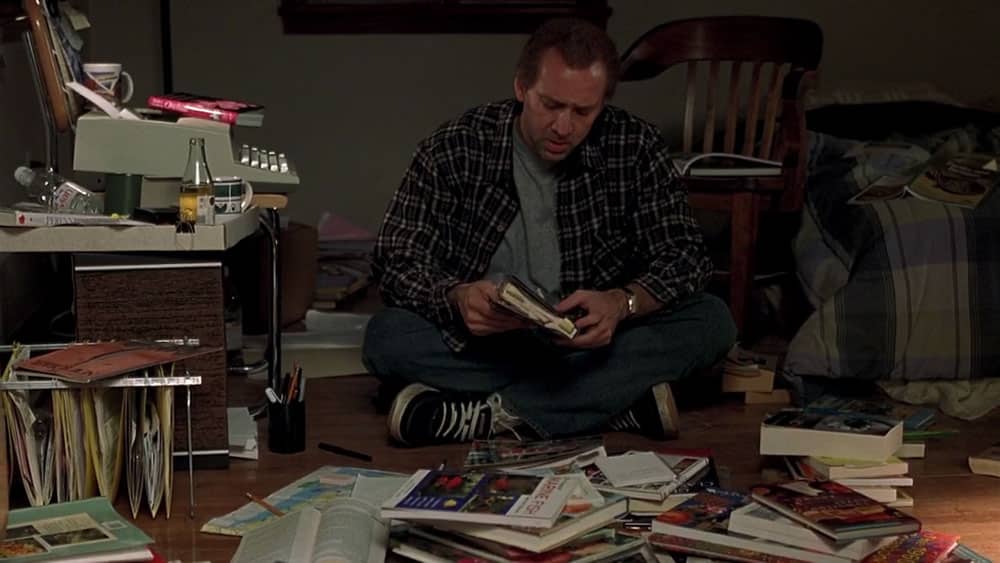
Adaptation is a homerun that delivers across the board, but it’s hard to deny that its overwhelming success rests heavily on Cage’s capable shoulders.
He delivers two distinct performances, often interacting with himself, but his ability to embody the contrasting personalities of the two brothers makes each feel like a fully realized character. As Charlie, Cage is neurotic, self-loathing, and paralyzed by doubt. His slouched posture, stammering speech, and visible anxiety perfectly convey the torment of an artist trapped in his own mind. Donald, on the other hand, is easy-going, extroverted, and full of confidence. He is everything Charlie wishes he could be.
The dual roles allowed Cage to showcase his range in a way few other films have. He is simultaneously heartbreaking and hilarious, shifting personas on a dime. One of the standout moments is when Charlie confesses to Donald his fear of being a failure; it’s painfully relatable and exquisitely vulnerable.
Cage knocks it so far out of the park with this one that it necessitates a new game.







Follow Us!