


In the sprawling battlefield of Nic Cage’s filmography, “Windtalkers” is a war-torn relic buried beneath more interesting cinematic debris.
No time to read? Click the button below to listen to this post.
It’s True Blue Cage this week, as we explore his work in films based on true stories. The random number generator gave us the unfortunate 2016 survival thriller USS Indianapolis: Men of Courage, a film whose story inspiration is intensely more compelling and harrowing than its watered-down, sleepy execution. For the audience pick, we let listeners choose between another WWII drama, Windtalkers, and a story about a morally conflicted arms dealer on the run in Lord of War.
After two rounds of voting, we ended up in a deadlock with the vote split 50/50. Thus, we’re covering both films, beginning with a trip back to the barracks for John Woo’s Windtalkers.
IN THIS CORNER: KELLY MINTZER
The Lowdown

There are a lot of ways to hate a Cage Match movie. There are also a lot of ways to love them, but unfortunately, we’ve been on a STREAK for stinkers, so I’m afraid my head is in more of the hater space. And Windtalkers did NOTHING to pull me from that headspace.
The true shame of Windtalkers is that it COULD be an interesting movie, inspired by the true story of Navajo code talkers who were instrumental in World War II. This movie SHOULD have been about those men; that would have been a unique approach to a war film and told an important story that hasn’t been explored in depth.
However, Windtalkers chooses to frame its Indigenous story through the lens of…you guessed it…white guys.
Look, I’m not a war movie fan under the best of circumstances. They straddle a peculiar line and land in a place where they say, “War is hell,” but it’s also glorious and the most manly, noble pursuit. I got back to Godzilla Minus One too much, perhaps, but it’s the first war movie that I think has had the balls to say “you are cattle to the military industrial complex”.
Windtalkers doesn’t take such a stand. This is man stuff! Men men-ing so hard. They’re gritty! They’re stoic! Oh boy, no one has ever man-ed like these guys.
Hidden in all of the explosions is a half-baked, elementary school level lesson about overcoming our differences (provided we’re talking about the differences between the Navajo and the honkies.
I could have done with FAR fewer insulting references to the Japanese. Yes, I understand that it was the time period in which the movie took place. But yes, I also think that through the lens of a filmmaker you could perhaps take a more nuanced approach to how much WWII sucked for literally everyone.
Additionally, in this movie that is about white guys coming to terms with the idea that other people might also be human beings, the suggestion is made and then executed that the Japanese would not notice that a Navajo is not, in fact, Japanese, which seems pretty damn racist to me.
I would believe that maybe the white dudes in the company wouldn’t be able to tell the difference between a Navajo man and a Japanese man. But do I think the JAPANESE can’t tell the difference? No. I do not.
The Cage Factor:

Rat in a Cage, obviously. I guess Nic’s doing fine, but it’s the kind of role I hate the most, where we celebrate the sort of aloof, tortured, emotionally unavailable alpha male. It’s tired, it’s boring, it’s most of the things I don’t want in a man, and also, I hated this movie.
AND IN THIS CORNER: STEPHANIE MALONE
The Lowdown
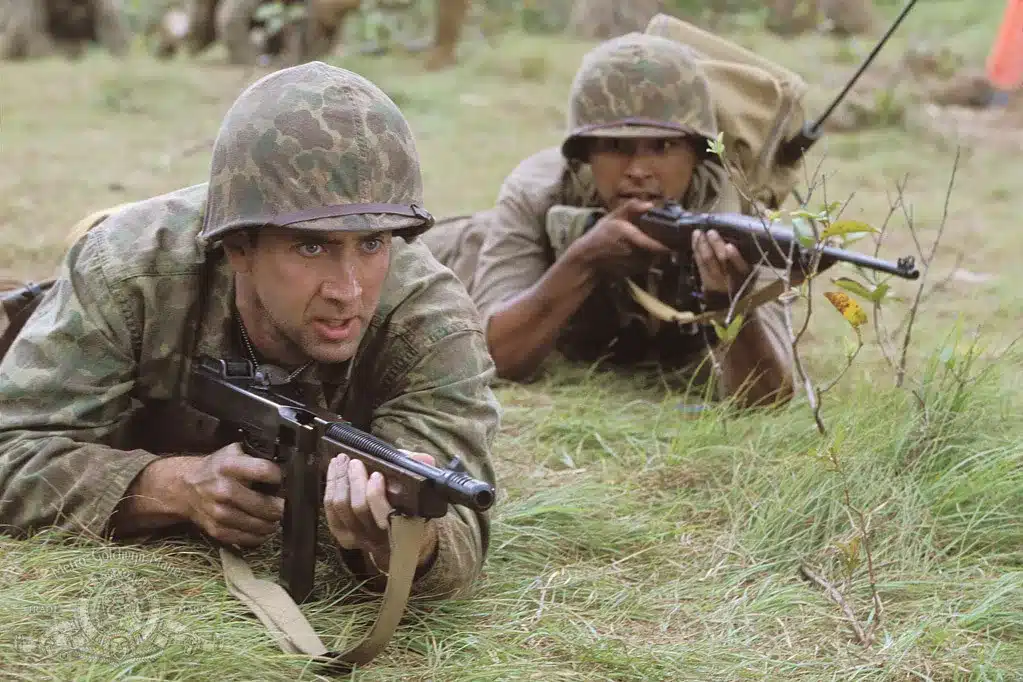
Directed by Hong Kong action maestro John Woo and starring a gritty, grimacing Cage, Windtalkers had all the components of a powerful historical epic.
What we got instead was a high-octane war flick that trips over its own intentions, burying an important real-life story beneath the rubble of genre clichés and a white savior narrative that now feels particularly tone-deaf.
On the plus side, Woo’s signature flair is alive and well here: bullets fly in slo-mo, bodies are flung through the air with ballet-like chaos, and the sound design rattles your bones. If you’re here for gritty, explosive battle scenes, you’re in for a visceral treat. The film also brought some mainstream attention, however flawed, to the incredible and largely overlooked contributions of the Navajo code talkers during World War II.
But the applause stops there.
The most glaring issue with Windtalkers is baked into its DNA: this is a film about Navajo code talkers that isn’t really about them. Instead, we’re handed the story of Sergeant Joe Enders (Nicolas Cage), a battle-scarred Marine tasked with protecting Private Ben Yahzee (Adam Beach), one of the titular code talkers. The twist? If capture is imminent, Enders may have to kill Yahzee to protect the code.
Sadly, the film makes the Navajo characters bit players in their own story and reduces their groundbreaking role in military history to a plot device for another white guy’s emotional redemption arc.
As for John Woo, his stamp is everywhere in the action sequences, but there’s a tonal clash between his operatic, almost mythic style and the film’s attempt at gritty war realism. When the bullets aren’t flying, the pacing drags, and emotional beats feel oddly staged.
Woo himself has since expressed dissatisfaction with the final cut, hinting that studio meddling may have contributed to the uneven result. That tracks.
This is a film that wants to be a patriotic tribute and a popcorn war flick all at once—and ends up satisfying neither fully.
The Cage Factor:

As Enders, Cage delivers the pain of a traumatized soldier with physicality and grit, chewing through lines with a gravelly weariness that suggests a man perpetually on the edge. There are moments where his internal struggle feels genuine, particularly in his more intimate scenes with Adam Beach. You believe Cage wants to make this man’s pain real.
Unfortunately, the script keeps pulling him back into brooding-warrior mode, forcing him into one too many stoic stares and gritted-teeth grunts. This is Action Hero With A Heart Cage, and the role doesn’t offer enough nuance to elevate his performance into something memorable.
This one’s strictly for Cage completists or lovers of stylized war carnage. Otherwise, skip the foxhole and seek out more honest retellings of this incredible true story.







Follow Us!