


A gripping exploration of guilt, redemption, and the human spirit, Scorsese’s “Bringing Out the Dead” is haunting and unforgettable.
No time to read? Click the button below to listen to this post.
IN THIS CORNER: KELLY MINTZER
The Lowdown
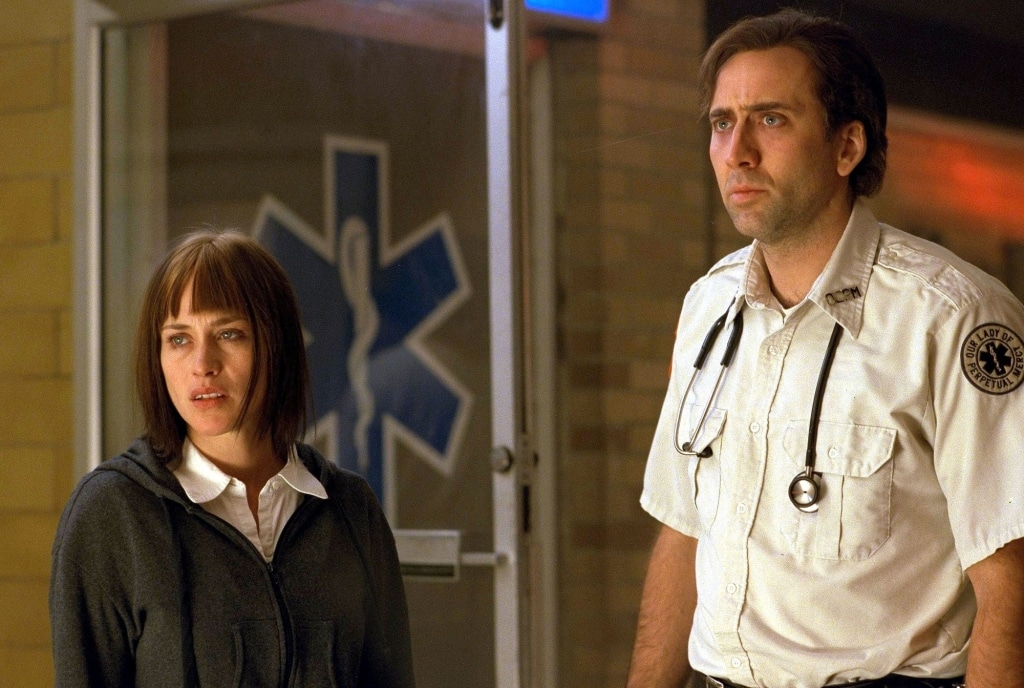
I can’t remember precisely how old I was when I was gifted my Rolling Stone subscription, but I know I was young (possibly too young, depending on who you ask). It was given to me because of an early enthusiasm for music that has never waned. However, it birthed something new I wasn’t entirely expecting: a passion for cinema. I greedily devoured the film reviews and put the ones with high ratings on a list, which my dutiful and patient mother would take me to the local West Coast Video to fulfill.
I am providing this arguably self-indulgent bit of biography simply to establish that I remember the exact moment in time that I became a Martin Scorsese fan, and it was pretty much the first frame of Bringing Out the Dead, a movie I watched specifically because Rolling Stone told me to.
After the Trapped in Paradise debacle, I was a little afraid of rewatching a movie that had had such a profound impact on young Kelly. But I had forgotten; this is Scorsese. And perhaps equally importantly, the man behind the pen is Paul Schrader, who has quite possibly the best grasp on presenting oft-overlooked careers and their place in the American dream.
Bringing Out the Dead is, in its simplest form, a movie about a paramedic dealing with the inevitable trauma and burnout such a job brings. It’s a sort of picaresque trip through a difficult period of his life, played with absolutely astonishing grace by Nicolas Cage.
THIS is the correct way to harness his trademark mania, but more on that later.
The movie is bound by a sort of collection of vignettes about Cage’s shifts and the people and experiences he encounters. Under Scorsese’s careful direction, the film is somehow both incredibly universal and highly specific; Cage’s depression and dissociation will speak to many of us, while the very particular pain and trauma of trying and failing to save lives… well, not too many of us know that.
The movie itself is an astonishing nightmare, anchored by Cage’s hallucinations of patients he failed to save.
It is, put simply, a beautiful, sad, powerful, and oft-overlooked piece of cinematic pathos, worthy of far more attention and acclaim than it ever achieved.
The Cage Factor:
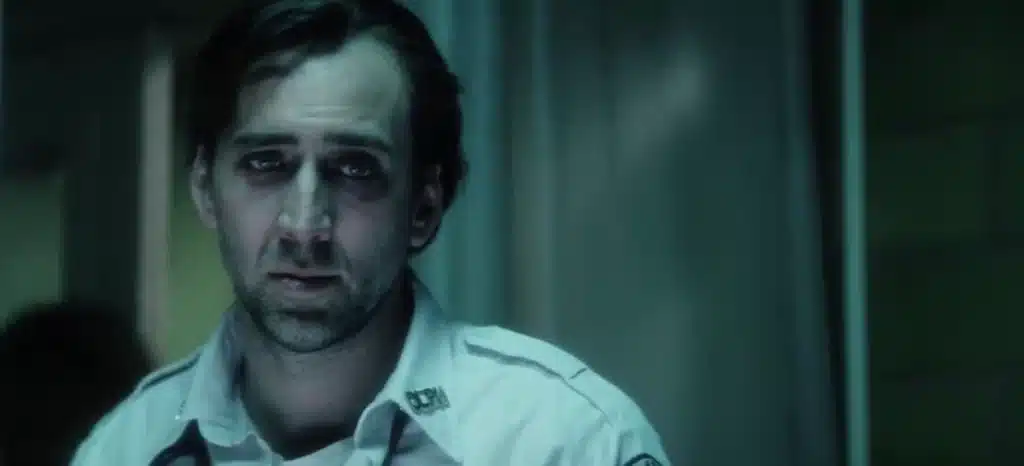
I must, by every reasonable metric, call this one a Cage Fighter. This is perhaps the most powerful use of Cage’s Cage-y-ness I’ve ever seen. His manic, wild energy makes so much sense as a trauma response in a man moving closer and closer to the edge of a breakdown and beyond. That said, it’s not going to be for everyone. It’s a hard watch in many ways. If you want just to see Nic Cage being super crazy and chewing scenery, this isn’t it. Skip it. But if you want a movie-watching experience that feels like it challenges you as a person, you can’t miss this one.
AND IN THIS CORNER: STEPHANIE MALONE
The Lowdown
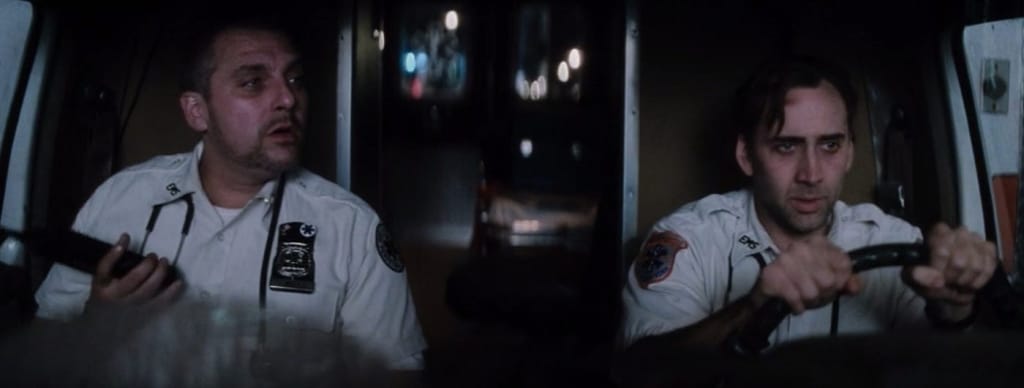
Martin Scorsese’s woefully underrated Bringing Out the Dead (1999) is an unforgettable dive into the fractured psyche of a man teetering on the edge of emotional collapse. Adapted by Paul Schrader from Joe Connelly’s novel, the film marries Scorsese’s kinetic direction with Schrader’s piercing exploration of guilt and redemption, creating a hauntingly beautiful and deeply moving masterpiece.
Set in the nocturnal, unrelenting chaos of 1990s New York City, the film captures a gritty, fever-dream quality.
Nicolas Cage’s performance as Frank Pierce is a revelation. I’ll be talking about that more shortly, but my god, what a tour de force. It’s no wonder Cage calls this perhaps the best film he’s ever done, and it’s difficult to argue with that.
The supporting cast—including Patricia Arquette, John Goodman, Ving Rhames, and Tom Sizemore—delivers stellar performances that complement Cage’s central role. Arquette’s Mary, a woman grappling with her father’s imminent death, provides a fragile counterpoint to Frank’s unraveling. Ving Rhames’s Bible-quoting, larger-than-life Marcus adds moments of levity, while Tom Sizemore’s dangerously unhinged Tom Wolls reflects the darker extremes of the paramedic profession.
Scorsese’s direction amplifies the film’s themes of spiritual desolation and fleeting salvation. The film’s score, a blend of moody rock tracks and elegiac compositions, further immerses the audience in Frank’s chaotic world. Cinematographer Robert Richardson’s work deserves special mention: his stark, high-contrast lighting paints New York as both a vibrant, living entity and a purgatorial abyss.
One of the film’s most compelling elements is its exploration of the thin line between life and death, salvation and damnation.
Through Frank’s eyes, we see the brutal realities of a paramedic’s job—the unending trauma, the fleeting triumphs, and the constant specter of mortality. Yet, amid this darkness, the film finds moments of grace.
Bringing Out the Dead is not an easy film to watch, but it’s an essential one. It’s a visceral, emotionally charged experience that captures the fragility of the human spirit with unflinching honesty. As harrowing as it is beautiful, it’s a haunting ode to those who walk the fine line between saving lives and losing themselves.
The Cage Factor:
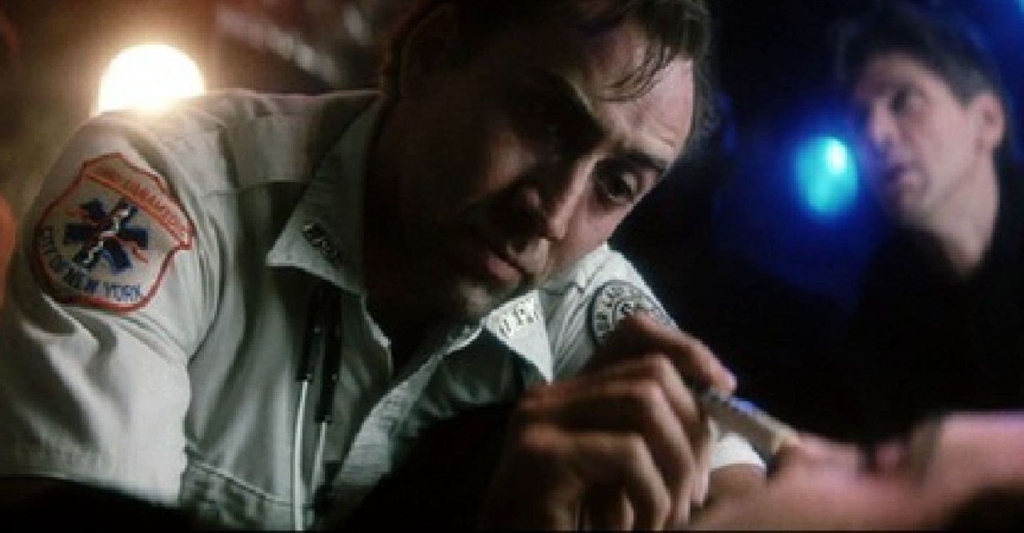
Cage, often celebrated (or criticized) for his flamboyant, over-the-top acting style, delivers here one of the most restrained, nuanced, and poignant performances of his career. Frank is an insomniac paramedic haunted by the faces of those he couldn’t save, particularly a young girl named Rose. His life has become a cycle of despair, sleepless nights, and fleeting moments of connection.
Cage embodies this tortured character with a quiet intensity that eschews his usual eccentricities in favor of a raw, deeply human portrayal.
What makes his performance extraordinary is its emotional sincerity. Frank’s weariness is palpable in every line of dialogue, every glance, every slump of his shoulders. Cage brilliantly captures the suffocating weight of Frank’s guilt and his yearning for redemption, crafting a character who is as compelling as he is tragic.
It’s a masterclass in restraint, a deeply empathetic portrayal of a man grappling with unimaginable pain. This is a performance stripped of vanity, one that digs deep into the core of human suffering and resilience.













1 Comment
1 Record
Scott Jones wrote: