

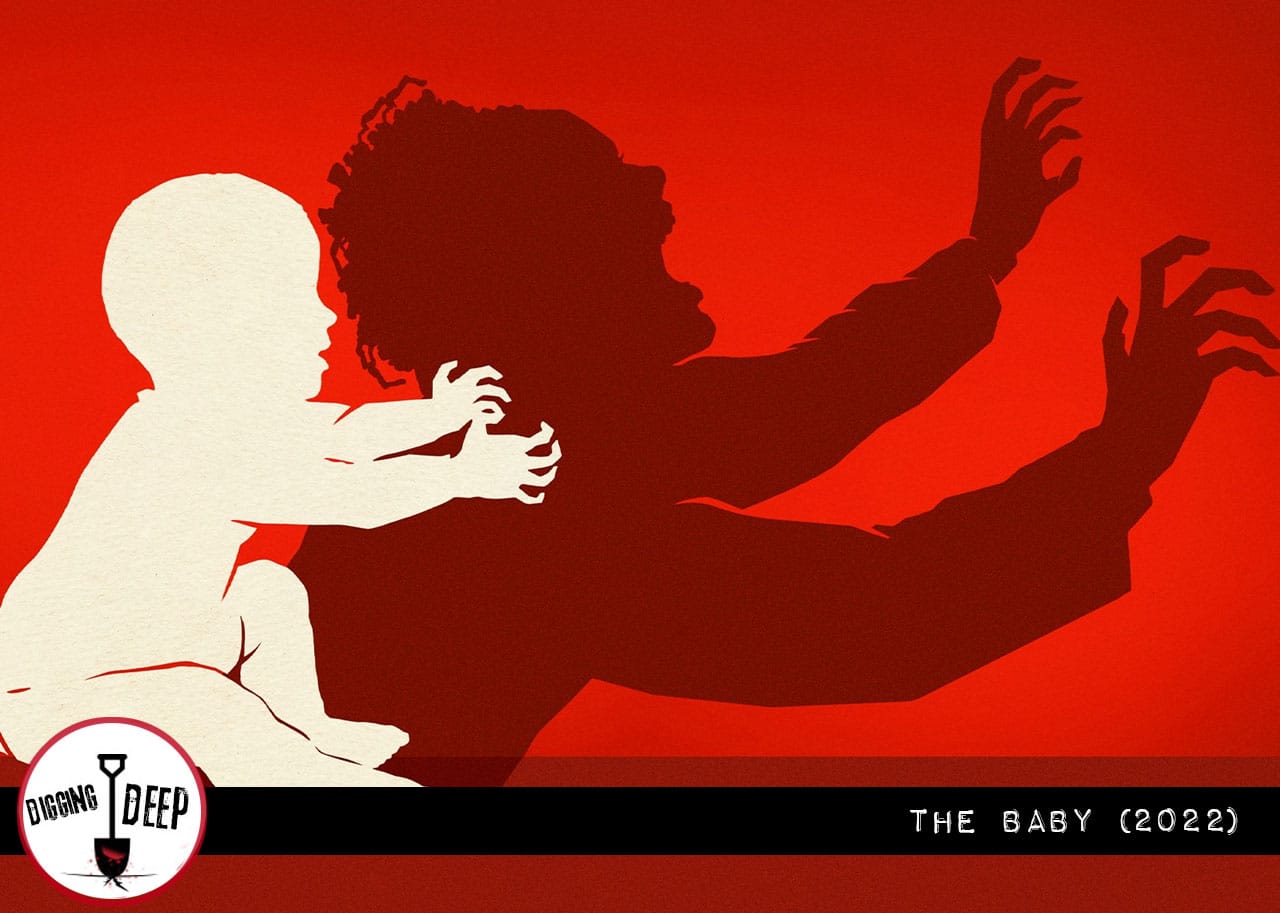
The persistence of patriarchal violence is explored to chilling effect in the woman-created British horror comedy series “The Baby”.

No time to read? Click the button below to listen to this post.
“Childless women get it,” was W.H. Auden’s ‘poetic’ prognosis of cancer in a poem akin to a misogynist mockery of women. It‘s not unlikely that Auden saw women as walking wombs refusing their purpose. His poem suggests that if an uterus didn’t house embryos, it would house tumors, bred by an underutilized maternal instinct.
Auden’s poem is its own kind of horror and sums up the twisted socio-psychological attitudes towards childfree women.
One such childfree woman is the protagonist of Lucy Gaymer’s and Siân Robins-Grace’s The Baby. The series’ main character is beset by a demonic baby intent on killing her. Though the creators of the horror comedy series seem aware of the reactionary pitfalls of their scenario, they don’t quite manage to escape them.
Over eight episodes, the blending of fun and frights follows independent single Natasha (Michelle de Swarte), whom the titular character chooses as its next foster mother. If she doesn’t want to wind up as dead as her predecessors, she must solve the baby’s mystery.

Similar works like Rosemary’s Baby, It’s Alive, Eraserhead, or more recently, Shelley are built around male fixations, fears, and aversions connected to pregnancy, birth, and newborns. However, the horror in The Baby is the baby’s hostile takeover of Natasha’s life.
The classic examples of baby and pregnancy horror commonly focus on demonizing pregnant women’s cravings, the disgust of pregnancy-induced physical changes, and the sheer frustration of a constantly crying child. In contrast, the series is driven by Natasha’s attempts to break free from her new obligation as (supposed) mother.
Since no one remembers her without a baby, she not only faces the loss of freedom but also has her personality basically erased. Her growing exasperation plays out like a sinister farce of the „foster kid converts career woman“ sub-genre. An ironic depiction of matrimania, archaic gender expectations, and a child’s disruptive influence on the mother’s life blend into a scenario that subverts idealized presentations of motherhood.
The presentation of enforced motherhood as a tool of male control over women, in retrospect, seems almost prophetic.

The baby is more than an amusing genre antagonist. As a white, able-bodied cis-male from a prosperous family, it is an emblem of white Christian patriarchy’s multileveled aggression.
This symbolic status is underlined by the baby‘s namelessness. It connects to women only as potential mothers and telekinetically kills them as soon as they are used up. Its supernatural abilities make it a parodistic personification of complex socio-political power imbalances that allow white cis-men to enforce their will while still being perceived as decent.
Natasha’s predecessors’ gruesome deaths serve as a potent symbolical punishment for the defiance of patriarchic social norms. Thus, the baby’s serial murders perpetuate the violence surrounding its creation by rape, torture and imprisonment.
All the more disturbing is the sudden u-turn Gaymer and Robins-Grace take when they suddenly sympathize with the baby. As Natasha unravels the cruel fate of the baby’s birth mother, Helen, she finds pity for her tiny tormentor. According to Natasha, he just wanted to be loved but was pushed away.
Her misguided empathy reassures the audience of Natasha’s caring instincts and encourages empathy with the baby.
Male aggression is downplayed and excused by framing it as “misunderstood” and a biological urge.

This and the gloating over the baby’s other victim’s fate reveal the same reactionary perceptions that the creators at first criticize. At their more astute, Gaymer and Robins-Grace expose the motivations of would-be parents as pitiful at best and monstrous at worst.
Natasha’s younger sister Bobbi (Amber Grappy) wants to satisfy her need for a functional family and fix her disintegrating relationship with a child. Natasha’s best friend Mags can’t even explain why and if she wanted children but has them anyway. Natasha’s mother uses her parental role to impart her esoteric beliefs to her foster children.
Worst of all, the baby’s father inflicted upon Helen violation, unwanted pregnancy, and forced birth to break her spirit.
This brutal scenario accumulates the intersectional aggression white Christian patriarchy is built upon: putting white comfort before PoC lives, forcing heteronormativity upon queer individuals, placing women under male dominance, imposing traditionalist family structures upon alternative lifestyles.
The story’s sole intact conventional family is revealed to be a perversion of love and care. It’s an uncomfortable reminder that traditional ‘family values’ are grounded in heterosexism, gender binarism, and the domination of the female-assigned body by men.
Despite the fact that the baby’s father is responsible for its existence, the baby directs its deadly hate against women.
The fact that the baby proves immortal seems less a metaphor for the continuation of patriarchic oppression than a bait for a possible next season.

The creators seem rather reluctant to go fully through with their queer feminist social critique.
Natasha’s aversion against children is explained by her unhappy childhood experience of parenting Bobbi, affirming the prejudice that it would take emotional scarring to not want children. Worse, Natasha asks a friend whose recent motherhood put a strain on their friendship for forgiveness.
Despite creating a sardonic, timely parable for the escalating extremes of patriarchal violence and toxic gender concepts, The Baby still insists that childfree women have to apologize.









Follow Us!