


Our fourth Cage Match may be Nic’s finest hour as he delivers an Oscar-winning performance in the bleak but beautiful “Leaving Las Vegas”.
No time to read? Click the button below to listen to this post.
IN THIS CORNER: KELLY MINTZER
The Lowdown

This is going to be a hard one. There’s so much to dive into that keeping the review section brief is going to kick my ass, but I paid my dime, I rolled my dice, and let’s see what we can do.
Leaving Las Vegas, man. Jesus Christ.
When I was in college, everyone was weirdly obsessed with Requiem for a Dream. I felt like it was a glorified after-school special… “Hey, kids! Did you know drugs are bad? Let’s show you, but we’ll add double-sided dildos to make it seem more adult and edgy.”
Leaving Las Vegas manages to do for alcoholism what Requiem for a Dream WISHED it could do for drugs.
Without proselytizing or soap-box standing, it shows the ugly, tragic side of alcoholism and how it can be enabled by even those with the best intentions.
Nic Cage is an alcoholic writer (we all nervously pull our collars from our necks like Rodney Dangerfield in unison) who has reached hopeless levels. He has decided to go to Vegas to drink himself to death and meets Sera (played absurdly beautifully by Elizabeth Shue), a kind, traumatized prostitute who chooses to accept him as he is. The two develop a rapid and intense trauma bond, built gorgeously around the fact that they DON’T fuck immediately and see their own broken parts in each other.
It sounds simple on paper, but Leaving Las Vegas has so much more up its sleeve.
To start with, Leaving Las Vegas seems to understand the meta-quality of the Hollywood representation of the lovable drunk. Yes, Nic Cage is likable when tipsy, but both the movie and the character know there’s a point when he slips from charming to upsetting.
There are bright bursts of absolutely inspired dark humor throughout.
There’s a particularly brilliant shot in a mall where Sera and Nic Cage are doing a walk-and-talk. They go up an escalator, walk across the thoroughfare, and he immediately accidentally gets back on the down escalator. It’s a perfect bit of physical comedy that also reinforces how the drink is addling his mind.
My one gripe—and something that I feel compelled to mention—is a late-in-the-movie sexual assault that I felt added nothing to the narrative. We have, at this point, already seen Sera as a punching bag for various men. Seeing her very particular trigger be violated felt needless, particularly in a love story so intimate and personal. I’m truly not sure why it’s there. It adds nothing and only serves to further punish a character who has already suffered so much.
But other than that… goddamn. What a movie.
Spoiler Alert! A less fearless film would have allowed her to save him; I respect Leaving Las Vegas so much for not giving in to that trope.
The Cage Factor:
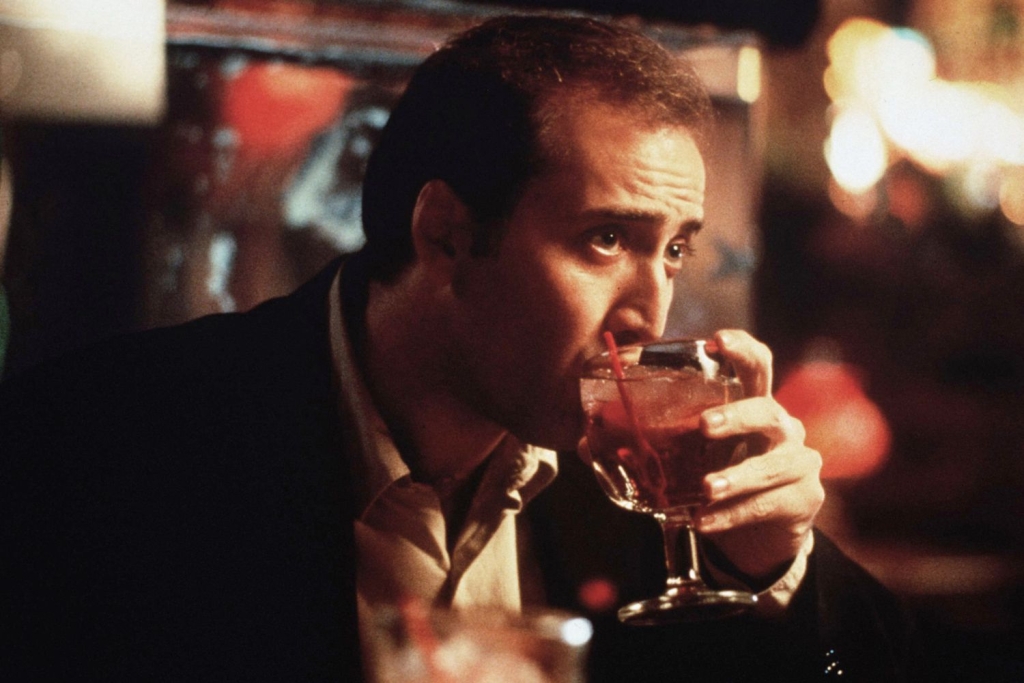
This is absolutely unmissable if you appreciate Nicolas Cage as an actor and not a punchline.
He is so good at this. It is an ego-free performance; he lets himself look like genuine shit. Pale, thinning hair, shaking from delirium tremens, sweaty; he looks like stone-cold garbage. But everything in the movie hinges on his portrayal of this wreck of a human and he just delivers the hell out of it. A few times throughout the runtime, he smiles in a way that makes you get it — it makes you understand why this woman with trust issues would think, “Ok, I’ll take a chance on this disaster.”
That’s the unexpected, subtle genius of Nicolas Cage. As over the top as he can be, with just a smile, he can absolutely convince you that he is the sweetest and loveliest person alive. There is so much else he does with his physicality; there are so many beautiful ways he delivers his lines. I honestly cannot overstate how goddamn good he is in this.
AND IN THIS CORNER: STEPHANIE MALONE
The Lowdown

Leaving Las Vegas is a haunting masterpiece, a challenging but richly rewarding watch. Director Mike Figgis crafts a raw, unflinching portrait of addiction and human connection that stands as one of the most powerful films of the 1990s.
At the center of this tour de force is Nicolas Cage’s career-defining performance as Ben Sanderson, a Hollywood screenwriter who has lost everything to alcoholism and travels to Las Vegas with the intention of drinking himself to death. Cage’s portrayal is nothing short of revelatory. He inhabits the role with such visceral intensity and vulnerability that it’s impossible to look away, even as Ben spirals deeper into his self-destructive journey.
Yet, the film works on multiple levels beyond just Cage’s performance. Elisabeth Shue gives an equally nuanced and heartbreaking turn as Sera, a prostitute who forms an unlikely bond with Ben. Their relationship, built on mutual understanding and a refusal to judge, forms the film’s emotional core.
Figgis’ direction is gritty and intimate, using handheld cameras and natural lighting to create a sense of uncomfortable realism. The screenplay, adapted by Figgis from John O’Brien’s semi-autobiographical novel, is unflinching in its depiction of addiction while still finding moments of dark humor and unexpected tenderness.
Leaving Las Vegas stands as a landmark film not just in Cage’s career but in the pantheon of American independent cinema. It’s a searing, uncompromising work that challenges viewers to confront the depths of human suffering and the possibility of connection even in the darkest circumstances.
Cage’s performance anchors the film, serving as a reminder of his immense talent and solidifying his place as one of the most daring actors of his generation.
In the years since its release, Leaving Las Vegas has only grown in stature. It remains a high-water mark for Cage — a film that continues to resonate with its unflinching honesty and emotional power.
For those willing to take the journey, it offers a profound and deeply moving experience that exemplifies the very best of what cinema can achieve.
The Cage Factor:
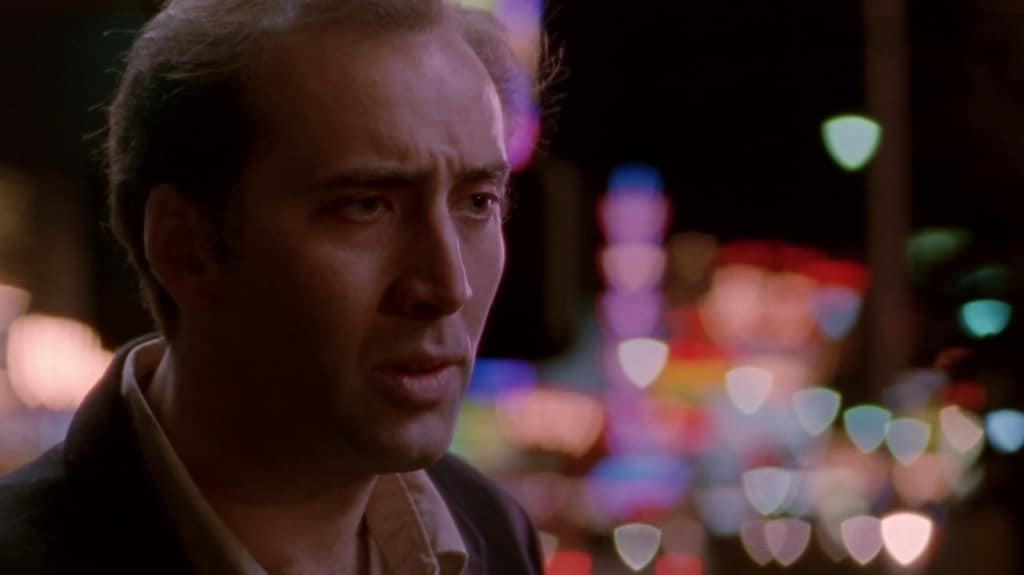
Leaving Las Vegas marked a turning point in Cage’s career. While he had always been known for his intensity and willingness to take risks, this film elevated him to a new level of critical respect. It proved that beneath the sometimes over-the-top persona, Cage was capable of astonishing depth and subtlety as an actor. In many ways, this role redefined how audiences and critics viewed him, establishing Cage as one of the most versatile and fearless actors of his generation.
His performance is a masterclass in nuance and emotional depth. He captures the manic energy of Ben’s binges, the crushing lows of his hangovers, and the fleeting moments of clarity with equal conviction. The actor’s physicality is particularly noteworthy — the way he stumbles and slurs, the tremors in his hands, and the glassy look in his eyes — all create a devastatingly realistic portrayal of addiction. It’s a knockout performance and one of the actor’s undisputed best.













Follow Us!