

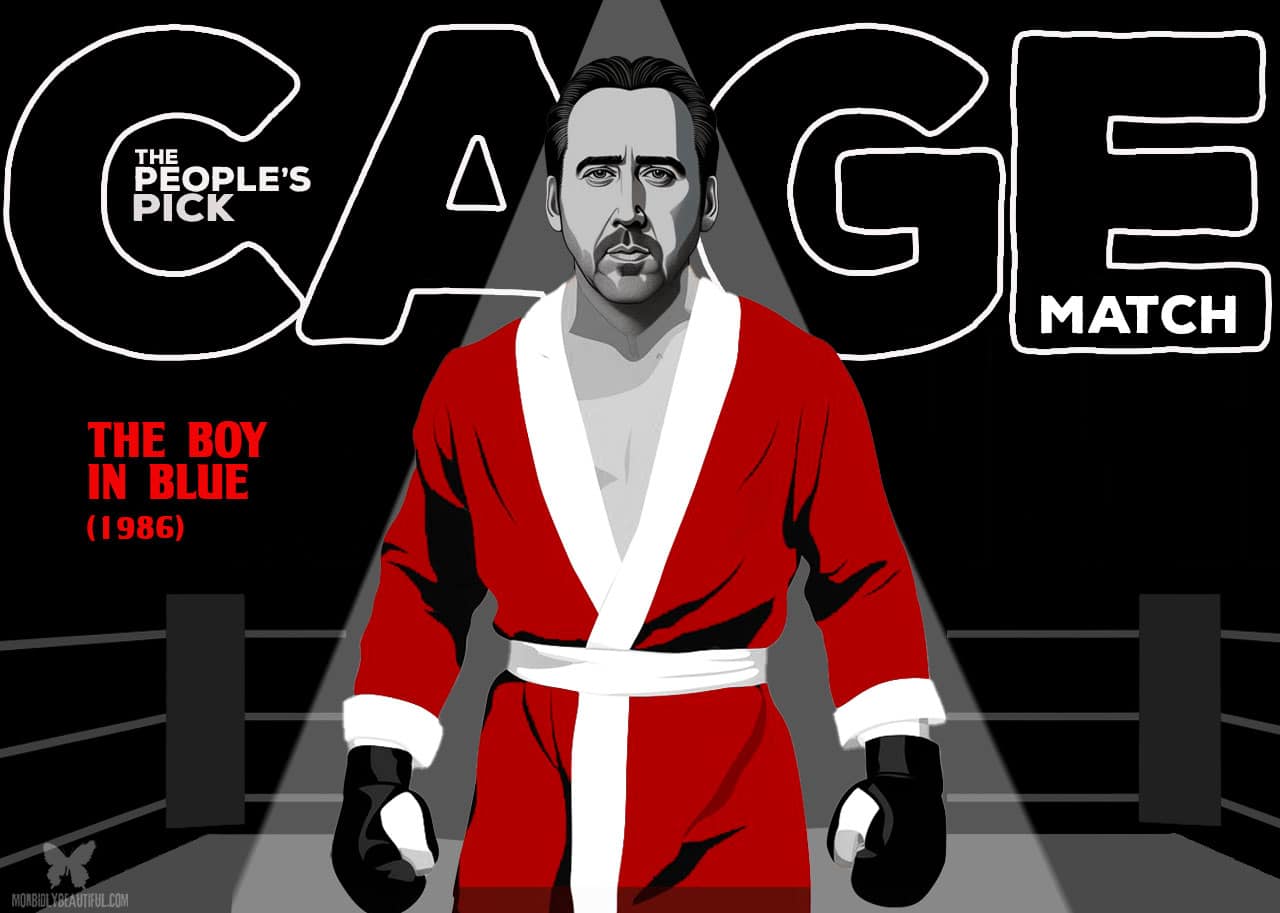
Join us as we dive into the obscure sports biopic “The Boy in Blue” — a cinematic Canadian time warp lost to time, perhaps for good reason.
No time to read? Click the button below to listen to this post.
This week’s Cage Match (as chosen by the random number generator from Cage’s entire filmography) was one of Nicolas Cage’s earliest outings on his road to superstardom, appearing in his uncle’s cinematic masterpiece Rumble Fish (1983). He had a small but memorable role that gave him an impressive stage to showcase his budding talents.
For the People’s Pick, we put two other 1980s Cage flix up for a vote: 1984’s Racing With the Moon and 1986’s The Boy in Blue. Almost certainly due to that unforgettable poster featuring a mega-buff shirtless Cage, The Boy in Blue rowed past the competition to secure its spot in this week’s spotlight.
IN THIS CORNER: KELLY MINTZER
The Lowdown
If you’ve been following along with Steph and my strange, Dante-esque descent into the wild world of Nicolas Cage movies, you’ll know that we have already — at this still early stage of the journey — ping-ponged across genres with reckless abandon. We’ve covered cosmic horror, teen comedy, kids (? we think?) movies, cocaine-fueled action nonsense, and actual Oscar award-winning dramas. But, readers, finally, the wait is over.
Finally, a goddamn movie about rowing.
Wait, what?
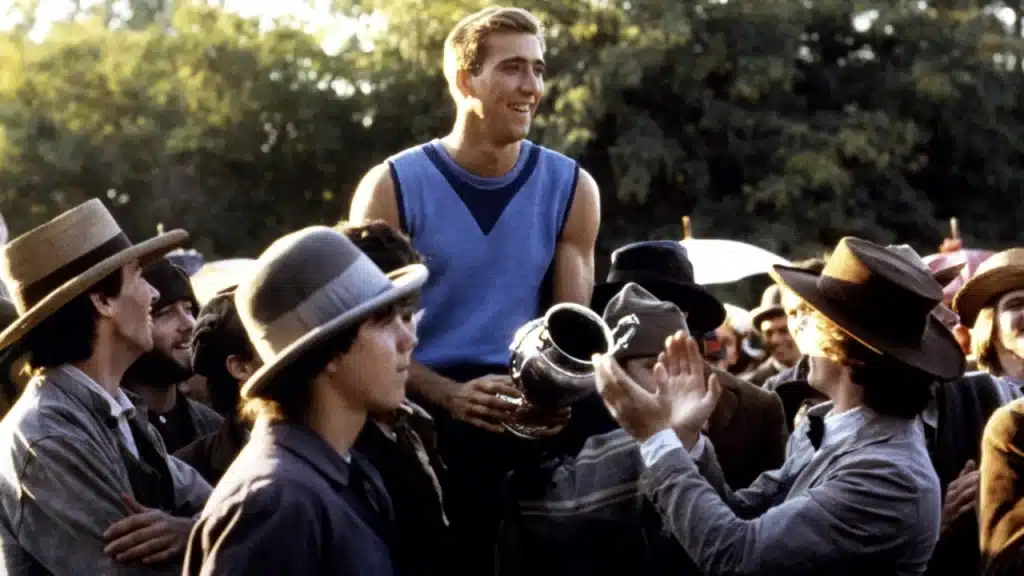
This week, we watched The Boy in Blue, a movie I genuinely didn’t know existed until Steph presented it to me. In fact, it seems to have made very little impact on the world of cinema or the career of Nicolas Cage. And I get why. It’s a perfectly serviceable, immediately forgettable, boilerplate sports biopic about a Canadian rower named Ned Hanlan.
I’m going to be sparse on plot details here simply because it hits every beat we’ve all come to expect from sports movies. Were you hoping for training montages? Oh, hell yes, we’ve got them. If you watch them on mute and in isolation, you’d probably assume the movie is similar to Karate Kid or Rocky… a lot of Nic Cage, hunkier than ever, wearing sweatshirts with sleeves cut off and sweatbands. Does he glisten with sweat? You bet your bippy.
Additionally, it’s a period piece, which makes it interesting to look at. The costumes are lovely and so is the scenery.
If it isn’t abundantly clear, I’m struggling a little to find much to say about this one. And some of that is down to personal preference. I do not care for sports movies; the formula is so well-established. A determined but troubled athlete struggles, he overcomes, and he becomes an inspiration for all! Our rower gets taken advantage of by unscrupulous people, of course. But his moxie and his pecs pull him through.
It was fine. I didn’t care for it.
The Cage Factor:

I’m hesitant to call it a Rat in a Cage because that seems too harsh for what is an extremely harmless movie. But I can’t muster any enthusiasm at all for this movie. Nic Cage is fine in it, though I would argue no one has ever been less Canadian than he is. But it’s all so very forgettable.
AND IN THIS CORNER: STEPHANIE MALONE
The Lowdown
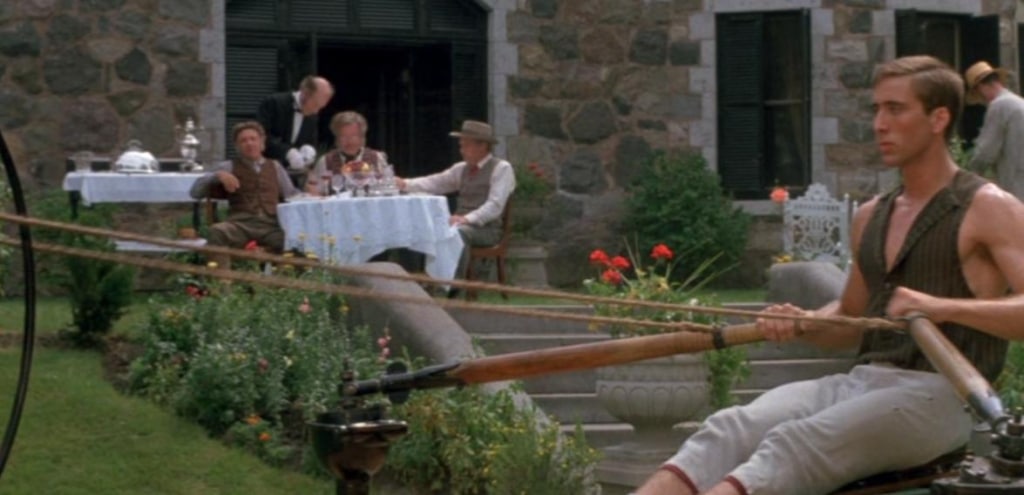
Ah, The Boy in Blue – a cinematic gem that’s about as rare as a Canadian heatwave in February.
The year is 1986, and someone in Canada decides the world needs a biopic about Ned Hanlan, a 19th-century rower. Not just any rower, mind you, but Canada’s first individual sports hero. Clearly, this was the story that was going to set the box office on fire. And who better to play this aquatic Adonis than a fresh-faced Nicolas Cage?
Cage, at the tender age of 22, was just beginning to dip his toes into the waters of stardom. The Boy in Blue caught him in that awkward phase between “up-and-coming actor” and “walking meme factory.”
Critics at the time were about as enthusiastic as a sloth on sedatives. The film’s pacing was often described as “languid,” which is a polite way of saying it moves slower than a glacier in molasses. One reviewer quipped, “If you want to watch Nicolas Cage row a boat for two hours, this is the film for you. If not, may I suggest literally anything else?”
The Boy in Blue attempts to transport us back to the 1870s with all the historical accuracy of a time-traveling DeLorean that took a wrong turn in the 1980s.
So why is this film so obscure and nearly impossible to track down? The answer I desperately WANT to be true comes courtesy of a Letterboxd reviewer: “The Canadians were so jealous of how sexy Nic Cage is that they buried this film.”
The real answer? It’s a perfect storm of mediocrity. It’s not bad enough to achieve cult status, not good enough to be remembered fondly, and not weird enough to fit into the “so bad it’s good” category. It’s the cinematic equivalent of beige wallpaper – inoffensive, forgettable, and probably best left in the 80s.
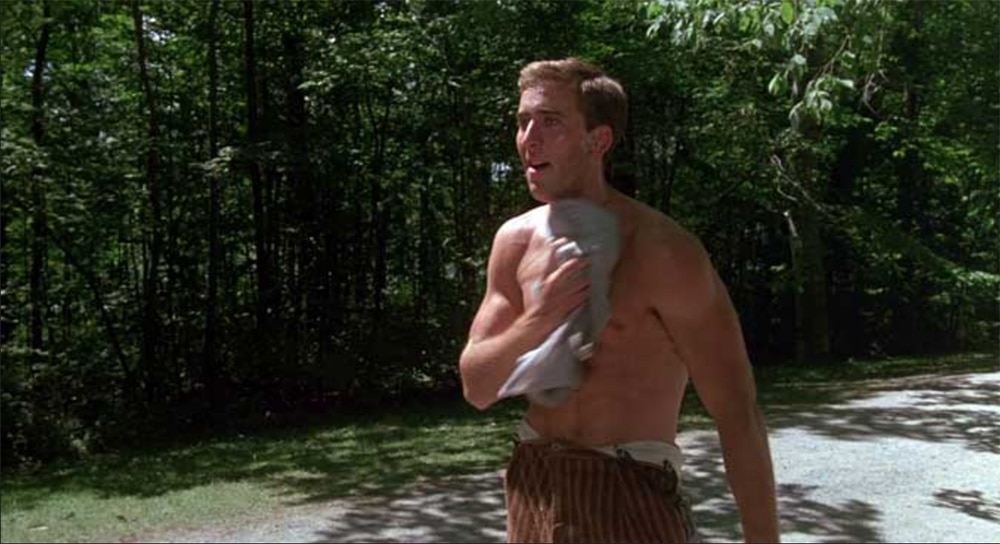
Is there anything truly memorable about The Boy in Blue besides a Rocky IV-esque training montage and Cage’s ridiculously (seriously, it’s insane!) well-toned physique? Well, there’s a scene where Cage’s character delivers one of the best shirt-ripping comebacks of all time, putting a snooty Harvard boy in his place and making his whipsmart love interest swoon.
It’s not Masterpiece Theater by any means, but boy, oh, boy, does a baby-faced Cage at his absolute hunkiest make this uninspired sports story almost entertaining. Almost.
The Cage Factor:
Nicolas Cage developed his reputation as a method actor in the 1980s, early in his career. His commitment to method acting became particularly noticeable in films like Birdy (1984) and Vampire’s Kiss (1988). In Birdy, Cage famously had two of his teeth pulled without anesthesia to make his character’s war wounds more authentic. In Vampire’s Kiss, he demanded to eat a live cockroach on camera and immersed himself in the eccentricity of his character.
Sandwiched between these two iconic roles is The Boy in Blue, in which Cage strangely refused to do literally anything to convincingly play a nineteenth-century Canadian. His impossibly shredded body, which spends much of the film in the glorious spotlight, does more acting than the man himself — at least convincing audiences that he’s an athlete in peak physical conditioning.
Cage’s most quotable line: “Well, they say I look bigger with my clothes off.” (He’s not lying.)
Is this essential viewing for Cage aficionados? Well, that depends. If you’re the type of fan who needs to see every frame of celluloid that’s ever captured the Cage essence, then by all means, row your boat to this cinematic shore. However, if you’re more interested in the Declaration of Independence-stealing Cage or the madman who would trade faces with John Travolta, you can probably leave this boy blue and move on to greener pastures.
(Caveat: As a hardcore Cage fangirl, seeing Cage at his yum-yum-yummiest was not unappealing.)











Follow Us!