

The September Project’s debut album “Phasing” is a hauntingly beautiful fusion of soulful vocals and atmospheric electronica.
No time to read? Click the button below to listen to this post.
I don’t feel it’s hyperbolic to opine that modern electronic music, or at least a good chunk of it, seems somewhat impersonal. There is a whole subset of music listeners who largely ignore synth-driven offerings, regardless of genre. Too clinical, some assert. Too detached. Too artificial.
Some of the 90s and early 00s trance and goa music surely felt that way to me—the beat was the draw, not the melody. And certainly not the lyrics, which were included almost as an afterthought (if they were present at all). Industrial, EBM, noise… I love them all, but, by and large, they tend to come across much the same way.
It’s a vast and occasionally desolate digital frontier out there, populated by overproduced hit machines and throwback bands chasing a sound from before they were born. A veritable sea of sameness.
But it also means that when bands like The September Project phase into existence, they shine all the brighter.
Marrying layered electronics and soulful vocals, The September Project resurrects the ghost in the machine, breathing life into a synthetic landscape. The duo of Adam Relf (electronics, production) and Polly Douglas (vocals, lyrics) invoke a modern, mournful version of Yaz (aka Erasure before Andy Bell detonated onto the scene). And, it must be said, there is NOTHING soulless or impersonal to be found here.
“Phasing”, which drops today (September 26, 2024) via West One Music, contains eleven tracks and clocks in around forty-eight minutes.
The press release likens the music to that of Lorn (one of this reviewer’s favorite electronic acts) and I would have to agree with that comparison.
But there’s more to The September Project than just a dark synthesizer drone and drum machines. If they’re comparable to Lorn, then it’s Lorn by way of Chromatics (another personal fave). And yet, dig deep enough, and you’ll find other elements as well: dollops of drum & bass, traces of trance, and a smattering of synthwave.
Conveying a world-weariness usually reserved for hardened film noir anti-heroes, Polly Douglas brings more than a tinge of R&B crooning to her vocals.
There’s a depth to her voice—a five-fathom feeling of solemnity and shadow.
She is clearly an old soul, and the frequency of her singing resonates with like-minded individuals. Like Allison Moyet before her, Polly wouldn’t be out of place in the dimly lit downtown lounge of yesteryear, serenading the whiskey-sodden crowd with songs of regret, lost love, and the inexorable pull of age. Her soulful singing meshes perfectly with the dark-electro backdrop.
These eleven tracks are snippets of life experiences transformed into wavelengths of emotion, and most of them require multiple listens in order to fully unpack the various musical layers threaded through and around each other.
This is not high-BPM dance music. These are not one-and-done dopamine hits.
On the musical front, Adam Relf (Empathy Test co-writer and producer) brings an almost classical sensibility to his compositions; the music is nearly cinematic in how it unfolds, as though scored for a half-remembered film.
Adam can take a seemingly innocuous or dissonant sound or melody and make it insidiously infectious, audio gene-splicing through keyboards and samplers. I’ve mentioned to Adam that TSP should release these tracks as instrumental-only versions as well—they’re that good.
While “Phasing” is best listened to start-to-finish like we used to, a few standout tracks deserve ample airtime on their own.

September – As the lead single from the album, September encapsulates the entire TSP sound in a four-minute package, giving the broad range of the album experience right up front. This is perhaps the most “Lorn-sounding” song on the album, swelling synths and down-tempo beats form the framework, while eerie sequences and melancholy vocalizing stand front-and-center.
A Painting – From the distorted percussion to the haunting vocals, A Painting finds TSP firing on all cylinders. Synths drift in and out behind Polly’s layered delivery, cross-fading left to right like a susurrant spirit, verses gradually building upon each other to form a mountain of emotion before fading out like a dream upon waking.
Sooner or Later – The song that lyrically impacted me the most, Sooner or Later, is an unremitting rumination on the bitter taste of unhappiness within a romantic entanglement. Adam scores the uncertainty with a deft hand, adding emphasis as needed and underpinning the entire narrative with notes of bittersweet sorrow.
Remember Me – My absolute favorite song on the album, Remember Me, closes “Phasing” out on a high note. From the propulsive beat to the ethereal synths on reverb, this is the closest to “catchy pop” that TSP allows themselves to be. Remember Me should, in my humble opinion, be the second single from the album. Polly really goes for the gusto on this track, and Adam’s songwriting chops are on full display, with soaring synthesizers providing the perfect climax to an already profound album.
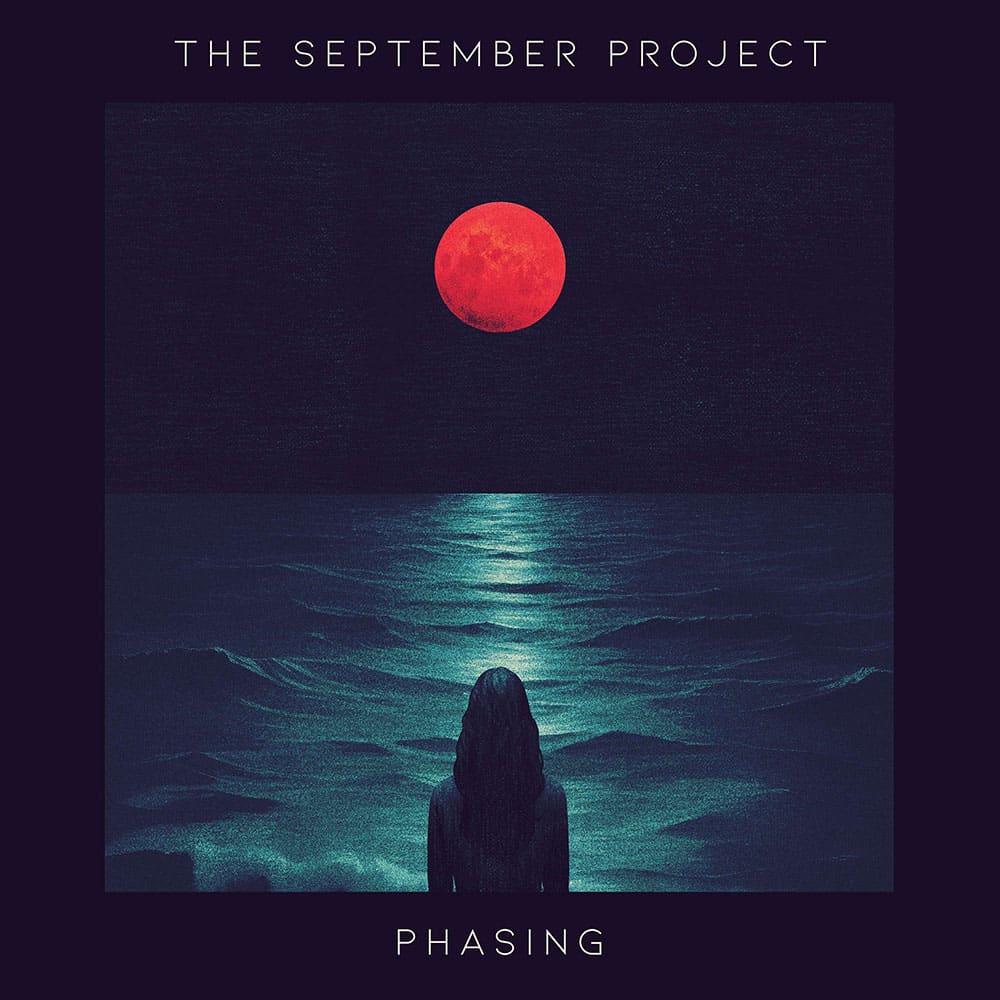
I would be remiss to leave out mention of the absolutely stellar album artwork, another area where Adam excels. The contrast of color between the moon and the female figure is striking and is a highly accurate visual indicator of what the songs are about. Is she a ghost in the waking world? A living woman in a ghost realm? Something in-between? The beauty is that, depending on the viewer/listener, it can be any of those things that still carry the same weight.
That’s the kind of visualization that I can get behind. In fact, it was his artistic ability that first brought me into Adam’s orbit several years ago, and he knocked it out of the park once again with The September Project.
The perfect soundtrack to herald the arrival of autumn, “Phasing” floats in on a wave of melancholic yearning, defying the punters who claim that electronic music has no soul. This is nothing BUT soul—a myriad of emotions; each laid bare in all their beautiful, ugly glory.
Equal amounts of fearless and fearful, a treatise on the human condition as spoken through ones and zeros.





Follow Us!