

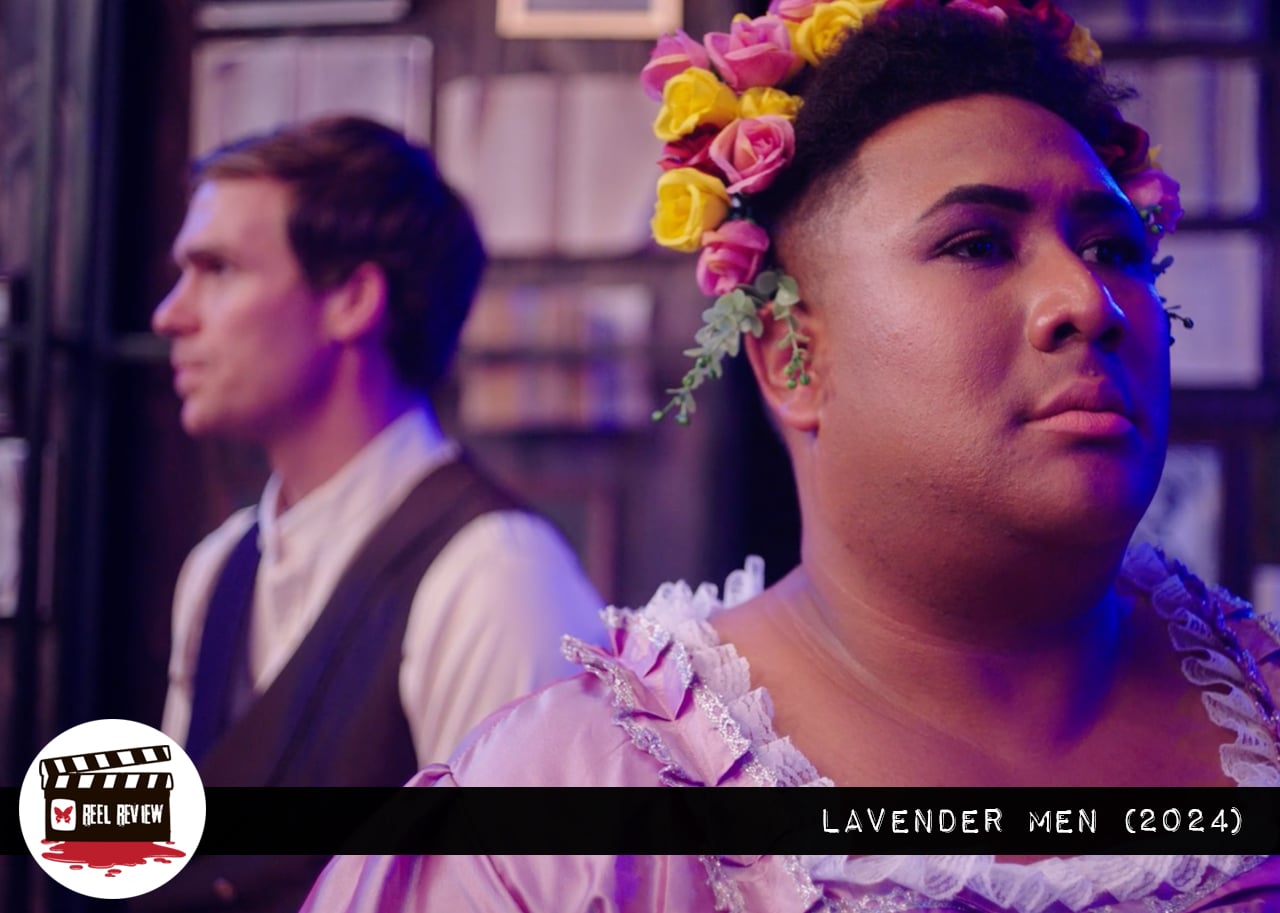
Unraveling the threads of America’s past and present, “Lavender Men” is a love story, a historical fantasia, and a journey of self-acceptance.

No time to read? Click the button below to listen to this post.
To coin a phrase from Joe Biden, if we truly are in a “battle for the soul of America,” it’s a war being won by the party of Trump, whose talon-like grasp on the country intensified greatly following his commanding win in the 2024 election.
The new Republican party, with its ultra-conservative social agenda and a platform that courts religious fundamentalism and right-wing extremism (see Project 2025), shares almost nothing in common with the party of Abe Lincoln. Founded in 1854 by anti-slavery activists, the original Republican party supported classical liberalism and economic reform while opposing the expansion of slavery into the free territories. 1860, Lincoln became the first Republican president, causing the Southern states to secede from the Union.
On November 19, 1863, Lincoln delivered what would become known as the Gettysburg Address, in which he advocated for equality and unity.
“Four score and seven years ago, our fathers brought forth on this continent a new nation, conceived in Liberty and dedicated to the proposition that all men are created equal. Now we are engaged in a great civil war, testing whether that nation or any nation so conceived and so dedicated can long endure.”
Now, 150 years after Lincoln’s death, the country remains as deeply divided as ever, and the question of whether we can endure remains.
Meanwhile, a political party founded on liberty and justice for all seeks to undermine freedom and civil rights at every turn. It’s a terrifying time to be anything other than a straight white male.
Not only was Lincoln “woke” more than a century before alt-right bigots would wield that word like a deadly weapon, but there is strong evidence that he may have been queer (an excellent new documentary, Lover of Men: The Untold History of Abraham Lincoln, tackles decades’ worth of speculation about the sexual orientation of the nation’s most consequential president).
In Lavender Men, writer-director Roger Q. Mason approaches Lincoln’s speculative sexuality from another angle—a deeply personal one.
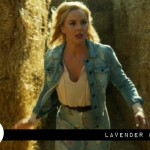
Based on Mason’s successful stage play, the film is a genre-bending fantasy about the 16th U.S. president seen through the eyes of Taffeta (played by Mason), a gender non-conforming queer person of color.
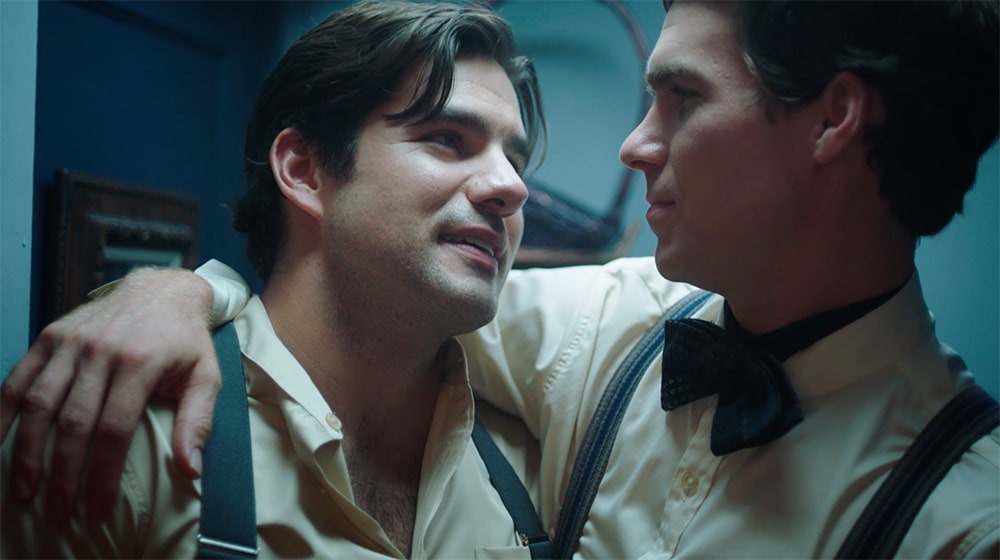
While working as a stage manager for an underperforming historical play about Abe Lincoln, the lonely and insecure Taffeta indulges in a theatrical, fever-dream fantasy (a “fantasia” they call it), in which they revisit—and attempt to rewrite—history while focusing on Lincoln’s imagined gay relationship with his law clerk and right-hand man, Elmer Ellsworth (Alex Esola).
In Taffeta’s fantasy play, both Lincoln (Pete Ploszek) and Elmer are dashing, devastatingly handsome young men.
Taffeta begins by summoning their ghosts and convincing the two victims of fate and the nation’s division—Lincoln assassinated and Ellsworth, the first Union officer to die in the American Civil War—to relive their painful past in the hopes of changing the outcome.
Taffeta inserts themselves directly into the story, gleefully playing a variety of roles—ranging from the beleaguered Mary Todd Lincoln to the fictional black maid Sister Sadie.
It’s whimsical, charming, and often wildly funny.
Yet, it’s also deeply poignant and sometimes heartbreaking as Taffeta attempts to unpack issues of race, sexuality, identity, belonging, and the kind of pervasive prejudice that’s somehow as insidious today as in Lincoln’s day.
Shot like a stage play to reflect the film’s theatrical roots, Lovell Holder skillfully directs Mason’s gripping tale of heartbreak, hope, horror, and history.
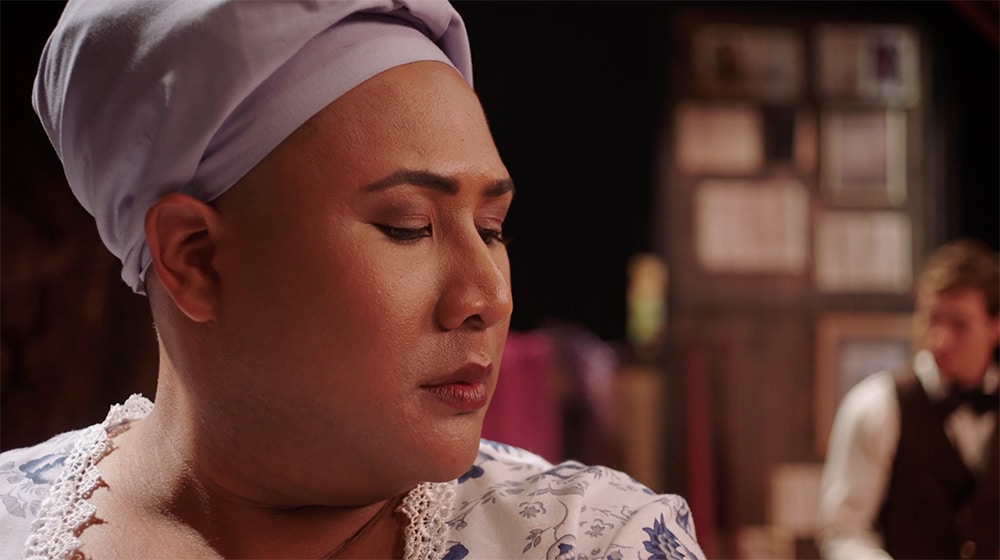
As Taffeta grapples with what was and what might have been, often breaking the fourth wall and speaking directly to the camera, they lay themselves bare to reveal deep-seated insecurities born out of being mistreated, overlooked, and marginalized.
Taffeta recounts a litany of cruelty lobbied against them for failing to fit the majority ideal. They describe in aching potency what it feels like to be judged, unseen, and less than for all the things that make them different—from their sexuality to their race to their physical appearance.
It’s a scathing critique of a country that imagines its greatness while maintaining a narrow view of what it means to be worthy of love, respect, and opportunity.
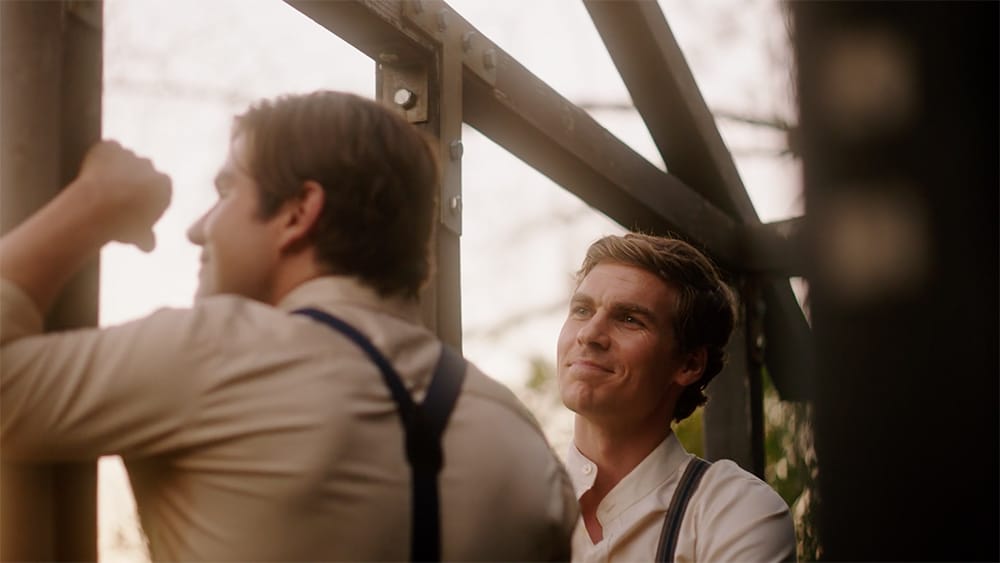
There are scenes and lines of dialogue that pierce so deeply that they take your breath away as Taffeta wrestles with their own demons while resisting the whitewashing of history, at one point screaming at a dismissive Lincoln, “You will not erase me from this room.”
For all of Lincoln’s noble words and admirable deeds, he was still a white man of privilege and power who longed for his place in the record books, his chance to be a great man.
When Taffeta, as the lonely and scorned Mary Todd sneers, “God save me from great men; there’s enough of them running around now ruining everything,” women shattered by the current political landscape and anti-women rhetoric can’t help but feel the crushing weight of those words.
Mason is nothing short of a revelation in a tour-de-force performance. Ploszek and Esola are equally mesmerizing and have electric chemistry as Abe and Elmer. The film also boasts one of the most sensual, gorgeously filmed, poetic love scenes ever put to celluloid.
The ending is exquisite.
As heartbreaking and often infuriating as Lavender Men is in its reflection of problematic American ideals, it’s ultimately a beautiful, deeply affecting film about self-acceptance and the courage to rewrite our own story, refusing to play the role society casts us in.
Overall Rating (Out of 5 Butterflies): 5
LAVENDER MEN was shown as part of the Micheaux Film Festival, where it was screened for this review. It is currently on the festival circuit, but we encourage you to keep this one on your radar.












2 Comments
2 Records
John wrote:
Stephanie Malone wrote:
I certainly appreciate your perspective. But woke just means having an awareness of social injustice and inequities and a concern for humanitarian issues. The fact that this is now considered an insult or something negative speaks volumes about the state of our society. This film does not present itself as a documentary. It’s a fantasy used to explore deep and personal themes of identity and belonging. I doubt you have a problem with films that reflect someone’s personal choices if it involves a heterosexual relationship or an expression of Christian religious beliefs. People’s identity is core to who they are, and they have a right to express that freely. We wouldn’t dare ask someone in a majority group to stop being themselves, and we never consider the expression of a mainstream identity as being shoved in our faces (i.e, a straight romance portrayed in film). You have every right not to consume media that’s not for you or engage with stories you don’t enjoy, but everyone has a right to express their personal identity and explore the topics and themes that are most important to them. Being a part of a minority should not be looked upon with scorn. People in the majority should feel grateful they have the privilege of being an oppressor rather than the oppressed… and then hopefully choose NOT to oppress. I hope more people will turn away from hate and open their hearts to allow a bit of tolerance and grace for those who see or experience the world differently.