


Hell is terrifying because it can be anything our worst nightmares can conjure, and horror has long exploited this terror in chilling ways.
No time to read? Click the button below to listen to this post.
When movies use the concept of Hell as a plot point, it can be as strange as the creators want. Hell is an abstract concept; nobody knows what it really looks like, so it can be anything anyone dreams up. Filmmakers can deliver enjoyable fever dreams that might not make much sense but are given gravitas and believability through context. Horror fans are then invited to make up their own answers and theories.
I’ll be exploring the use of the Hell trope in Hellraiser: Hellworld (1998) (the sequel to the 1987 Hellraiser), Event Horizon (1997), and As Above, So Below (2014).
Set Design

Hellbound had an almost ridiculous amount going on with regard to plot and set design. It was labyrinthian and never-ending. While Kirsti casts about to find her father, her horrible stepmother, Julia, has returned to serve the Leviathan diamond god-thing in the sky. This object is actually a puzzle made from the Lament Configuration, and Julia’s goal is to regain her skin through a megalomaniac doctor. The doctor is changed into a Cenobite and decides to try and take over Hell by challenging the Hell Priest, known popularly as Pinhead.
Parts of the movie take place in the real world, but Hell is a surrealist painting that we watch come to life.
In Event Horizon, the titular ship accidentally went to literal Hell while traveling through deep space. Though presented as hallucinations or dreams as a manifestation of grief, similar to a haunting, the journey to Hell is from the attempt at folding space-time to create an artificial wormhole. This mission was launched to reach our nearest star, Alpha Centauri, but disappears near Neptune; the story picks up with a rescue mission by the ship Lewis & Clark.
I do love this idea of space being threatening. We have no idea what’s out there. Hell, now embodying the dead ship, uses what you fear against you, “a defensive reaction”; this marks the ship as somewhat alive. Darkness here is like an infection, possessing Dr. Weir as it brings your worst fears to life because it knows you. This dimension they stumbled upon is of chaos, pain, and suffering. The Hell footage gleaned from the captain’s logs looks like it comes from a Cenobites’ wet dream of torture: body horror, laceration, unnatural forms, and maggots — a terrible new kind of creation with existing body parts.
The ship itself looks cold with metallic designs, and the carnage makes it seem like a gruesome place of death.
As Above descends far below Earth’s surface via the catacombs of Paris with walls made of bones from human bodies lined with the bones of the dead. This time, we’re embroiled in a found footage Dante-esque journey down into several levels of Hell. Each person who comes down there is tortured by their dark memories, and several people die in this pursuit.
This movie works largely because of its found-footage aspect, where different shots are picked up by cameras attached to the explorers’ heads. We see what they see and experience it in real-time with them, down deep in the dark. The combination of headlamps, darkness, and human remains make As Above a haunting nightmare.
Trauma Hell

All three movies also dealt with trauma in their own way, which was explored through the plot device of Hell.
The second Hellraiser installment looks at the murder of Tiffany’s mother and Kirsti’s dad. In Event Horizon, the trauma of one’s worst memories and what’s truly out there in the universe is on display. As Above, So Below is about confronting the trauma of guilt and our own sins.
Some conceptions of Hell are designed as a place filled with tiny personal hellscapes, so every person is punished who is sent there.
In Hellbound, Hell is endless labyrinthian hallways that have a different person experiencing their own version of hell in each room. Uncle Frank from the first movie is there, tempted by women he’ll never touch, unable to escape. Since he is responsible for the Cenobites coming into Kirsty’s life and killing her father, she makes sure Frank never leaves.
As Above includes illusions of each person’s personal sins and guilt manifested magically in front of everyone’s eyes in this underground maze.
Hell for all three movies is filled with the events from life that haunt one the most, so hell is personalized.
Selling the Hell
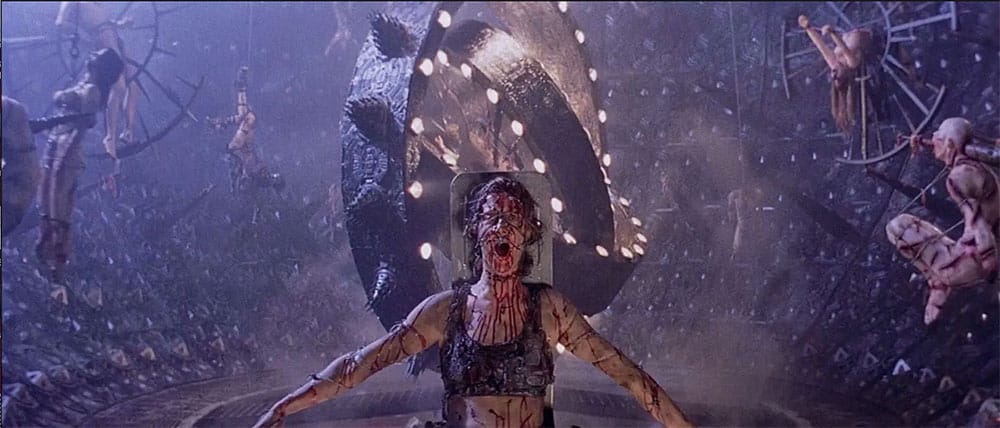
Hell is traditionally not known for being a wonderful place, so the challenge is to create a place so horrible that it actually could be Hell.
Practical effects that are nauseatingly awesome and a solid storyline help, too. Each of these movies shares the gruesome ability to make sure you don’t look away from the sheer insanity. The storylines had enough cohesion to sell their various hellscapes.
Event Horizon only truly makes sense as an extension of the Hellraiser universe, given the horrific imagery and the way that Hell seems designed to rip people apart. The movie was partly inspired by the Hellraiser movies and the infamous Lament Configuration when designing the black hole machine.
As Above sent a group underground to look for the folkloric Philosopher’s Stone. They encountered Hell along the way—one that held personal hells designed for each of them in the form of illusions. I loved the idea that Hell could easily be our worst memories.
Hell is what you make of it. Personalized or impersonal, it doesn’t matter as long as it becomes nightmare fuel for the living.









Follow Us!