

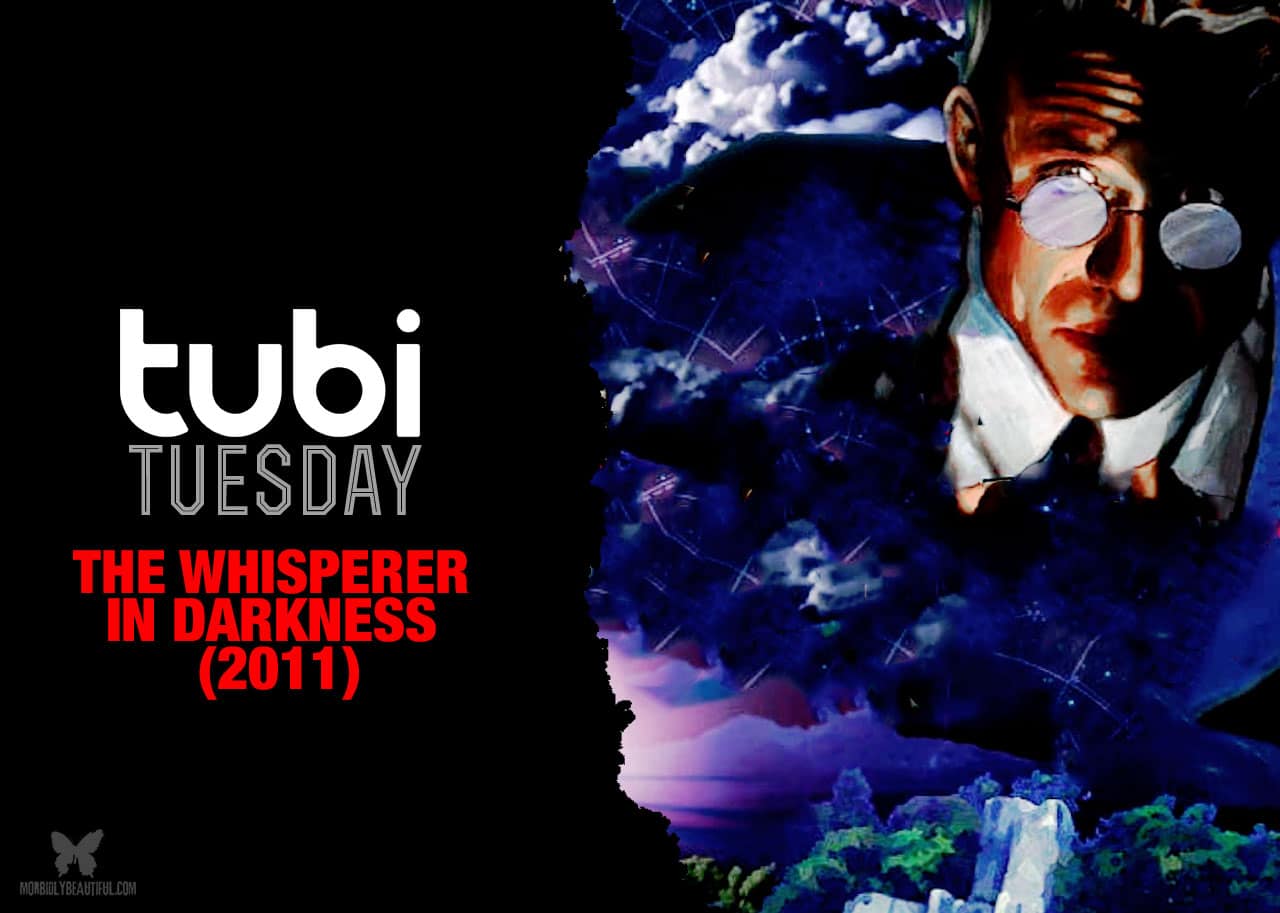
An underrated labor of love drenched in atmosphere, “The Whisperer in Darkness” is a must-watch for fans of Lovecraftian horror.

No time to read? Click the button below to listen to this post.
What would indie horror be without H.P. Lovecraft?
Everyone’s favorite deeply problematic but immensely influential weird fiction author’s works have been adapted for the screen countless times by any number of hungry young filmmakers, likely due as much to his impact on the genre as to the fact that many of them are in the public domain.
While a great number of these films have used his stories more as loose frameworks than sacred texts, few have approached the task of adapting his work with as much faithfulness as the true believers of the H.P. Lovecraft Historical Society.
The California-based fan club and production company has made it their mission to adapt Lovecraft’s works into all manner of media, from films to stage shows to musical revues. To date, they’ve produced two feature film adaptations, 2005’s silent movie The Call of Cthulhu and 2011’s The Whisperer in Darkness.
Directed by HPLHS co-founder Sean Branney and co-written by Branney and fellow co-founder Andrew Leman (both of whom also appear in the film), The Whisperer in Darkness adapts Lovecraft’s 1931 novella of the same name as if it was released by Universal Pictures the following year.
Any indie movie can slap a black-and-white filter over itself and call it an homage, but Branney and the crew go far beyond just desaturating the color.
Their attention to 1930s period detail is incredible, from the title sequence to David Robertson’s chiaroscuro cinematography to Troy Sterling Nies’ elegant score and everything in between.
The success of the film pretty much all rides on this sense of period style, and it carries it off with aplomb.

The Whisperer in Darkness took a long time to come together.
After Cthulhu was released in 2005, the team decided their next film project would be an adaptation of Whisperer. After working on a script for the better part of two years, a teaser trailer was screened at a Lovecraft film festival in 2007. It would be nearly another four years of work building and sourcing props, securing actors, finding locations, and all the other stuff an indie production has to figure out before Whisperer finally saw the light of day in 2011.
Having not read the original novella, I’m not totally sure how faithful this adaptation is, but judging from a quick summary, it seems that Branney and Leman stuck closely to the original story and added on a new final act to make it a bit more satisfying as a movie.
This also seems like an appropriate choice for its homage to classic Universal horror, which often resulted in films that were wildly different from their source material. The finale lends the movie a bit more derring-do than Lovecraft likely intended with his more ambiguous ending, but it manages to be genuinely suspenseful in its own way.
As with a lot of Lovecraft’s work, THE WHISPERER IN THE DARKNESS hearkens back to an earlier time in America, long before we mapped out every corner—when myth and legend still held sway.

It seems unfathomable in our current information age, but there was a time when not every question could so easily be answered, a time when it was entirely plausible that there might be something unknown lurking out there.
In the woods of Vermont, there have long been stories of strange, winged, crab-like creatures but no evidence to prove their existence beyond the word of the locals. For Albert Wilmarth (Matt Foyer), a professor of folklore at Lovecraft’s oft-mentioned Miskatonic University, this is more than enough to deduce that the legends are nothing more than stories.
But when his Vermonter pen pal Henry Akeley (Barry Lynch) sends him a strange letter expressing a newfound appreciation for the creatures, Wilmarth can’t resist making the trip to investigate.
What he finds there puts his skepticism to rest once and for all.
The Whisperer in Darkness is the kind of movie that’s probably destined to be overlooked.

It’s old-fashioned and out of step with the horror trends of its era, and proud to be that way.
It’s filmed in the Society’s own made-up Mythoscope process, which seems to mostly consist of combining old filmmaking techniques with digital effects, and the fusion of old and new works pretty well, especially when the effects are subtle. Bigger CG effects at the film’s climax don’t integrate quite as well, and I couldn’t help but wish they stuck to the old-school methods in those moments, but it’s an understandable trade-off.
The film’s commitment to its period setting is so deep that it’s even paced like one of its inspirations, relying more on atmosphere than nerve-jangling scares. But luckily, what an atmosphere it is.
The Society’s love of the material and the care they put into their craft is evident in nearly every frame of this film, and it’s a joy to watch for that reason alone.

I’m admittedly not the biggest Lovecraft-head; despite my love of the genre that he undoubtedly helped create, I haven’t read much of his work, in part because it’s already so ubiquitous and in part because of his deeply troubling personal reputation (something the Society admits on their website is a regular struggle to reconcile).
But really, anything made with this level of love and dedication is worth celebrating.
The Whisperer in Darkness is, to date, the Society’s most recent film project, but they’re still going strong, producing audio dramas, books, live shows, and beyond. Hopefully, someday, we’ll be treated to another of their strange and terrifying onscreen visions.
Overall Rating (Out of 5 Butterflies): 4









Follow Us!