


“Fight Club” remains influential twenty-five years later by exploring still-relevant themes of alienation, masculinity, and consumerism.

No time to read? Click the button below to listen to this post.
Now, I’m about to break the first two rules of Fight Club. You ABSOLUTELY…. do NOT…fucking talk… about FIGHT CLUB! But hey, all rules are made to be broken.
Released on October 15, 1999, the film—directed by David Fincher and adapted from Chuck Palahniuk’s 1996 novel—features Brad Pitt and Edward Norton portraying Tyler Durden and Jack, characters representing the id and superego. Helena Bonham Carter plays Marla Singer, a woman entangled in a complex relationship with them.
Chuck Palahniuk conceived the novel after a camping trip during which he was assaulted for complaining about noisy campers. Upon returning to work, he noticed nobody acknowledged his injuries, opting for mundane conversation. This indifference led him to believe that people were unwilling to engage personally. This societal disconnect inspired the story.
The film begins with Edward Norton’s character, an unnamed narrator, visibly distressed and holding a gun in his mouth. Brad Pitt’s character, Tyler Durden, is the owner of the weapon, and a group of tall buildings are on the verge of being demolished.
This serves as a ticking clock, prompting the film to explore how Norton’s character arrived at this point.

The narrator is dissatisfied with his job and struggles with insomnia. He finds solace by attending support groups and feigning terminal illnesses, receiving comfort and compassion from individuals dealing with various serious health issues. However, nirvana is soon disrupted by Helena Bonham Carter’s character, Marla Singer, who disrupts the narrator’s facade. Subsequently, the narrator encounters Tyler, and after his apartment is obliterated, he moves in with Tyler to his old, dilapidated house.
A pivotal moment occurs when Tyler asks the narrator to physically assault him, leading to the formation of an underground fighting club that expands as others join.
However, complications arise when Tyler engages in a relationship with Marla, triggering feelings of jealousy and resentment in the narrator. As the Fight Club gains momentum, Tyler assigns participants to various subversive activities, escalating into Project Mayhem, which involves increasingly audacious and unlawful actions, creating a rift between the two central characters.
This movie remains an icon because it speaks to a generation tired of living under the weight of their parents’ expectations.
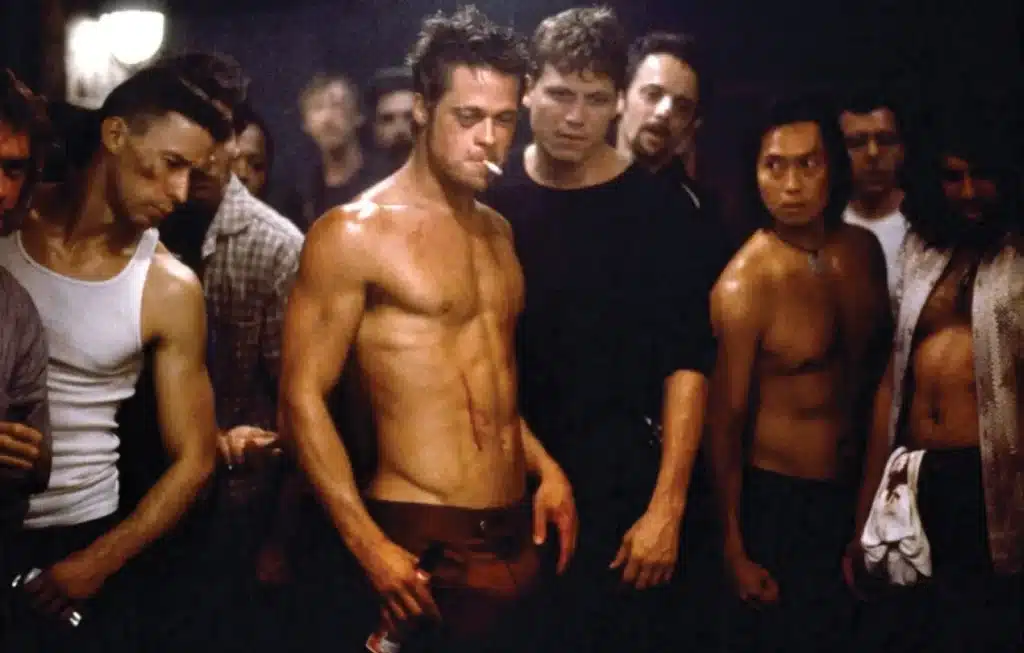
The film satirically criticizes and acknowledges that today’s males, mainly white males from the lower middle class to the middle class, have been emasculated by society, becoming comfortable with being docile and obedient.
Fight Club was a catalyst that would later help lead to a political and cultural upheaval. The film can be read as a commentary on how capitalism and consumerism have dehumanized and objectified both men and women. As Tyler puts it, they are men raised by women, and the thought of starting a family or getting married is foreign to them, so they repress their emotions by engaging in physical altercations. Sound familiar? Eat your heart out, Kevin Samuels!
For these men, sexual intimacy is either absent or purely physical, avoiding emotional closeness with women.
FIGHT CLUB is a visceral, provocative film that challenges the status quo and encourages viewers to question their assumptions about gender roles and power dynamics.

It is a powerful and poignant statement about the state of masculinity and the role of violence in society.
The most significant and recurring trope in Fight Club is the concept of the Man vs. Society. In this world, it is common for men to repress their emotions and act on their more primal impulses.
I remember the first time I watched Fight Club. I was hooked. It’s an iconic piece of cinema and an excellent example of a movie that had a massive impact on me. The story was unlike anything I had seen before, and I found it extremely relatable. The dialogue is smart and witty, and the performances are spot-on.
Brad Pitt and Edward Norton give outstanding performances, and Helena Bonham Carter is a scene-stealer.
The movie’s depiction of masculinity is raw and honest, and it challenges the notion that violence is inherently bad or wrong.

Instead, the film explores the complexities of violence and how it can be a form of catharsis and release.
At the time, David Fincher was already a household name with the release of the movie Seven, but this marked a significant advancement into more than just typical genre work. The film briefly encapsulated a pre-9/11 era of men untouched by war becoming disinterested and apathetic. Utilizing CGI in groundbreaking ways, the film still consistently impresses with its composition and editing.
In conclusion, Fight Club is an iconic film that has had a lasting impact on popular culture.
With its unique story and powerful message, it is no wonder that the movie is still relevant and referenced decades after its release.
Overall Rating (Out of 5 Butterflies): 5











Follow Us!