


While it may not please purists, Gary Dauberman’s “Salem’s Lot” breathes new life into a King classic and lets the scares take center stage.
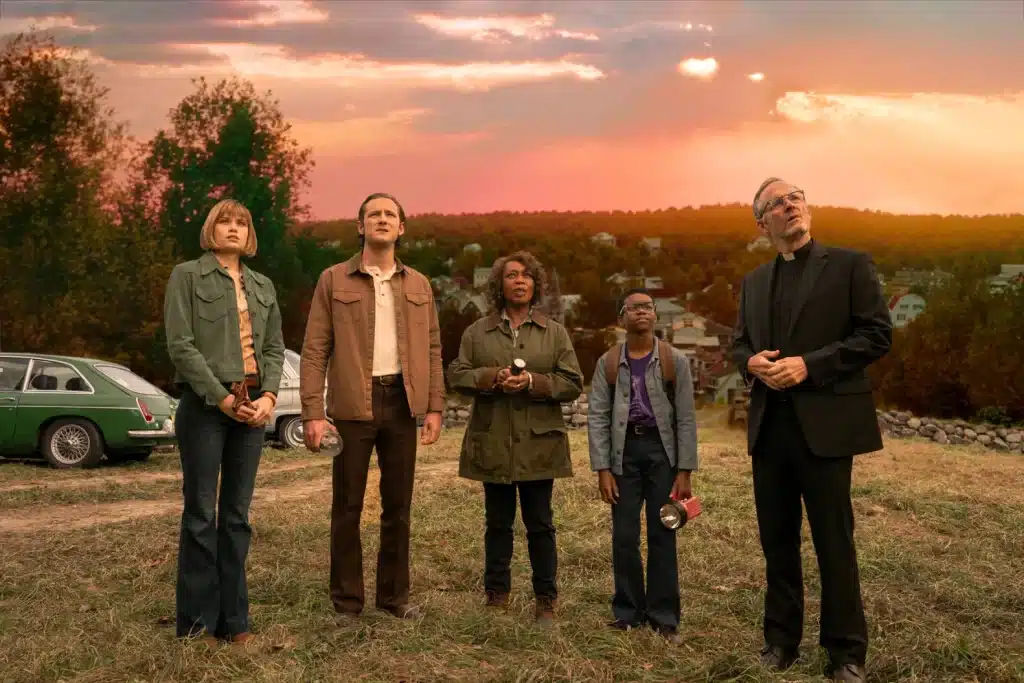
Gary Daubeman is a writer best known for his work on The Conjuring Universe with The Nun and the popular Annabelle series, working as both writer and director on Annabelle Comes Home. He’s also known for having a deft hand when it comes to Stephen King adaptations, having penned 2017’s IT and 2019’s IT Chapter Two. This time around, he’s back pulling double duty as writer and director, tackling another beloved King property: Salem’s Lot.
This highly anticipated adaptation of a King favorite begins in a similar fashion to the original (1979), with author Ben Mears (Lewis Pullman) returning to his hometown of Jerusaelm’s Lot — now renamed to the titular Salem’s Lot. The prodigal son has returned to research his new novel. He enters Larry Crockett’s (Fred Willard) real estate office to ask about a rental property, the Marsten House, which he learns is unavailable to rent because partners Richard Straker (Pilou Asbaek) and the mysterious Kurt Barlow (Alexander Ward) have purchased the house, intent on opening an antique store.
I’m describing Barlow as mysterious because no one has actually seen or met him. Straker is the only person anyone has interacted with, and when asked when people will have the pleasure of meeting Barlow, he responds evasively. This enigmatic avoidance creates an underlying sense that something is not quite right.
Mears stays at Eva’s Bed N Breakfast, owned and operated by Eva Miller (Marilyn Busch), where he has a good view of Marsten’s house. In his mind, the house represents the evil in the town. When he was a child, he entered Marsten’s house and saw something that scared him, which haunted him his entire life.
The Marsten House, a place of unspeakable horrors, is a central element in the story, adding a layer of dread to the narrative.

Even better, the house was built specifically for the movie but is even more frightening than the one used in 1979.
This release concentrates more on the horror plot than the characters’ personal relationships. This shift in focus creates a more intense and chilling viewing experience. That experience is aided by stellar effects that feel more genuine than the original and still convey that ‘wow’ element.
The score is appropriately chilling. The music in this remake doesn’t just accompany the story; it enhances the plot, subtly building the suspense and horror. The audience is left on the edge of their seats, knowing something is coming but unsure exactly how or when.
Some critics have called the special effects lacking in practical magic. Yet, comparing them to the 1979 version, it’s hard not to concede that those effects were cheesier and far more unrealistic.
Even the characters’ reactions are more authentic when they discover that vampires are on the loose in their small town. Alfre Woodard’s portrayal of Dr. Cody’s response to the revelation that a patient was a Vampire is both realistic and memorable, enhancing the audience’s connection with the characters.
Pullman also makes for a much more robust and defined Ben Mears.

You learn who the villain is early in the movie, but that knowledge, combined with Lewis Pullman’s excellent acting as Ben Mears and the haunting music score by Nathan Barr and Lisbeth Scott, makes this film even more hair-raising than the 1979 version.
Salem Lot‘s ending differs from the book and the 1979 movie; I won’t ruin it for you. However, I liked this version because it leaves it open to going the way of the novel, depending on what the characters choose to do next.
Adaptation purists who want to see King’s work faithfully adapted—and those who have a strong connection to the 1979 film—are likely to walk away disappointed from this heavily condensed version. However, those willing to embrace a fresh take who are more interested in scare-heavy vampire horror should find a lot to appreciate.
The enhanced shadowing and special effects, a far cry from the late 1970s, significantly elevate the atmosphere and intensify the chilling factor, making this one a fun and frightening adaptation.






Follow Us!