


Coralie Fargeat’s “Revenge” is a bold reclaiming of a problematic subgenre that masterfully shifts the narrative of justifiable vengeance.

No time to read? Click the button below to listen to this post.
At first glance, Coralie Fargeat’s directorial debut Revenge is your mere rape-revenge narrative. A girl is sexually assaulted, left for dead, and awakens as a metaphorical phoenix hell-bent on redemption. But what Revenge brings to the table that distinguishes itself from its predecessors, like Meir Zarchi’s I Spit on Your Grave, is a female perspective that is so gloriously realized that it feels fresh.
The rape-revenge subgenre has been haunting our screens since 1978 when Zarchi introduced a female protagonist who takes matters into her own unforgiving hands and hunts down her rapists one by one. However, while Zarchi’s intentions were likely pure, they failed to translate on screen. The film’s intended theme of female empowerment was overshadowed by grotesque imagery that reeked of the male gaze – a term coined by film theorist Laura Mulvey.
In her essay Visual Pleasure and Narrative Cinema, Mulvey argued that the cinematic look often places the viewer in the shoes of a heterosexual male, objectifying female characters.
In Zarchi’s controversial film, as with others in the subgenre, the brutal rape scenes are shot in a way that could be interpreted as gratuitous and exploitative. The camera doesn’t shy away from the violence; rather, it focuses on Jennifer’s (Camile Keaton) nudity and vulnerability, reinforcing her objectification even in moments of extreme distress. And while Jennifer’s revenge on her attackers can be empowering, she’s portrayed in a sexualized manner that prioritizes male fantasy and gratification.
That’s what makes Fargeat’s entry so refreshing. She effectively subverts the classic tropes of the subgenre by centering the plot from the protagonist’s point of view.
From the offset, Revenge jumps out at us with vibrant imagery and a hitting electronic score that grabs our attention.

This vibrancy continues with the introduction of Jen (Matilda Lutz), the precociously seductive young mistress doted in a bright pink outfit while flirtatiously sucking on a lollipop.
In the beginning, Fargeat puts the male gaze to use by characterizing Jen as someone secure in her sexuality, strutting around her boyfriend Richard’s (Kevin Janssens) holiday home while Richard and his friends Dimitri (Guillaume Bouchede) and Stan (Vincent Colombe) are in constant awe of her body.
During a pivotal scene in the first act, Jen dances seductively for the three men in a short dress. She gives them lap dances and flirtatiously grinds on them while they continue to admire her beauty. Fargeat wants the viewer to take the perspective of these men, with close-up shots of Jen’s body as she dances around them, only to flip the switch and shock us with the dreadful circumstances of the next scene.
With an uncomfortable confrontation between Jen and Stan the following morning, as he becomes increasingly invasive and accuses Jen of leading him on, it all comes to a brutal climax when Jen is assaulted.
This is the moment you realize Fargeat’s film isn’t typical of others in the subgenre, with the assault taking place off-screen.
Unlike I Spit on Your Grave or Wes Craven’s Last House on the Left, Fargeat proves that you can be just as effective with off-screen violence, relying solely on Jen’s echoed screams to convey what’s happening.
It’s also in this moment that Fargeat begins to shift to Jen’s perspective, with close-up shots of Dimitri chewing on a chocolate bar as he turns his back on the assault, placing us in the center of Jen’s disgust and hopelessness.
While the rape scene is handled with delicacy and respect for the character, the scenes that follow are depicted in horrific and gory detail.
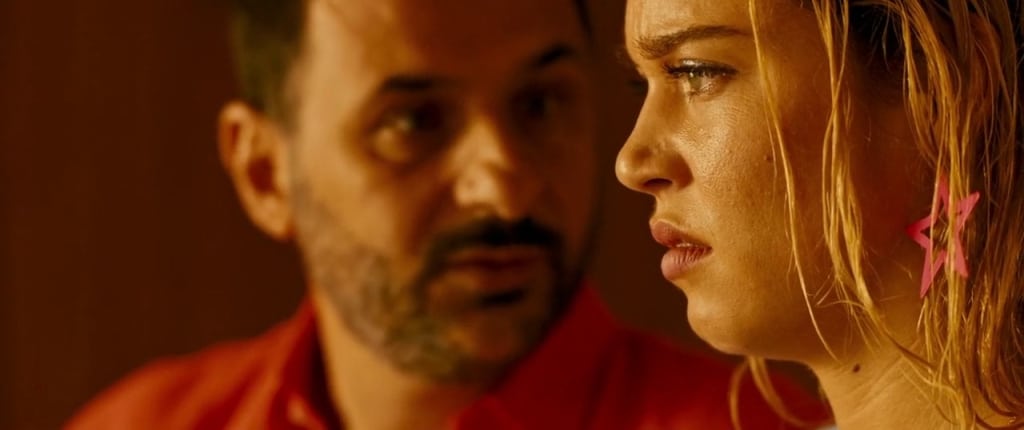
Stuck in the middle of nowhere, with an unsympathetic boyfriend and two men willing to do anything to silence her, Jen is faced with no other option but to run out into the desert, where she is pushed off a cliff and left for dead.
While a woman on the run and seeking vengeance is a staple of this subgenre, Revenge defies the classic tropes by breaking beyond the typical male gaze. Although Fargeat initially makes Jen the object of these men’s lust, Jen’s point-of-view is now at the forefront as she transitions from victim to warrior.
In one of the most pivotal moments in the film, a wounded Jen, who’s taken refuge in an abandoned cave, uses the bottom of an aluminum soda can with a distinctive phoenix logo to cauterize her wound. As Jen fights for her life in the cave, hallucinations brought on by Richard’s hallucinogenics, which she stole earlier in the film, offer a glimpse into her perceptions of the three men. One particularly striking image is of Stan, who’s depicted as a grotesque lizard, symbolizing his predatory and dehumanized nature.
This not only underscores Jen’s revulsion and fear but also strips away any remaining humanity from her assailants, portraying them as the vile creatures they are in her eyes. This symbolic imagery reinforces Fargeat’s criticism of the male gaze by reducing the men to repulsive, subhuman beings, undermining their power and dominance.
Fargeat wants us to see the men from Jen’s perspective and not sympathize with them as she avenges her suffering. Instead, she urges us to revel in their demise and experience their destruction as a powerful and just culmination of Jen’s journey.
Typically, films in this subgenre evoke sympathy for the antagonists through explicit violence.

We see the men in their final moments of fear and pain, which naturally generates a sense of pity or empathy despite their earlier actions.
But Fargeat goes against this by minimizing the psychological and physical suffering of the three men. Rather than showing their fear or remorse in close detail, the scenes focus on Jen’s actions and the impact of her revenge.
In the film’s climax, Jen and Richard face off in an intense game of cat and mouse. Richard’s fear and desperation are depicted more as fleeting background elements with a focus on Jen’s determination and the precision of her actions. As their final showdown nears, Jen’s actions dominate the frame, turning the climactic battle into a powerful conclusion of her journey.
Revenge is much more than just a reimagining of the rape-revenge subgenre; it’s a serious critique of it, emphasizing the shift from male-centric exploitation to a female empowerment narrative.
By focussing on Jen’s perspectives and transformation from victim to warrior, Fargeat reclaims the subgenre from its problematic roots.
Revenge thus serves as a powerful example of how genre tropes can be creatively subverted to offer a more nuanced, compelling, and ultimately redemptive portrayal of vengeance.











Follow Us!