


A wonderfully odd alien abduction movie adapted from a bestseller, “Communion” channels Walken’s eccentric charms to deliver something unique.
No time to read? Click the button below to listen to this post.
In our last Tubi Tuesday installment, we looked at the lengths some people will go to justify their beliefs, no matter how far it pushes them away from others. Today’s movie could be a companion piece, a story of how others try desperately not to believe in something, denying the evidence of their eyes and ears because the implications are far too disturbing otherwise.
When the unbelievable happens, you can either embrace it or reject it, but honestly, neither outcome seems so great. If you embrace it, people will think you’ve gone off the deep end. If you reject it, you might think you’ve gone off the deep end. Either way, you risk looking a little nuts.
Such is the case with author Whitley Strieber and his fictionalized counterpart, played by Christopher Walken in 1989’s Communion, the film adaptation of Strieber’s memoir of his experiences being abducted by aliens. Released in 1987, the book was a bestseller despite (or more likely because of) its controversy.
Directed by Philippe Mora and scripted by Strieber himself, it’s a movie that’s as much concerned with the implications of an extraterrestrial encounter as it is with the encounter itself.
Walken plays Strieber as a slightly weird but loving family man, making a comfortable living as a writer in New York City with his wife Anne (Lindsay Crouse) and young son Andrew (Joel Carlson). After a rather disastrous dinner with their friends Alex (Andreas Katsulas) and Sarah (Terri Hanauer), they take a trip to the Striebers’ family cabin for what they hope will be a relaxing getaway. But alas, it’s not to be.
The night they arrive, everyone besides Anne sees strange, impossibly bright lights over the cabin. Whitley is convinced someone or something has bypassed his elaborate security measures and entered the house. The experience rattles Alex and Sarah so badly that they demand to be taken back to New York the next day. Things largely return to normal after that, at least, until the family returns to the cabin for Christmas, and whatever visited them that first night comes back, and then some.
Mora and Strieber play coy with showing us the alien encounter, taking a while to get to what we’re all here to see.
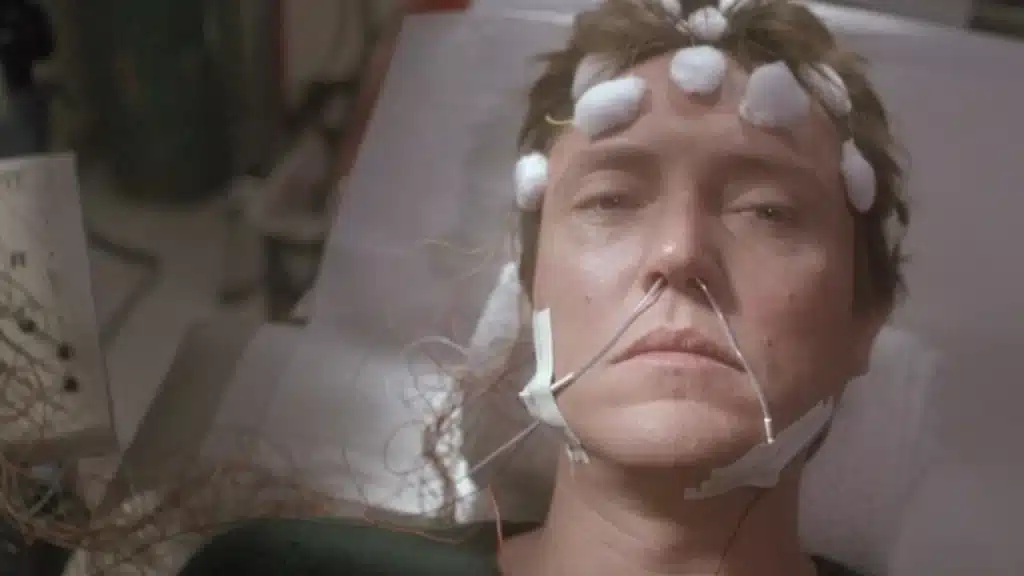
Whitley’s grip on his sanity and family begins slipping along the way. He finds himself unable to write, sullen and withdrawn, and what’s worse, his distress is rubbing off on Andrew, who also claims to have visitations.
Things get so bad that Whitley finally goes to see Dr. Janet Duffy (Frances Sternhagen), a psychiatrist who uses hypnotism to help him unlock his repressed memories.
Communion is an odd sort of alien abduction movie.
It delivers the goods but also seems to take its characters seriously, giving us a convincing portrait of a family in crisis. It hints that these visitations may be genetic in some way, passed down through the generations, making it a malleable metaphor, though I don’t think Strieber wants us to see it as anything other than what it is. Like its spiritual sibling Fire in the Sky from a few years later, everyone around the abductee might have trouble believing their claims, but the trauma of their experiences is plain as day.
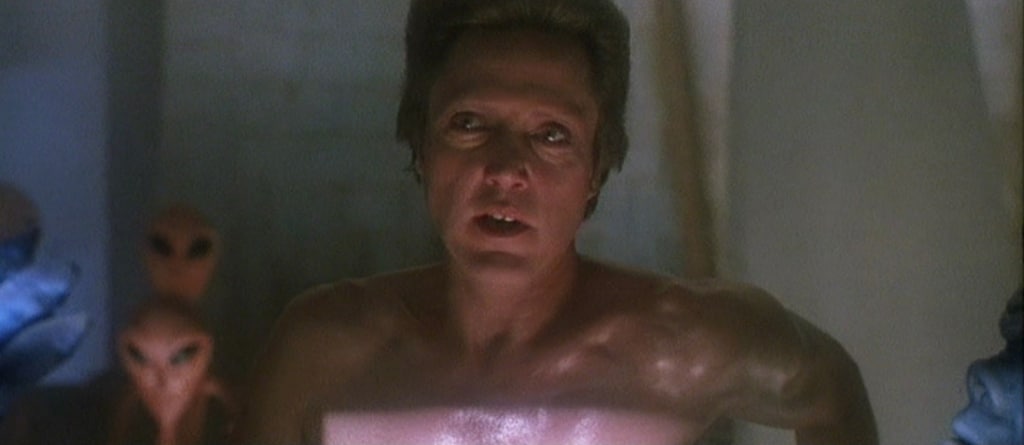
Luckily, Communion eventually shows us what Whitley saw, and it’s as magnificently weird as you might hope, if not more so.
The big abduction scene plays like some stoned fever dream, with a dazed and naked Whitley palling around with little blue creatures while some more traditional lanky gray aliens float above them, all floppy-armed.
The film’s effects are breathtakingly silly, which I think was meant to be intentional.
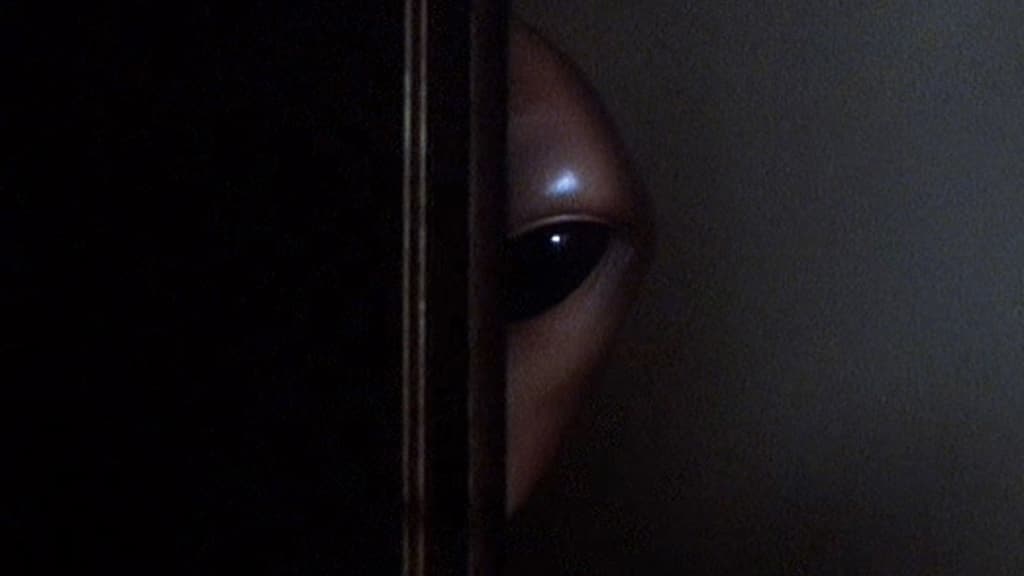
Whitley says the aliens showed him what they thought he wanted to see, which many experiencers have echoed. So they thought he’d want to see them as cheap Halloween decorations, I guess? Hey, if it makes the whole thing a little easier to swallow, then why not?
According to Strieber, the film was produced independently to avoid the meddling influence of a big studio that would undoubtedly blunt its edges and push it towards something more traditional. I’m very thankful they made that choice.
Evidently, Strieber and Mora agreed to each handle their respective writing and directing duties without interference, leading to a much more unconventional final product than we’d likely get otherwise.
This also trickled down to Walken, who was given free rein to do his Walken thing all over the place. If you’re like me, a Walken fan who’s never seen this movie, I recommend it for his performance alone, which has all the primo Walkenness you could hope for, from off-kilter line readings to spontaneous dancing and everything in between.
Even beyond its more immediate, goofy pleasures, Communion manages to be a worthwhile and unique entry in the alien abduction genre. Mora and Strieber were clearly aiming for something different.
While I’m not sure they quite grabbed what they were reaching for, I’d always rather have something messy and ambitious than competent and safe.
Overall Rating (Out of 5 Butterflies): 3.5










Follow Us!