


“The Room Next Door” meditates on mortality, friendship, and the fragile yet profound ways we find meaning in life amidst its inevitable end.
“There are lots of ways to live inside of tragedy.” – The Room Next Door
No time to read? Click the button below to listen to this post.
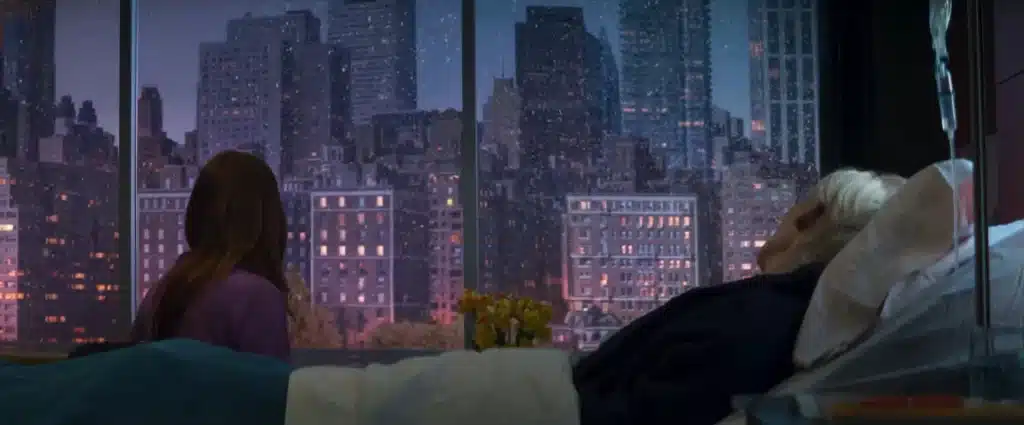
Ingrid (Julianne Moore), a bestselling author, has just published another well-received book centered on her overwhelming fear of dying and helping others learn to accept the inevitable. At a book signing in New York, a friend lets her know that her old journalism friend, Martha (Tilda Swinton), is in a hospital being treated for cervical cancer.
Ingrid immediately goes to visit her estranged friend, discovering she has stage three, inoperable cancer. However, her experimental treatment has been going surprisingly well, and her diagnosis is optimistic.
Martha, a former war correspondent, confesses she had made peace with death and is now somewhat disoriented to face a future she was sure she wouldn’t have.
As they rekindle their friendship, Martha shares stories of her life—from wartime atrocities to the pain of her estranged relationship with her daughter to the loss of her first love and fond memories of a mutual ex with Ingrid (Damian, played by John Turturro).
Tragically, Martha discovers her treatment is failing, and the looming specter of an agonizing death has returned with a vengeance.
Determined to go out on her own terms, free from as much suffering as possible, Martha implores Ingrid to help her die with dignity.
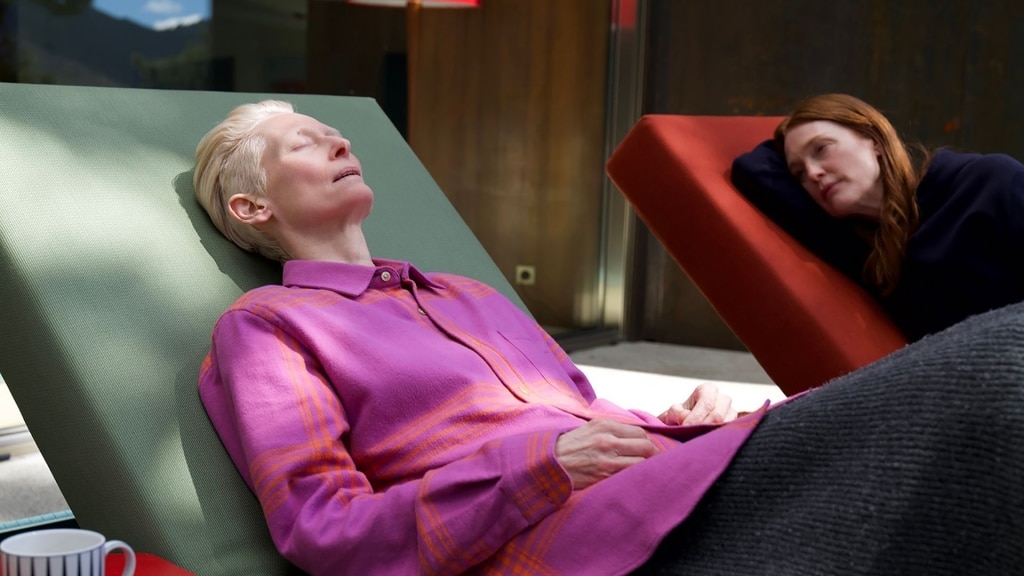
However, the ask is accompanied by a moment of brutal honesty: The death-averse Ingrid is her last resort after those closest to Martha have refused to be a part of her morbid plan.
Martha books a beautiful, remote home for an extended stay and acquires a euthanasia pill. She asks Ingrid to simply keep her company so she doesn’t die alone and refuses to tell her when she plans to take the pill outside of “within a month.”
Ingrid remains in touch with Damian, a former free spirit who now travels the world lecturing on the impending devastation of the climate crisis. While meeting for lunch, the two debate the inevitability of our extinction and the purpose of art in a doomed extinction.
At this point, the film seems to expand its worldview—with multiple references to James Joyce’s The Dead and its meditation on our shared mortality— asking us to consider our inescapable fate as a human species and the ways in which we try to numb or distract ourselves from the horror.
Are such diversions—art, music, poetry, film, ephemeral human connections—ridiculously futile or essential to our survival? Perhaps it’s a healthy mix of both.
I’m still reeling from the recent loss of visionary auteur David Lynch. Still, I’m struck by one of the many profound life lessons he left behind: “Negativity is the enemy of creativity.” We must create despite our pain, hope despite our fear, and love despite the promise of grief and loss. It won’t save us from the inevitable, but it gives what little time we have on this big blue ball meaning.
This is a quiet, character-driven film anchored by the strength of two stellar performances.

It is his first English-language feature, Pedro Almodóvar himself penned the adaptation of Sigrid Nunez’s novel What Are You Going Through.
It’s a lot of talking and thoughtful reflection, and the story moves at a languished pace that won’t work for everyone. But there is so much depth beneath the surface for those willing to walk this exquisitely adorned path of understanding.
There’s a stunning scene where the two friends pop in a tape of the film adaptation of The Dead. As Ingrid watches the final haunting scene, enraptured, she mutters along with every word.
“His soul swooned slowly as he heard the snow falling faintly through the universe and faintly falling, like the descent of their last end, upon all the living and the dead.”
It’s a moment when the main character, Gabriel Conroy, realizes that death is the great unifier and that everyone ends up the same, regardless of their differences. There is equal parts despair and comfort in that realization—a dichotomy that forms the crux of The Room Next Door.
Ultimately, the film is about the power of friendship and the strength to show up for someone even when it’s impossibly hard. It’s about the poignant understanding that, in the end, death comes for us all… but how we choose to live is entirely up to us.
With a late-firm surprise and a breathtaking ending echoing Joyce’s profound assertion that the ever-looming shadow of death is our most potent mandate to embrace life, The Room Next Door is a stirring triumph.
Overall Rating (Out of 5 Butterflies): 4









Follow Us!