

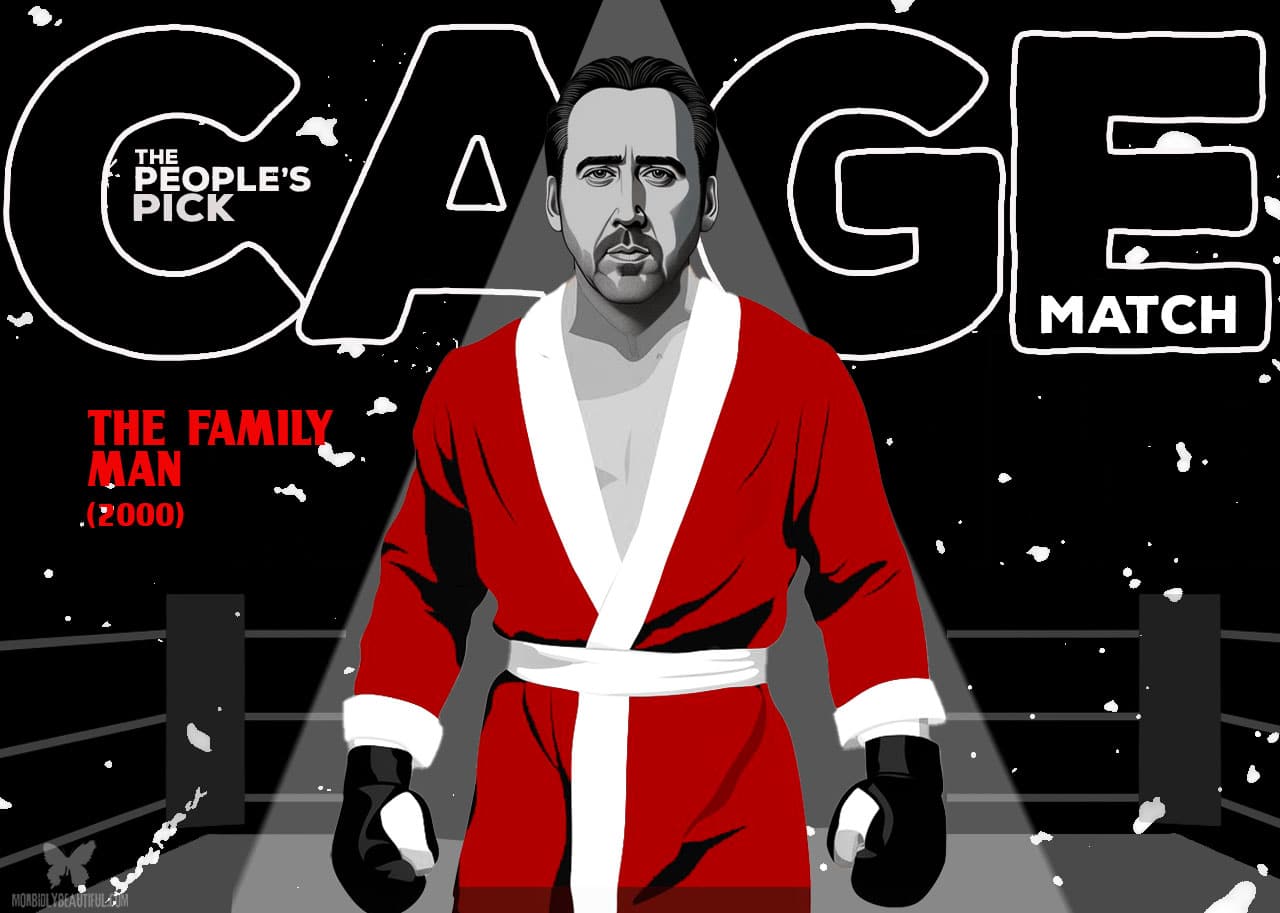
“The Family Man” isn’t exactly the fruitcake of holiday rom-coms because it’s not quite a seasonal staple, but it may be just as divisive.
No time to read? Click the button below to listen to this post.
It’s romance week up in the Cage Match. We kicked things off with City of Angels, in which a lovestruck Cage plays an angel ready to clip his wings to woo a beautiful doctor, played by Meg Ryan—at peak adorableness. Then we watched him play a charming loose cannon with one hand in Moonstruck, a man wooing his brother’s pragmatic fiancee, played by the incomparable Cher in an Academy Award-winning performance. Last (and possibly least…we’ll see) is the feel-good holiday romp, The Family Man, where Cage plays an insufferable billionaire forced to confront his life choices and see if he was wise to sacrifice true love for power and fortune.
IN THIS CORNER: KELLY MINTZER
The Lowdown
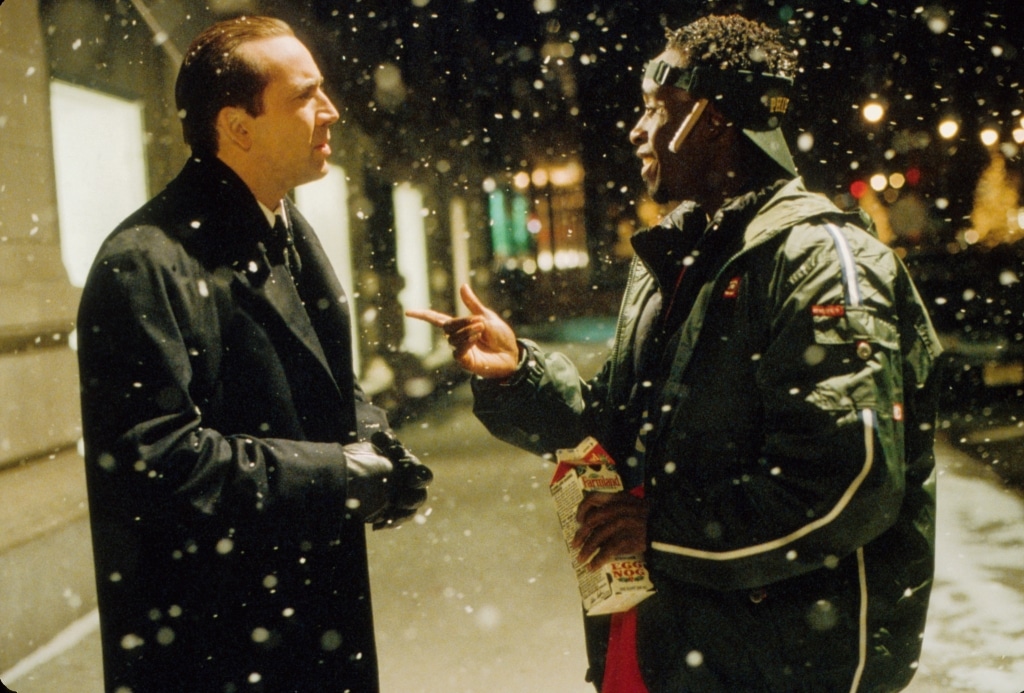
I usually try to come up with some sort of a clever preamble for these reviews, but Family Man kind of broke me, so you get what you get. And what you get is a deeply disturbed Kelly. Because boy, oh boy, this movie is bonkers in a way that it wants me to believe is sweet, but instead, it seems wildly misguided and even upsetting.
Let’s get right into the basic setup. The movie opens with Nic Cage and Tea Leoni in an airport, just a couple of 40-year-old young lovers. This is not any snark at the age of 40—I myself am staring it down. The movie wants us to believe that these two actors, who look great but look their age, are college-aged. This should probably have been the first indicator that I was in for it.
Anyway.
Nic is about to get on a plane to fly to London for an internship, and Tea decides she doesn’t want him to and gives an impassioned speech about their future—one cannot help but think it’s a speech that should have come BEFORE he is supposed to board a plane. The movie wants me to side with her, but all I can think is that plane tickets are expensive, and he would have had to have arranged housing and a wide range of moving parts if he was leaving for London in five damn minutes.
I am always on the side of love, but asking him to stay at that moment is absurd and ill-conceived. Make it a week before! To be clear, this sets up a fundamental disagreement between the movie and me—that Tea Leoni’s character is in the right.
Flash forward 13 years, and Nic is a filthy rich muckety muck who—to be clear—seems to really dig his life. He’s not Scrooge. He’s not unhappy. He’s living it up. But after he prevents a robbery (I guess? More on the odd internal logic of that later) by Don Cheadle, in a role that felt pretty racist until it turns into… something(?) else completely, he is rewarded with a “glimpse” of what life could have been. He wakes up in the suburbs, married to Tea, and wackiness ensues.
Alright. So let’s get into some of the really weird shit in this narrative morass.
For starters, alternate-universe Tea is supposed to believe that she has been married or with, in some capacity, this man for 13 years, at least. Yet when his behavior becomes erratic and out of character, she doesn’t suggest he see a doctor, nor does she particularly interrogate it. She just gets annoyed.
The movie would have us believe that this manic pixie dream wife is charming, with her loud singing of “Beast of Burden”—complete with wacky, over-the-top dance moves—in the shower, and her low-paying non-profit lawyer job, but I found her deeply tedious. I was unclear why he was supposed to be so in love with her.
Then there’s the child. Alternate-universe Nic Cage has two children, the older of whom recognizes that THIS Nic Cage isn’t her father. This weirdly suggests that somewhere, there’s a very confused suburban dad version of Nic Cage out of space and out of time. This is a needless detail that is exceptionally confusing.
And now for Don Cheadle. He is, I guess, sort of the Clarence/Ghost of Christmas Could Have Been in this story. This then raises the question of whether he was sent to stage a bodega robbery as a test to Nic Cage. For what reason? By who? And to what end? Apparently, Cage is “rewarded”—Don tells us the glimpse is a sort of gift—but it seems like a pretty shitty reward.
Stay on this alternate timeline until you like it enough to want to remain, and then we’ll whisk you away from it. What?! And also, why?
Anyway, this movie sucks.
The Cage Factor:
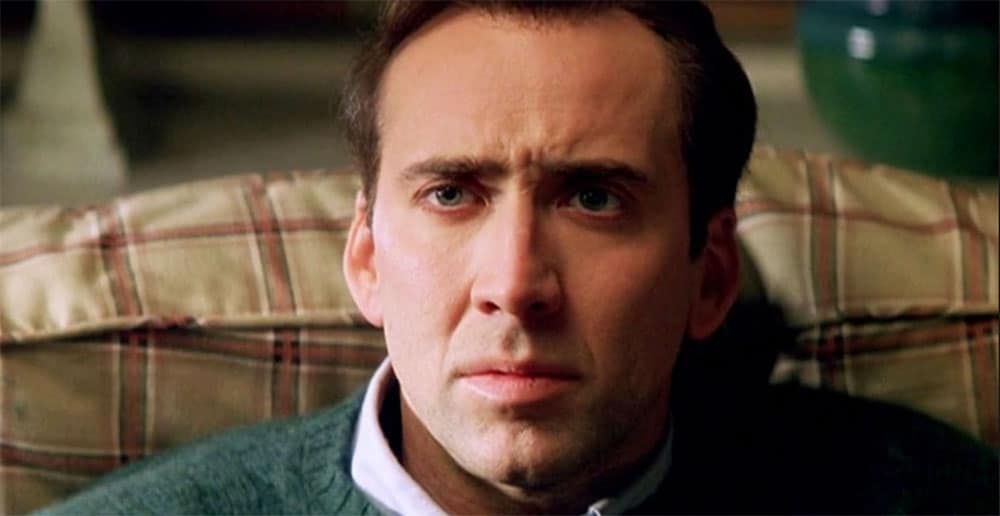
Eh, let’s give it the ol’ Cautious Cage. I didn’t care for it, but I bet there are lots of people who do, and they’re no more wrong than I am right. And Cage is doing fine enough work in it. He’s putting in the effort. The failings of the movie don’t fall at his feet in any way, shape, or form.
AND IN THIS CORNER: STEPHANIE MALONE
The Lowdown

I’m beginning this review with a hearty chuckle—provided, not courtesy of The Family Man but rather courtesy of my Cage Match co-fighter Kelly.
Her scathing review of this feel-good holiday flick made me laugh out loud. She REALLY hated it, and I expected a different response from someone with so much holiday spirit and genuine joie de vie. She gives a pretty great summary of the film from a plot perspective, so I’m going to skip all that and dive right into how well this film works (or definitely doesn’t if you’re Kelly) as a typical “the true meaning of life” Christmas schmaltz-fest.
The Family Man (2000) is a holiday film that wears its heart on its snow-dusted sleeve, delivering a blend of charming sentimentality and light comedy that follows a classic “what-if” narrative. Like every film heavily inspired by the two titans of holiday heartstrings cinema—It’s a Wonderful Life and A Christmas Carol—it’s got one singular job to do: make you a bit weepy and remind you to try, even for a short period, to focus on gooey tenderness and gratitude for a life that may look a lot less shiny any other time of the year.
I’d argue that The Family Man does, in fact, succeed as a heartwarming tale that explores universal themes of love, family, and the road not taken.
Cage balances Jack’s initial arrogance with vulnerability as he adapts to his new reality. 90s Hollywood “it girl” Téa Leoni is the film’s emotional anchor, radiating warmth and making it easy to root for her character. Cage and Leoni share a natural chemistry that sells the emotional stakes of Jack’s journey.
(Ironically, Leoni, whose career was on fire when she made this film, gave up her own glitzy life for a chance at domestic bliss, pulling back from acting a good deal to raise her two kids with then-husband David Duchovny.)
The holiday atmosphere, bolstered by snowy suburban settings and festive cheer, makes this an ideal Christmas movie… if you’re into that sort of thing.
It borrows liberally from the holiday classics with a modern spin, portraying the conflict between material success and personal fulfillment in a relatable way. However, it does teeter on the edge of sentimentality, so you need to be prepared for that. Its plot feels familiar and predictable, failing to delve deeper into its intriguing premise. Underdeveloped subplots, unanswered questions, and a questionable ending prevent the story from reaching its full emotional potential.
It’s not going to change your life, but it is a cozy, feel-good holiday movie that succeeds in tugging at the heartstrings, even if it lacks a ton of depth or originality. Ultimately, it’s a cinematic cup of hot cocoa—comforting and just sweet enough to satisfy, even if it’s not that memorable.
Of course, if you need a reason to avoid this film other than Kelly’s condemnation, it was directed by Hollywood pariah Brett Ratner, so you couldn’t be blamed for getting your seasonal schmaltz elsewhere.
The Cage Factor:
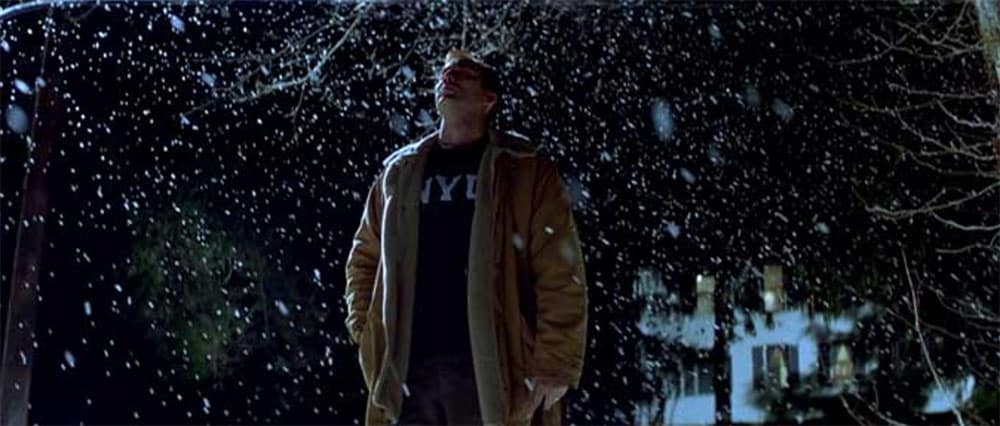
Nicolas Cage’s performance in The Family Man stands out as one of his more restrained and heartfelt turns as a romantic lead. He begins the film embodying the archetype of a brash, self-absorbed businessman but gradually softens into a character grappling with vulnerability, love, and the pull of domestic life. Cage’s ability to bring genuine emotion to Jack’s evolution lends depth to a film that might otherwise have leaned too heavily on its predictable narrative.
Unlike his intense romantic drama roles in Moonstruck or City of Angels, here Cage delivers an understated charm that suits the film’s family-friendly tone. He grounds Jack’s journey without succumbing to overt sentimentality, ensuring the character feels relatable rather than saccharine. He’s especially dreamy and delivers a warm, measured performance Cage fans should enjoy.










Follow Us!