


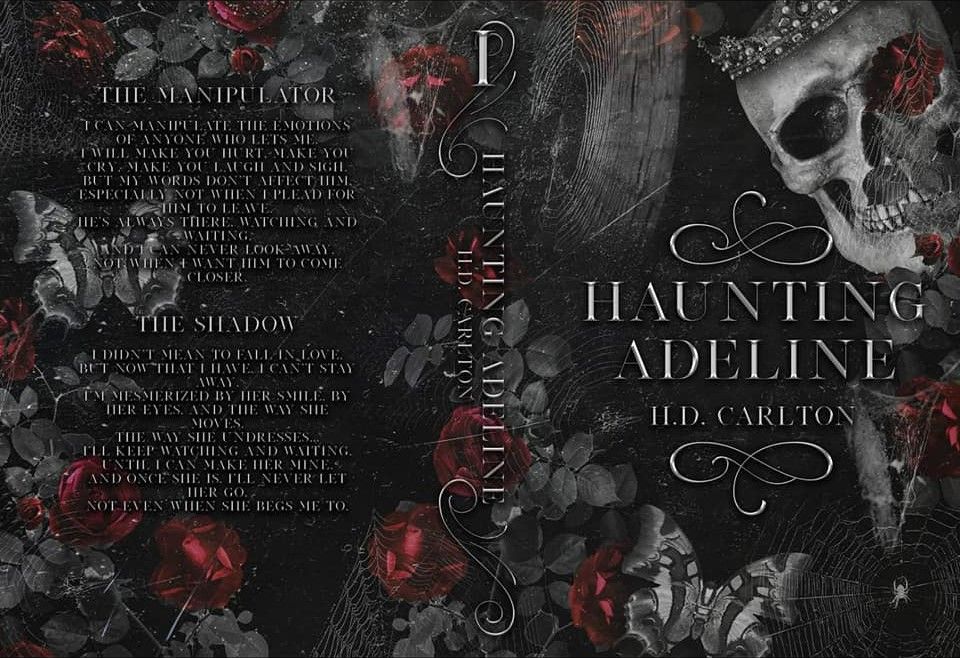
Do dark romance books like the controversial “Haunting Adeline” romanticize violence against women and dangerous, controlling relationships?
No time to read? Click the button below to listen to this post.
Warning: This article will primarily discuss the book Haunting Adeline. Along with spoilers, there will be a discussion of sexual assault featured in this critical analysis. Reader discretion is advised.
Over summer break in 2023, I decided to take the plunge and read books in the “Dark Romance” genre. I began with the most talked-about book in the genre (at the time): Haunting Adeline.
The other day, I was scrolling on Instagram when I saw a post from H.D. Carlton, author of Haunting Adeline. The post showed that her infamous book was on the New York Times Best Sellers List at number 9. Now, of course, I think it is incredible to see H.D. Carlton rise to the fame she has. She started as a self-published author and is now a New York Times best-selling author. That is truly remarkable.
What concerned me was the book’s content and how it handles its “romance” elements.
When people think of the “Dark Romance” genre, this is more likely than not the first book that comes to mind (outside of the thematically similar Fifty Shades of Grey). It has become somewhat of the mascot for the subgenre, for better or worse. I would argue that the book’s popularity is somewhat concerning.
I think of women who may read this book and believe that sexual assault is okay. Worse, the message even seems to be that, given some time, you can even learn to love it. I worry about the young, impressionable girls who read this book. Yes, I know it’s an 18+ book, but we all know that doesn’t stop minors from reading it.
When I first read the title, I thought it would be about ghosts, but I was disappointed to find out that wasn’t the case. I went on to read Hunting Adeline, hoping that this second book would fix some of the issues I saw in the character Zade and perhaps give him a redemption arc. But nope, the second book is even more graphic.
If you’ve never read the book, let me give you a rundown.

Haunting Adeline is about an author named Adeline who inherits her late grandmother’s house. She attracts the attention of Zade, who uses unusual and unethical methods to get her attention. He stalks her, breaks into her home, and assaults her. Finally, she gives in to his advances and develops feelings for him. The assault starts fairly early on, from what I remember. He breaks into her house and assaults her with a loaded gun.
It is a horrifying scene that many people had to DNF the book because of, and I don’t blame them.
What I found ironic was the fact that Zade saves women and children from predators and hates to see them sexually abused… yet he goes out of his way to do just that to Adeline. The math isn’t mathing, my friends.
I’ve seen the argument that this book features CNC (or consensual non-consent). But I wouldn’t even say it does. As I mentioned before, he quite literally breaks into her house and assaults her on numerous occasions. There is no mention of her consenting to CNC or anything of the sort.
This book has a lot of sex scenes (both consensual and non-consensual… but primarily non-consensual). But as far as romance goes? Really, in my opinion, there isn’t much of it.
In the second book, these two profess their love for each other. However, as a reader, I wasn’t buying it. In my interpretation, Zade enjoyed having control over Adeline, and Adeline became a victim of Stockholm syndrome.
Now, before you make a reasonable assumption that maybe I’m just not the target audience for this book, let me clarify: I am a fan of Dark Romance books.

There are many books in this genre that I have read and loved. They feature all kinds of taboo things, including knife play, CBC (which is actually consented to), slashers, and even monsters. They are often full of dark elements and questionable things that could cross the line for many. I don’t have a problem with that. In fact, as long as there is mutual CONSENT between the main characters, I’m game for all sorts of twisted adventures.
It’s the lack of that consent and the troubling nature of the underlying message in Haunting Adeline that gives me pause.
Editor’s Notes:If you’re familiar with Fifty Shades of Grey by E.L. James, Carlton’s Haunting Adeline is similar in its exploration of dark, unconventional romance and elements of control and obsession within relationships. However, they differ significantly in tone, plot, and the intensity of the dark themes they explore. Both books fall under the dark romance genre, where relationships involve strong elements of control, obsession, and possessive behavior.
In Fifty Shades of Grey, Christian Grey exhibits controlling tendencies through BDSM, while in Haunting Adeline, Zade is a stalker who controls and manipulates the heroine. Both Christian Grey and Zade are portrayed as dominant, emotionally complex, and possessive characters. Their intense fixation on the female protagonists blurs the line between romantic and abusive behavior. While both novels explore taboo elements within romantic relationships, Haunting Adeline delves into much darker themes, including stalking, manipulation, and violence.
The most important difference is the issue of consent. In Fifty Shades of Grey, though the BDSM relationship is controversial, consent is emphasized (though it is not always depicted well, leading to criticism). Anastasia enters the BDSM arrangement with knowledge and some degree of autonomy. Haunting Adeline, however, challenges the concept of consent more aggressively, as Zade’s stalking and manipulation of Adeline occur without her initial consent, adding layers of non-consensual behavior and blurring the boundaries of the romantic dynamic even more severely.
End Editor’s NotesGiven the sobering statistics related to domestic abuse, this potentially harmful messaging causes me great concern.

Approximately 1 in 4 women and 1 in 10 men in the U.S. have experienced some form of intimate partner violence (IPV) during their lifetime. According to the National Coalition Against Domestic Violence (NCADV), there are over 10 million abuse victims annually in the U.S. 81% of women who experience intimate partner violence report significant impacts like injury, the need for medical care, or legal action.
Domestic abuse is vastly underreported due to fear, stigma, or lack of support. The Bureau of Justice Statistics (BJS) estimates that nearly 50% of domestic violence incidents go unreported. The National Crime Victimization Survey (NCVS) suggests that around 58% of intimate partner violence against women and 41% against men are not reported to police.
There is growing concern and some evidence suggesting that the portrayal of romanticized abuse in media, including dark romance stories, can contribute to increased tolerance for domestic abuse and reinforce social stigma surrounding victims.
End Editor’s NotesIf you read the story and were a fan, that is great. I am also not putting down the author. She worked hard to write these stories; her talent is not on trial here.
It’s also a fair critique to say that not every book has to be for everyone, and I, like every other reader, have the choice to simply not read the material I find questionable or objectionable. Ordinarily, I’d agree and stress that one critic’s opinion of a book (or film) should not be interpreted as a broad condemnation of the material. These are opinions, after all.
My point in writing this article, however, is not to argue why readers may not enjoy the book but rather to open a dialogue about the impact of the material on those who do read it.
I have even seen posts of other readers who refuse to read Dark Romance, claiming that it “romanticizes abuse.” While I wish I could disagree with them, I must confess that some books, including Haunting Adeline, do just that.
I’m not saying that every person who reads this book is going to take away the message that non-consensual sexual assault is a good thing.
But I do worry that some of the themes in this book, particularly, promote dangerous elements in relationships, which the reading community should be aware of.









Follow Us!