

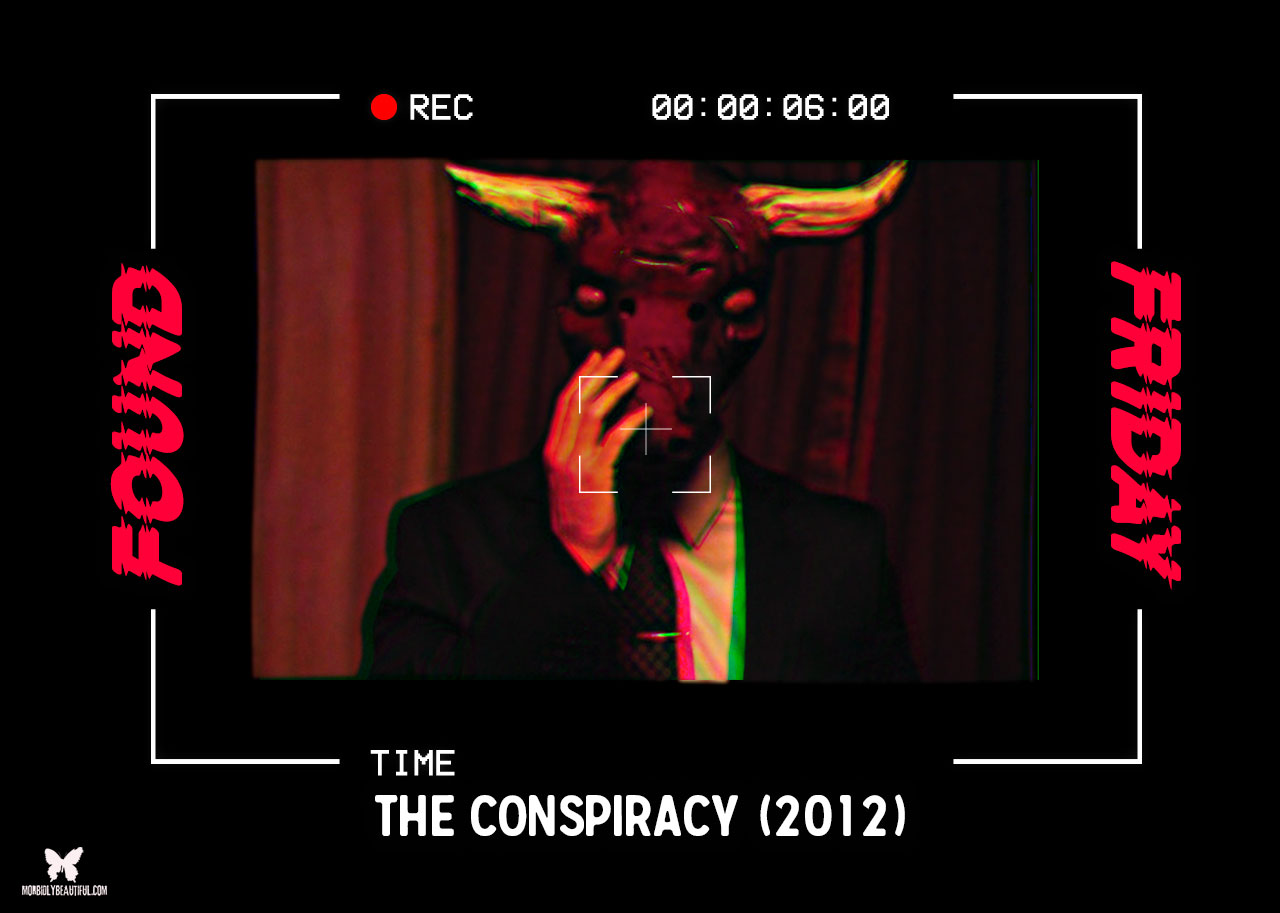
“The Conspiracy” is a captivating faux-documentary that blurs the lines between fact and fiction, leaving you questioning everything.

“We’re conditioned to ignore what’s right in front of our eyes—that we’re really just slaves.” – THE CONSPIRACY
No time to read? Click the button below to listen to this post.

What if the raving conspiracy theorist on the street corner wasn’t delusional? What if he were simply better informed and more attuned to the world than most of us? And what if his “crazy” rants were actually dire warnings?
That’s the clever premise behind Director Christopher MacBride’s 2012 mockumentary-styled thriller The Conspiracy, and it’s an essential hidden gem in the found-footage canon—especially for anyone with even a passing curiosity in conspiracy culture.
If you’ve ever gone down a Reddit rabbit hole about the Illuminati, skimmed a Bohemian Grove exposé, or side-eyed a political headline and thought “this feels off,” this movie is for you.

However, while the film works as a compelling found-footage thriller, its real power lies in its exploration of the paranoid mindset itself. It doesn’t necessarily aim to convince you to believe in every conspiracy theory, but rather to evoke empathy for the intense fear and exhilaration that accompany deep-seated paranoia.
It begins with an intriguing yet grounded premise: two filmmakers, Aaron and Jim (played by Aaron Poole and James Gilbert), embark on a project to document conspiracy theorists. Their main subject, a street preacher named Terrance G. (Alan C. Peterson), appears to be a typical “sheeple”-shouting doomsayer. When he mysteriously vanishes, it triggers a deep dive into his research.
That research includes mapping out a network of real-world power players, historical events, and shadowy institutions that begin to feel uncomfortably plausible. At the heart of it all: the Tarsus Club, a fictional (but all-too-familiar) stand-in for elite groups like the Bilderberg Group and Bohemian Grove.
What The Conspiracy does so well is blur the line between fiction and reality.

MacBride incorporates real speeches (including an eerie excerpt from JFK), actual conspiracy theories, and historical context into the narrative. This isn’t a wink-wink satire or a paranormal hoax. It’s a fictional documentary that feels authentic, to the point where you may find yourself Googling elements mid-watch, only to discover some are unsettlingly true.
This grounding in reality adds a creeping, psychological horror. It’s not about monsters under the bed; it’s about the monster behind the curtain. And the horror isn’t in what the filmmakers uncover. It’s in how easy it is to believe them.
Aaron, in particular, becomes consumed by Terrance’s research, echoing the path of countless real-world truthers who begin as curious skeptics and become radicalized investigators.
The film deftly explores this transformation and the intoxicating thrill of connecting the dots, as well as the isolation that follows and the deep paranoia that seeps in when you can no longer take reality at face value.
As Terrance ominously warns: “It’s easy to become like me… but you don’t want to.”
By the time Aaron and Jim infiltrate a Tarsus Club gathering using hidden cameras, the movie shifts gears from investigative curiosity to full-blown dread.

The infiltration sequence is brilliantly executed. It’s tense, immersive, and richly atmospheric. The cult-like ritual, the masked participants, and the lavish setting all feel bizarrely ceremonial. The climax is a heart-pounding descent into elite horror, and the final moments will leave you rattled.
Found footage can often feel cheap or gimmicky, but The Conspiracy is deliberate and effective.
MacBride knows how to stretch a low budget for maximum psychological impact. The shaky cam isn’t overused; instead, we get clever visual storytelling through YouTube clips, digital archives, wearable cams, and documentary-style interviews. This creates a believable, media-savvy ecosystem where truth and illusion blur.
And that’s the real point: THE CONSPIRACY isn’t just about shadowy societies. It’s about the danger of believing too much… and the danger of believing nothing.

While many conspiracy theories are baseless, history has shown us instances where seemingly outlandish claims (MKUltra, the Tuskegee Syphilis Experiment, Operation Paperclip, or COINTELPRO) turned out to be horrifying realities. This film plays on that unsettling dichotomy, forcing us to confront how easily our understanding of the world can be manipulated and how power can corrupt.
In an age where misinformation and media manipulation run rampant, the film asks: What if the next “crazy” theory is real? And what if it’s already too late?
It also doesn’t preach. The film smartly presents two terrifying outcomes: either these sinister forces truly exist… or they don’t, and the paranoia itself is the monster. It’s left ambiguous, but the ambiguity is the horror.
If you’re looking for gore or ghosts, this might not be your found-footage fix. But if you’re drawn to the creeping dread of realism, this one hits like a gut punch.
Overall Rating (Out of 5 Butterflies): 3.5


Follow Us!