

“Resurrected” melds theology with screenlife horror, exploring the chilling consequences of a world where death is no longer final.
No time to read? Click the button below to listen to this post.
Resurrection has always been a tricky thing in Catholicism. Sure, Christ died for our sins, but he got brought back to life a few days later, right? So, was the whole self-sacrifice thing really that big a deal? When death, the ultimate, irreversible consequence, is off the table, what does that mean for life as we know it? These are all big questions that theologians and faith leaders have pondered for centuries, and this movie reviewer certainly doesn’t claim to have any ideas.
It might sound a bit too high-minded to be the basis for a horror movie, but it’s just what director Egor Baranov attempted in his little-seen 2023 film Resurrected.
Resurrected could be described as a “screenlife” movie, that modern found-footage subgenre that places the action entirely within computer screens, as seen in the likes of 2018’s Searching or 2023’s sort-of sequel Missing.
Baranov plays a bit fast and loose with the rules of the subgenre, such as they are, switching between computers and employing some cinematic trickery to speed up time at points, which might irk the purists (if there are any such people for such a new type of film), but I thought worked pretty well.
We mostly find ourselves within the computer of Stanley Martin (the wonderfully named Dave Davis), a former salesman and devout Catholic whose happy home life was destroyed when his young son Nicholas (Beau Boyd) was killed in a car accident that may or may not have been worsened by Stan having a couple of drinks before driving. That’s certainly the belief of his wife, Audrey (Karli Hall), who blames him for the accident and cuts ties with him.
But all is not lost for the Martins. Shortly after Nicholas’s death, Audrey is approached by their priest, Father Hill (Ezra Buzzington), with an irresistible offer: they’ve figured out how to bring the dead back to life, and they want Nicholas to be the first. Miraculously, the mysterious procedure works and the world will never be the same.
One breathless exposition montage later, we’re in a world transformed by the resurrection process, with millions given a second chance at life by the Church.
That is, as long as their pasts are deemed suitably sinless by the Cherubim, hackers deployed by the Church to dig around for skeletons in our digital closets.
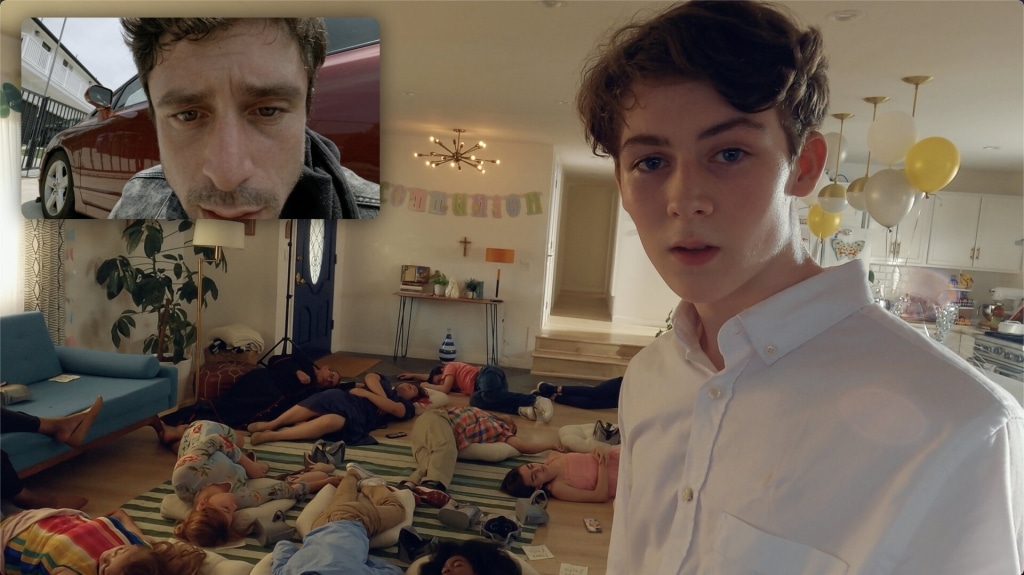
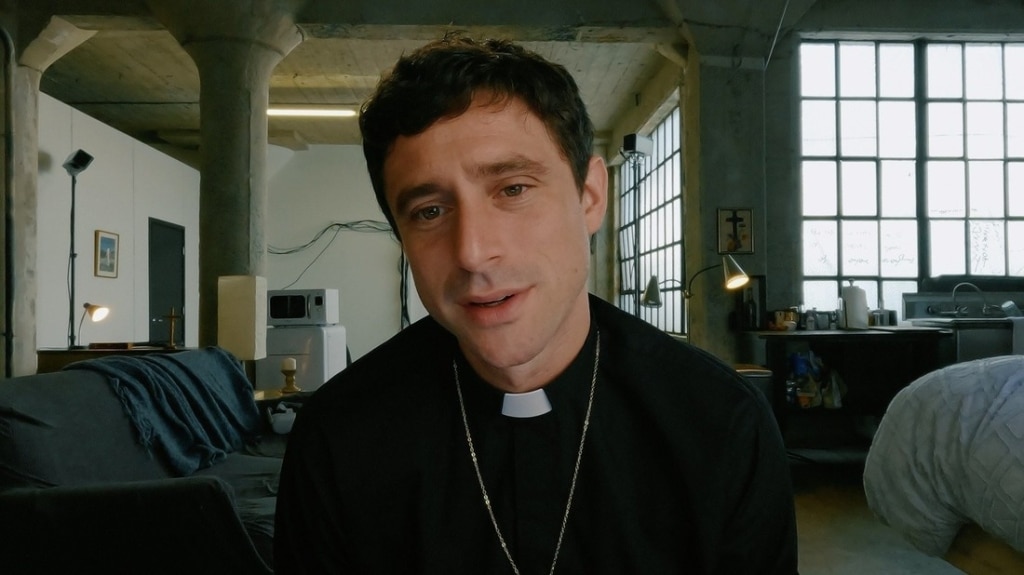
Nicholas is something of a teenage celebrity (played by Julian Moser as an older kid), and Stan has become a priest, leading the newly converted faithful in one of the many VR churches created to handle the massive influx of believers.
It’s a bit of a lonely existence, but an okay one, until one Resurrected Person (RP for short) under Stan’s care brutally murders his coworkers seemingly for no reason.
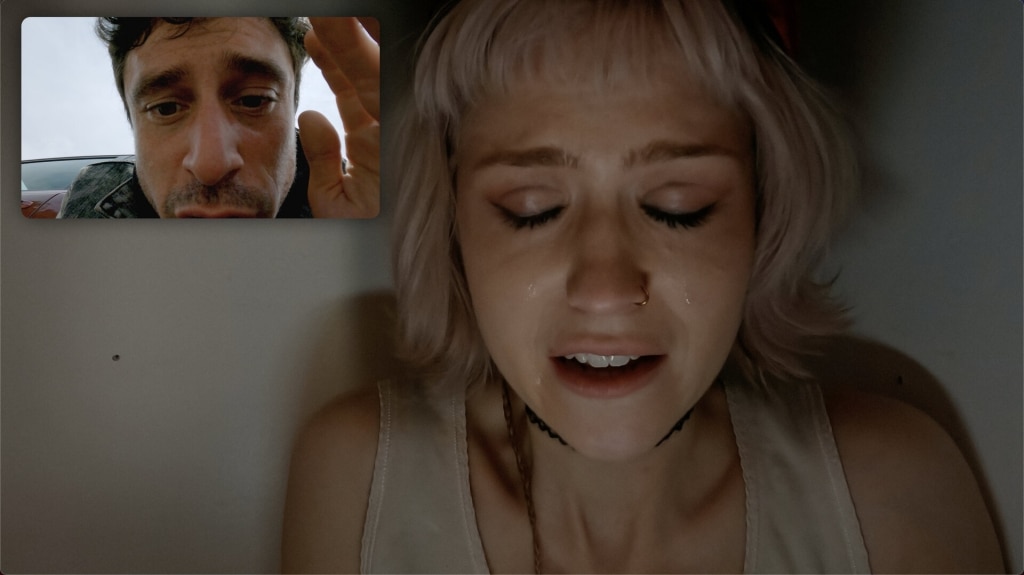
While the Church is quick to label him as a “bad apple” and move on, Stan uncovers a slew of RP-connected murders, swept under the rug and out of the press. Convinced there’s a conspiracy afoot, he tries to uncover the truth, aided by a Cherub named Rat (Erika Chase), and they quickly uncover something much more sinister than they imagined.
Resurrected plays around with many fascinating ideas across its central “what if” scenario, from RPs’ struggles to return to life after death to a growing pro-death backlash to how our digital footprint can either absolve or condemn us.
It’s a movie stuffed with thorny material that it doesn’t have the time to fully explore within its condensed narrative, but it at least has more on its mind than the average found-footage thriller.
Unfortunately, despite its surfeit of ideas, Resurrected isn’t the most skillfully made movie, particularly on a storytelling level.
It works well enough on a technical level; Baranov has a good handle on the pacing and moves us along breezily, but the script has a habit of underlining the subtext and telling us things it would be better off showing.
This is always tricky in found footage, which attempts to pull off a higher level of verisimilitude than a more traditional scripted film. Still, it ultimately makes the artifice that much more apparent when it’s not done well. The actors do what they can to sell it, but they can only do so much.
A late-film revelation about the true motive behind the murders is chilling in its implications but isn’t given enough room to be fully explored, feeling more like a half-baked analogy for the far-right extremist violence that’s been on the rise in recent years.
Really, it all works better if you just don’t take it too seriously.
It’s probably best thought of as a sort of technofied take on the religious paranoia thrillers of old, fun but hokey stuff like God Told Me To or End of Days rather than a more serious treatise on religion and technology.
In that sense, it’s a pretty fun watch — well-paced with interesting ideas that carry it through where its technique lags behind.
Overall Rating (Out of 5 Butterflies): 3





Follow Us!