


“The Substance” is a visceral, body-horror meditation on society’s relationship with youth and beauty and the pressures faced by aging women.

No time to read? Click the button below to listen to this post.
EDITOR'S NOTE
The following article contains an in-depth analysis of the film The Substance. As a result, you are strongly encouraged to watch the film, which is currently available to stream on Mubi (free with a 30-day trial), before reading this analysis to avoid any significant plot spoilers.
The true horror in The Substance (2024) is not aging but the way women in male-dominated societies are made to feel about their aging bodies.
Women are viewed as if they lose value past a certain age while men sink into decrepit states, yet are told they’re still amazing and powerful while the men themselves look horrific. Elisabeth has this amazing, rich life but, at the same time, nothing for herself—the success seems to validate her insecurities, but what makes her truly happy? She is a very beautiful woman and worthy in her skin; even if she isn’t beautiful, Elisabeth deserves to live and be happy.
Summary

Elisabeth Sparkle (Demi Moore), a fitness guru, is being forcibly pushed out of the show she’s cultivated for decades because she has turned fifty. When she gets into a car accident, she’s approached by a strange man about being young again through a mysterious company with a compound called the Substance. After a series of events that end in self-hatred, she takes it, and from her slit-open spine comes a young, lithe version of Elisabeth, who calls herself Sue (Margaret Qualley); they are one, but they need to trade off each week.
While one is lying on the floor feeding from a tube, the other version gets to live in the world, and then they switch. Sue has to take a compound made by Elisabeth’s spine, or she falls apart. Soon, it’s clear Sue is greedy about the time she’s spending in the world and her newfound fame as a fitness show performer and eventually abuses the trade-off deal, leaving Elisabeth to age rapidly in a coma while Sue lives.
Note: Click the button below only if you don’t mind significant plot spoilers, including knowing exactly how the film ends.
To Be Young Again

Given the chance, many people would take the Substance, especially billionaires trying to escape the effects of Father Time who are already trying to find a way not to age. Though this is not possible yet, The Substance dreams of the consequences: the breakage of the self and one’s shadow side deciding to take over, leaving the original body for dead.
The way this movie is shot, nothing is wasted. Every single shot is meticulous in its messaging.
When the door jams as Elisabeth waits to get into the warehouse where the Substance is housed, it’s obvious that she has to be willing to get on her hands and knees to be young again because this is exactly what happens.
The Substance is also a comment on celebrity culture in general and the desire to stay relevant and reach a new generation of admirers—there must be a lot of pressure to be famous, to be photographed when you’re just going around the corner to get groceries, and then have magazines pick apart your every flaw or comment on your body.
The culture I grew up with surrounding celebrities has changed significantly, but not enough. People still treat celebrities like they aren’t human beings but pieces of meat or playthings to pick apart, and when celebrities push back, people exclaim that this abuse is the price of fame.
A Mother’s Jealousy

The spine-splitting birth scene of Sue is very visceral; it’s as if Elisabeth’s spine is literally being ripped out.
Sue is like a daughter to her but born fully formed. Sue views her “mother” like a disgusting shell she’s grown out of, but there’s very much a mother’s jealousy at play: Sue is younger, still has her life ahead of her, no mistakes, and gravity hasn’t even begun to notice her. Then Elisabeth wakes up to her spinal injury in horrible pain.
It feels like a comment on motherhood, which, to me personally, sounds terrifying.
You push an entire human being out of your body, possibly ruining one’s body for good, only to watch them be ungrateful. Motherhood here is having to clean up a young you’s mess and grow older while she grows younger, withering the original husk. I’m sure motherhood is rewarding past the body horror, but in The Substance, it’s far from that.
As older people will attest, the young are selfish: Elisabeth hates Sue and vice versa, but neither can live without the other, metaphorically and in reality.

Sue needs Elisabeth’s body to produce a spinal compound for her to live, essentially demanding she “Giving Tree” herself out of existence. In contrast, Elisabeth needs the adoration of Sue’s youth to feel validation. It’s difficult not to see this relationship between Elisabeth and Sue as also being parasitic in nature. They are one, yet Elisabeth is on the ground, half-dead, while Sue takes from her to keep herself alive.
It feels disrespectful to leave each other on the bathroom floor and other floors in the apartment. Why not tuck each other into bed while the other is (essentially) dead for a week? This is likely to note the imbalance that exists between them.
The shadow side, or the darker parts of a person’s psyche, is brought to life in Fargeat’s portrayal. This side of us lies deep in the subconscious: traumatized and often unexplored. If not dealt with, the shadow side of people becomes hungry and takes more than their fair share, usually through therapy or other forms of self-exploration.
Picking Apart Femininity

“I need you because I hate myself… you’re the only lovable part of me.”
This line is powerful and heartbreaking. As women, we often experience long periods of self-hatred as young people. The true horror is never growing out of it and never feeling acceptance within oneself or feeling better in one’s skin. Everyone needs love, especially from themselves.
Nakedness is shown as a weakness in Elisabeth because she harshly criticizes her body in the mirror. However, nakedness is power in Sue, who is an advertisement for youth, beauty, and vitality without the wisdom of time.
I love Sue’s sparkly star earrings; she is a star, and she knows it. The pink spandex is revealing, but in a way that radiates sexual prowess, so femininity is displayed as a form of power since she gets off on what she does to men. They become ridiculous in her presence in their desire to possess her body for their own pleasure.
Though Sue currently has the power that Elisabeth once possessed, even she is not immune to the ravages of time.

Men will pick her apart, too, which we see in her nightmares about not being perfect, wherein the Substance begins to grow a tumor-like object under her skin from what Elisabeth is eating.
Sue, in her end scenes, looks like she’s at Cinderella’s prom in her blue fluffy dress and crown, coughing up her teeth and falling apart yet told to smile by a group of men. While men pick women apart (when they’re not good-looking themselves) from behind casting tables, women wait for their judgment, hoping that they’re good enough for hyper-critical eyes.
The shrimp-eating scene with Dennis Quaid is a commentary about how men devour women until there’s nothing left, then cast us aside when it no longer suits them as they’re fed. This kind of man changes his assistant’s name to benefit himself because he feels the world should bend to his whims.
Older women are derided and even verbally abused by pissed-off men like Oliver and Troy, while young, fuckable women are treated like princesses simply because they are desired. Pretty privilege is real, but so is young privilege; men do act like fools in front of women they want. They are also incredibly creepy when you give them a taste of what they want, which Sue does with her show.
At least in this movie, an unexplored facet of this type of fame is how some men get obsessed and try to hurt the object they desire.
Validation in a Patriarchal World

Throughout, I feel sorry for Elisabeth, who is looking for some validation in this world that values only youth and beauty, a product of pure patriarchy and internalized misogyny.
Sure, you benefit from it when you’re young, but what about when you inevitably age, and they toss you aside for someone younger? How could you hate yourself so much? How she looks at herself and finds fault breaks the audience’s collective hearts. Internalized misogyny leaves only broken mirror images and self-hatred for not being able to be the ideal forever.
Men also desire young women because they are often dumb and pliable for controlling men to mold into whatever they want—older women are confident and move with power and surety that only comes with time in the world. This is a physical horror story of what happens when you lose yourself or are at odds with yourself. It’s a vicious cycle, this validation: it is a fragile mirror that eventually breaks as the body begins to age and not give what it once did, shattering your previous male-validating ideas of self.
Sue has begun to understand the pressures of being perfect all the time, of the expectation placed on her young body; her nightmares exist of men judging her body, frame by frame, as she tries to keep a quickly decaying body vital.
Irreplaceable is something you’ll never be in show business.
What happens at the end is a warping of what you become when you live for the female gaze: a monster, a distortion of what you once were. Elisabeth’s inward feelings about herself, combined with Sue’s, make their shared self-hatred outward for all to see.
Conclusion
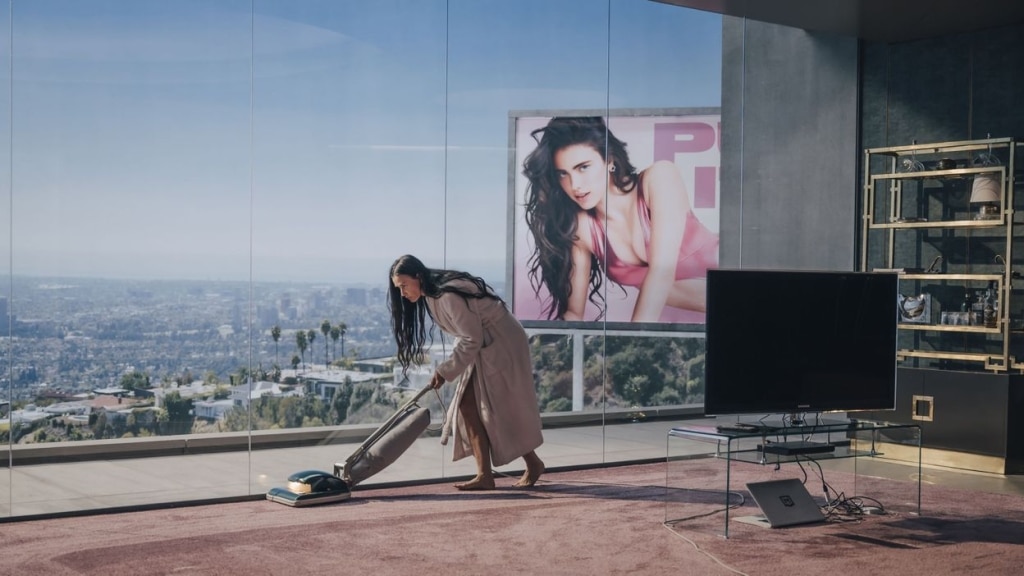
Aging in horror films is often about the body itself breaking down, becoming useless and decrepit as time marches on. Still, this movie is more about how we see ourselves as women and where we’re getting our validation.
Some women get it from their partners, some from motherhood, some from their careers or social media platforms, but what about the women who don’t want kids and prioritize their careers over finding love? Are they cast aside past age 50? Women should be taught to love themselves, but sadly, they aren’t even in 2024. We’re told from young ages to look to celebrities who are being paid to sell us things to “fix” ourselves.
This kind of messaging is damaging and horrible.
I hope movies like this masterpiece of womanhood and body horror keep being made to expose how stupid the patriarchal notion of beauty is and that we’re all beautiful and worthy in our skin without substances trying to correct aging; it is a natural process and not to be feared or abhorred. Love yourself.












Follow Us!