

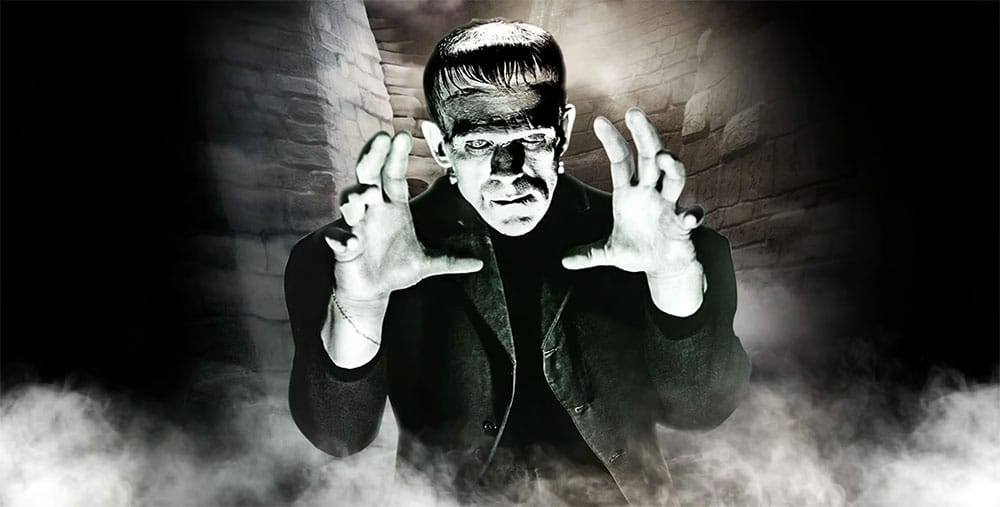
“Frankenstein” cemented itself as a cornerstone of horror cinema, shaping the genre’s visual language and cultural impact for generations.
No time to read? Click the button below to listen to this post.
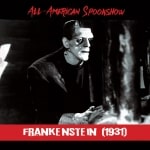
You don’t need to be a horror fan to know Mary Shelley’s timeless tale, Frankenstein. The image we conjure when thinking about the story is most closely associated with horror icon Boris Karloff’s portrayal in 1931’s Frankenstein. Following Count Dracula, Frankenstein’s monster became just as iconic as the Count.
Every year on Halloween, the image of Boris Karloff’s monster is ubiquitous, appearing everywhere on TV and in Halloween merchandise. As Count Dracula became “Count Chocula,” an animated Lugosi-style vampire character to sell chocolate-flavored breakfast cereal, Frankenstein’s monster was the face of the brand’s strawberry-flavored variant, Frankenberry.
The monster, who eventually became known simply as “Frankenstein,” took his place in the pantheon of horror history, along with the “mad scientist” Dr. Frankenstein and his assistant.
I don’t think I need to include a plot synopsis for the film, but here it is: Mad scientist Henry Frankenstein (Colin Clive) dares to try creating life himself. With the help of his assistant, Fritz (Dwight Frye), Frankenstein pieces together his creation (Boris Karloff) out of parts harvested from corpses. All seems well until he reacts violently towards Fritz when the monster sees the assistant with a torch. After Dr. Frankenstein and his friend, Dr. Waldman (Edward Van Sloan), discover that the creature killed Fritz, they decide the monster must be destroyed.
Frankenstein was both a critical and commercial success upon its 1931 release.

The film spawned a series of sequels and spin-offs. As of 1991, Frankenstein is preserved in the National Film Registry for its significant cultural impact. Universal Studios reportedly earned $708,871 by 1943, and the film’s re-releases raked in an estimated profit of $12 million as of 1953.
Like many other iconic films before or since, Frankenstein rode the usual production roller coaster.
We have Carl Laemmle Jr. to thank for the film’s existence. Carl Laemmle, Sr. established Universal Studios in 1915. Two years earlier, for his 21st birthday, he made his son head of the studio. The 23-year-old was the only executive at Universal interested in bringing Frankenstein to the big screen.
Laemmle Jr. wasn’t the first producer to adapt Mary Shelley’s immortal tale for the screen—it was the famous inventor Thomas Edison. Made in 1910, Edison’s adaptation is a 16-minute silent film lost for years. Recently, it’s been rediscovered and restored.
According to Film School Rejects, Frankenstein was under consideration to be made into a film before Dracula’s February 1931 release. John Balderston was hired to adapt 1920s stage adaptations of Dracula by Hamilton Deane and Peggy Webling’s Frankenstein for American audiences. Universal’s Dracula was based on Balderston’s adaption of Dean’s stage play.
For Frankenstein, Universal purchased the screen rights from Webling and Balderston for $20,000.

Some things were added, and others were cut from the film to prevent religious groups from being offended. Shelley’s original tale contains the controversial theme of a scientist assuming the role of creation. Needless to say, from a religious perspective, this is God’s power. This is why the film opens with a “warning.”
Lines of dialogue in which Dr. Frankenstein claims to know what it’s like to be God were cut from the film to comply with the Hays Code. This was done in every version of the film in time for its re-release in 1937.
Before James Whale, Robert Florey was hired to direct Frankenstein. Due to Whale having a successful film, Waterloo Bridge, the director was allowed to choose his next project. When Whale chose Frankenstein, Florey was out.
Coming off the previously successful Dracula, Bela Lugosi was originally wanted for the role of the monster. Universal officially announced that Lugosi would play the monster in April 1931, but Lugosi wasn’t interested in playing the part because there was no dialogue.
Universal conducted screen tests for Frankenstein, with Lugosi as the monster.

Other Dracula cast members played the other roles. Lugosi’s monster makeup resembled the titular character in The Golem. However, Laemmle Jr. wasn’t frightened and said he ‘laughed like a hyena” after seeing Lugosi in character.
Lugosi didn’t want to play a mindless, speechless brute, and reports are that he showed up to the test with an air of arrogance. Lugosi also objected to the role because the monster was a less sympathetic character in the original screenplay.
Lugosi eventually played the monster in 1943’s Frankenstein Meets the Wolfman. In the film, Lugosi does have dialogue as the monster. However, producers decided to cut the scenes. They felt that Lugosi’s Hungarian accent made the scenes “unintentionally funny.”
Even though he apparently didn’t like the character, Lugosi’s portrayal lent a characteristic that would become associated with it—the monster’s walk. In Frankenstein Meets the Wolfman, Lugosi walks with his arms stretched out in front of him because, in the original screenplay, the monster is supposed to be blind.
Frankenstein made Boris Karloff a horror icon.

However, before Frankenstein, Boris Karloff was an unknown actor.
After Whale was hired to direct, he insisted on casting Karloff. At the time, Karloff was working on another film for Universal. When Whale saw Karloff in the commissary, he asked him to play the role of the monster. However, studio executives were nervous about casting an unknown actor.
At the time, Karloff was under contract for another film at another studio. Fortunately, that film’s director, Rowland V. Lee, changed the schedule, allowing Karloff to shoot his scenes in time to work on Frankenstein.
Mental Floss reports that Karloff was so little known that he wasn’t even invited to Frankenstein’s premiere.
British actor Leslie Howard was the first choice for Dr. Frankenstein. The popular actor was under contract to MGM, which turned down Universal’s request for a “loan out.”
Besides Mae Clarke, Bette Davis was on the list for possible Elizabeths. Whale wanted Clarke since he previously worked with Clarke on Waterloo Bridge. Film School Rejects quotes Whale, “On Frankenstein, I asked for Mae Clarke for Elizabeth because of her intelligence, fervor, and sincere belief that Frankenstein would claim the public interest.”
Karloff met with makeup artist Jack Pierce every night before production began to work on the Monster’s look.
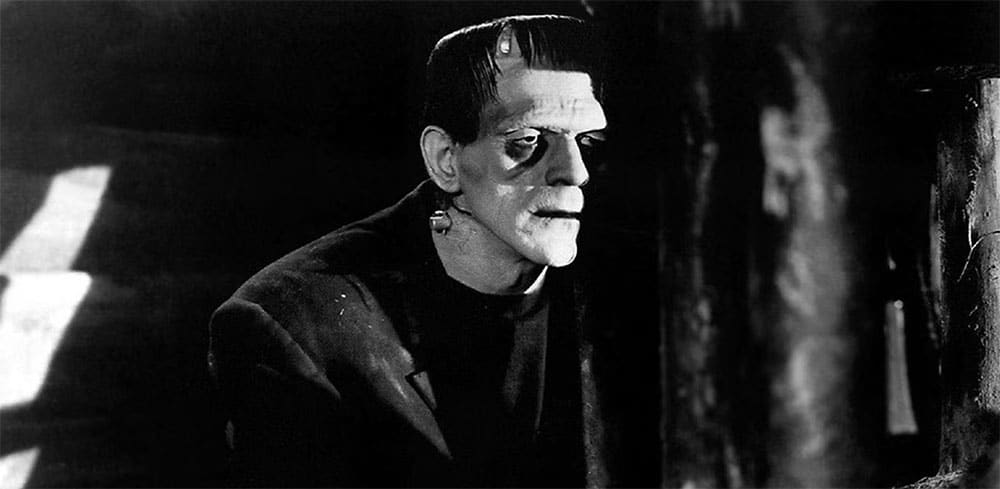
Pierce worked with blue-green makeup. To give the monster’s cheeks a sunk-in look, Karloff removed a bridge of molars from his right side, which Pierce then shaded in. Karloff also gave his input on the monster’s eyes, suggesting they look heavy, as if the creature isn’t fully aware of what is going on around him.
Electrician Kenneth Strickfaden created Dr. Frankenstein’s lab equipment. Strickfaden had a long career in the movie industry, creating electric pyrotechnics for movies from the 1930s to the 1970s. He stretched the parameters of his creativity and went beyond using various electrical parts, including spare auto parts. Strickfaden said, “The styling all depended on what kind of junk I had at hand.”
Frankenstein has intrigued horror fans since its publication in 1818. Over 200 years later, the misunderstood monster is just as much an icon as ever. Mary Shelley’s immortal tale has seen countless adaptations to both stage and screen. But it was Universal’s 1931 gothic masterpiece that cemented the image that would last for decades in the minds of horror fans and beyond.
It is more than just the image of Dr. Frankenstein’s creation that captivates audiences. Shelley’s intriguing story transcends horror and causes us to question the world around us.
Frankenstein, in all its incarnations, is thought-provoking and rich with timely themes that resonate just as strongly today, more than two hundred years later.
SOURCES
“24 Things We Learned From the ‘Frankenstein’ (1931) Commentary,” by Kate Erberland, October 24, 2012. Film School Rejects; “Boris Karloff Wasn’t Invited To The Premiere of ‘Frankenstein,’ And 21 Other Fascinating Facts About This Iconic Horror Film,” by Crystal Ro, May 17, 2022, Buzz Feed; Frankenstein. (2024, October 30). In Wikipedia. https://en.wikipedia.org/wiki/Frankenstein_(1931_film); John L. Balderston. (2024, July 15). In Wikipedia. https://en.wikipedia.org/wiki/John_L._Balderston.
Follow Us!