


If you don’t worship intellectual horror, “Heretic”—with its smart script and chilling lead performance, may just make a convert out of you.

No time to read? Click the button below to listen to this post.
Hugh Grant is an odd choice for a horror movie, isn’t he? Maybe this feeling is due to the fact that it’s hard to name an actor who has been more typecast. True, the lovelorn twenty-something yuppie in Four Weddings, the slightly bored thirty-something bookseller in Notting Hill, and the forty-something prime minister in Love Actually are all in different milieus and stages of their lives. Yet, if we’re honest, they are also basically the same.
Floppy-haired and apologetic: Mr. Whoops-a-daisy. Grant has been quite open in interviews about how he felt about repeatedly reprising those types – in short, he didn’t like it – and anyone watching him speak candidly will be struck by how little he resembles those characters.
Sarcastic and seemingly a little tired of the world and its massive dollops of dog shit, there is clearly potential for a villain behind that caricatured British charm.
It’s reductive to split things into two thematic halves (and there are exceptions to my argument here, such as Bridget Jones), but at that reductive level, there does seem to have been a point in Grant’s career where he made the shift from loveable if hapless hero to villain. One would hope that this isn’t just because he is getting older and, as an audience, we find old people super scary.
Nevertheless, it is true that since a fun antagonistic turn in 2017’s Paddington 2, directors seem to have recognized the actor’s potential for cinematic evil.
An equally enjoyable role as a dodgy geezer in Guy Ritchie’s The Gentlemen followed the mac-wearing bear sequel in 2019 before 2023’s Dungeons and Dragons again demonstrated Grant’s suitability for a villain that can turn deviousness into a kind of cinematic joy.
And so we come to 2024’s Heretic.
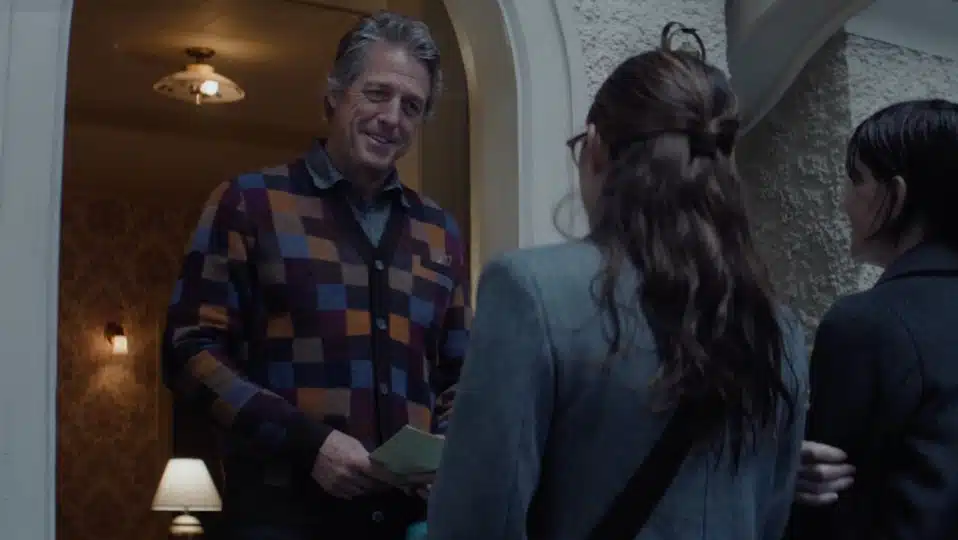
All three leads are well-written and acted, but there is little doubt that the film is built around Grant, and he does not disappoint in delivering his most chilling portrayal to date. His veneer of affability and its occasional cracks make the first half of the film some of the tensest sitting-around-and-talking-about-stuff since 2015’s The Invitation.
The movie begins with two Mormon missionaries, Sister Barnes (Sophie Thatcher) and Sister Paxton (Chloe East), completing their daily proselytizing rounds before arriving at the remote house of Mr. Reed (Grant), a potential convert who has some probing questions about religion.
When the two women realize that Reed wants more from them than a few leaflets on the Church and flattering tales of Joseph Smith, they attempt to escape a house that seems designed to keep them prisoners.
Much of the narrative is formed from this deadly game of cat and mouse.
While the gendered power imbalance between two young women and a sixty-something man does require a little suspension of disbelief, the politics of such power navigation and the rhetoric used to maintain it provide much of the film’s intrigue.
Unfortunately, the brilliant tension of the first half does not extend to the latter, which is more formulaic and, with its denouement, a little contrived. The movie’s initial promise of an intricate H.H. Holmes murder house is also never truly realized, aside from self-locking doors and creepy, wet basements.
While Heretic is never preachy, it does have quite a lot to say about faith.
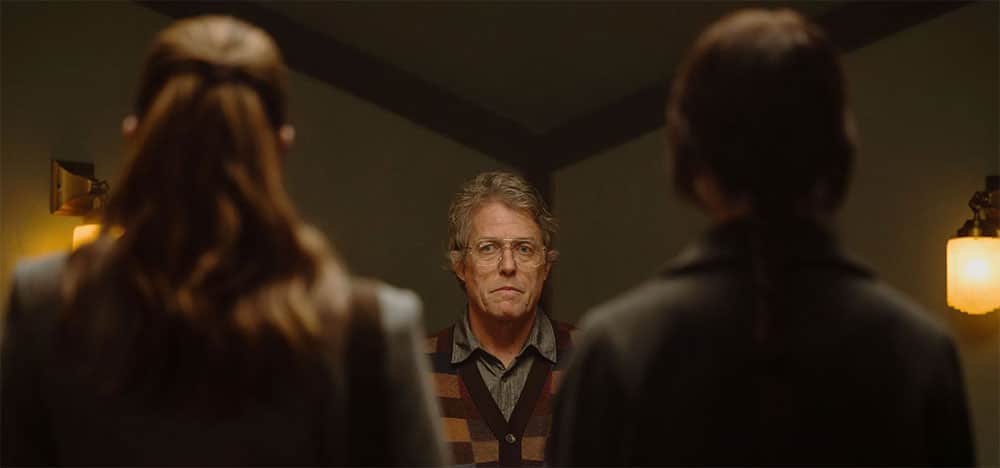
Joint leads Thatcher and East were both raised Mormon, and the portrayal of their missionary characters in the film is a balanced one that never stoops to parody—and, in fact, reactions from former missionaries suggest that their experience is entirely relatable, up to a non-murderous point.
Thatcher showed impressive emotional range in her stints as Natalie in Yellowjackets, and her performance here is just as layered, shifting from fear to defiance as she combats both her internal struggle with faith and the man determined to break her mentally and physically.
East is also very impressive in her – for horror fans, admittedly quite familiar – transformation from a meek and naïve victim to a desperate but hardened adversary. Horror, don’t you know, is all about personal growth.
Pushing this growth forward is Grant’s sense of menace.
He provides a fear-inducing threat that feeds on the natural charm of the actor’s earlier characters and subverts audience expectations. Just as Krusty chooses Sideshow Bob over Sideshow Mel because to be successfully ridiculed, you first need dignity (“Simpsons Already Did It”), so the charm of Grant’s earlier characters helps to provide a particularly jarring sense of horror when the audience is faced with what hides beneath it.
This contradiction is also smartly interwoven into the film itself, which asks how much religion is founded on the smiling face of compassion and how much on a simple will to control.
In scares and narrative composition, Heretic is a solid horror movie, but it is elevated by a philosophical core and a deliciously wicked turn by an actor once mainly famous for apologizing profusely on screen.
Overall Rating (Out of 5 Butterflies): 4








Follow Us!