
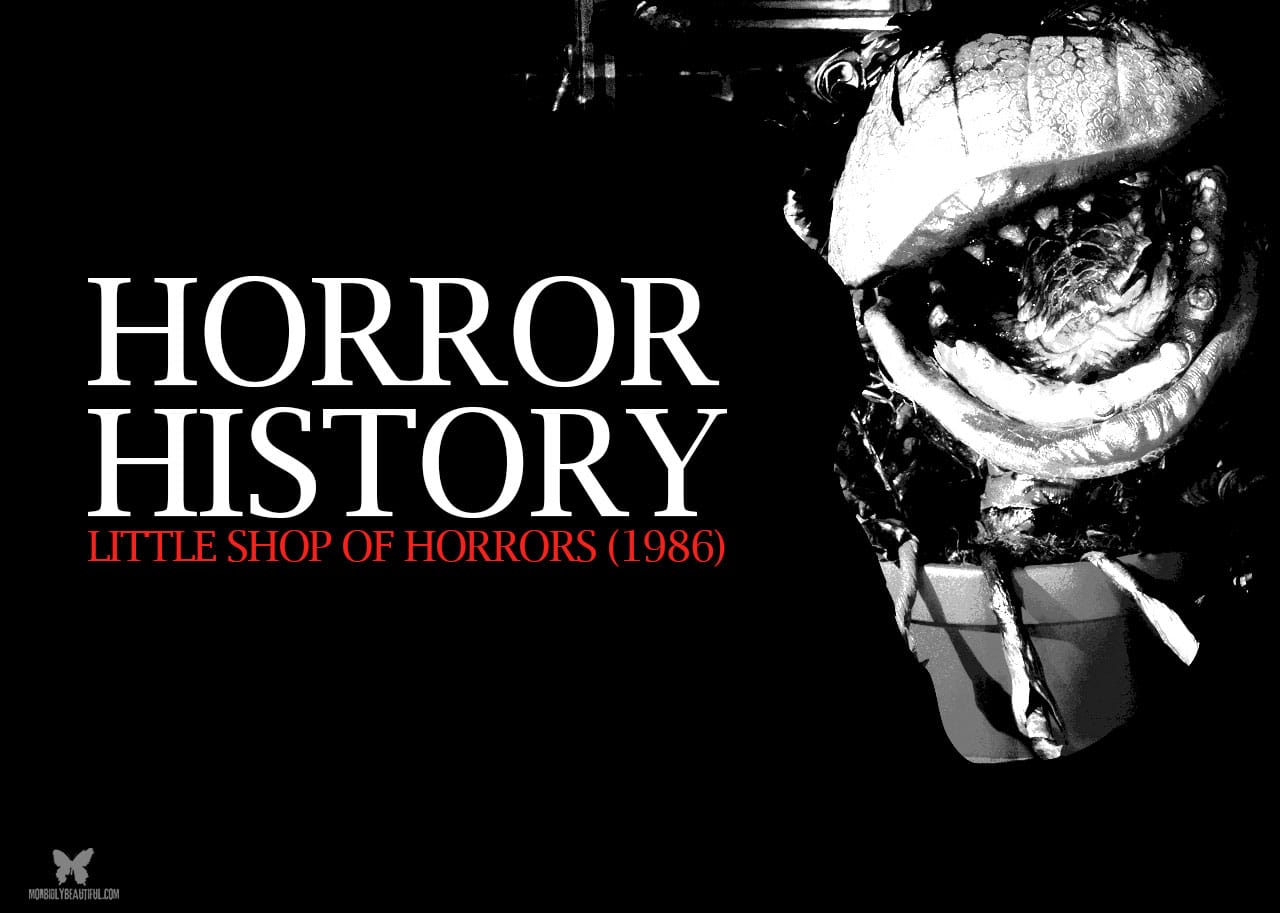
With its dark humor, catchy tunes, and groundbreaking effects, “Little Shop of Horrors” has charmed audiences for nearly four decades.
No time to read? Click the button below to listen to this post.
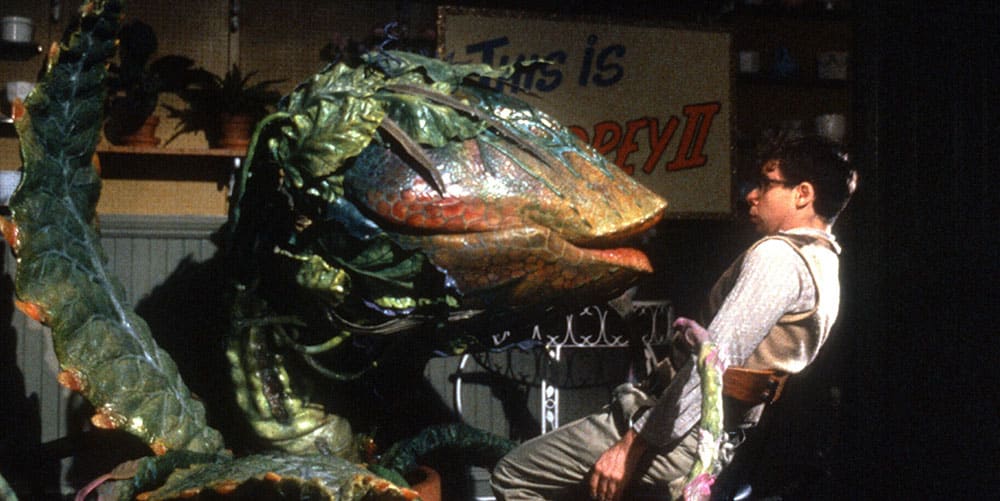
Seymour Krelborn (Rick Moranis) has no idea what he’s gotten into after purchasing a mysterious plant from a Chinese flower shop during a solar eclipse. Krelborn works at Mushnik’s flower shop with Audrey (Ellen Greene). As business wanes, Mr. Mushnik (Vincent Gardenia) considers closing the shop. Audrey suggests they display Seymour’s unique plant—which they name “Audrey II.”
As Audrey II attracts more customers, the plant begins to wither. Seymour soon discovers that conventional plant food will not do; Audrey II needs human blood to thrive!
Little Shop of Horrors, directed by Frank Oz, the film version of Alan Menken and Harold Ashman’s musical, was released on December 19, 1986. It was both a critical and commercial success.
At the time, its budget set a record for the most expensive movie made at Warner Bros., with a $25 million budget, surpassing Aliens’ $18 million budget. Frank Oz’s horror comedy musical film about a homicidal, vampiric plant raked in an estimated $40 million at box offices globally.
Critics gave rave reviews. The film’s popularity increased after its release on home video in 1987 and eventually achieved cult classic status.
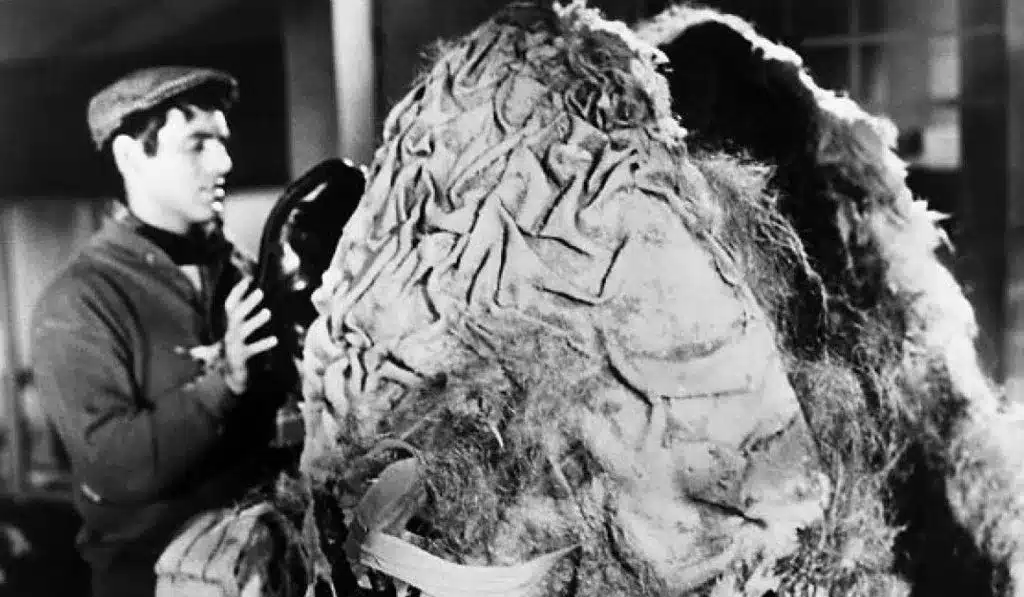
So, where did this bizarre musical come from? The mind of classic cult filmmaker Roger Corman. The 1986 musical film is based on a 1982 musical stage play of the same name, which was, in turn, based on Corman’s low-budget 1960 film.
It all started with a bet.
(Just like Mary Shelley’s Frankenstein, along with numerous other literary classics.)
Roger Corman bet his brother, Gene, he could make an entire film within a week. They chose the last week of 1959. Corman had access to sets left over from another film. He brainstormed and devised an idea for a horror comedy fueled by time spent hanging out in LA coffee shops. His initial idea centered around a music critic who was a vampire. He scrapped that, and then he considered centering the story around a chef whose customers were his main ingredient.
Worried about the reaction of censors to the chef’s idea, Corman decided to make the chef a plant instead.
Corman already had the sets and most of the cast, who were stock actors he had worked with previously. One of these actors was Jack Nicholson. Corman’s 1960 film was one of Nicholson’s first appearances on film. Nicholson recalled he “just did a lot of weird shit” for his brief appearance. Not only that, but the budget was so tight that Nicholson said Corman wouldn’t pay to make copies of the script.

Corman’s film became a popular movie shown on late-night TV. The film inspired composer Alan Menken and lyricist Howard Ashman to turn it into a musical to satirize campy, low-budget 1960s horror films.
The off-Broadway hit premiered on May 6, 1982; one month later, a producer picked up the musical, and it embarked on a five-year run.
At the time, it was the highest-grossing off-Broadway production ever. David Geffen, one of the producers of the off-Broadway show, decided to make a film version.
When Geffen decided to develop the play into a film, the production had its usual ups and downs.
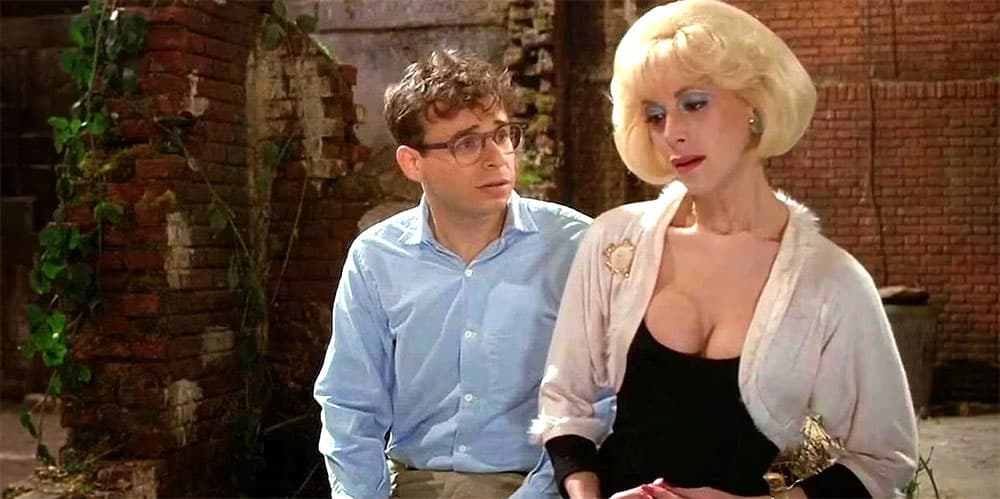
The studio played the usual game of musical chairs with the director’s seat. Before Frank Oz, Martin Scorcese and John Landis were the first two names on the studio’s list of directors. Scorcese was supposed to direct the movie in 3-D.
The studio finally settled on letting Ellen Greene reprise her role as Audrey from the stage production. Before she was cast, Cyndi Lauper, Madonna, and Barbara Streisand were offered the role of Audrey. Before R&B legend and Four Tops lead singer Levi Stubbs lent his voice to Audrey II, the role of the wisecracking plant was offered to Eddie Murphy.
John Candy turned down the role of Mr. Mushnik to play the smaller part of radio host Wink Wilson. The production eventually required re-shoots, during which Paul Dooley was replaced with James Belushi as Patrick Martin, the man who confronts Seymour about Audrey II.
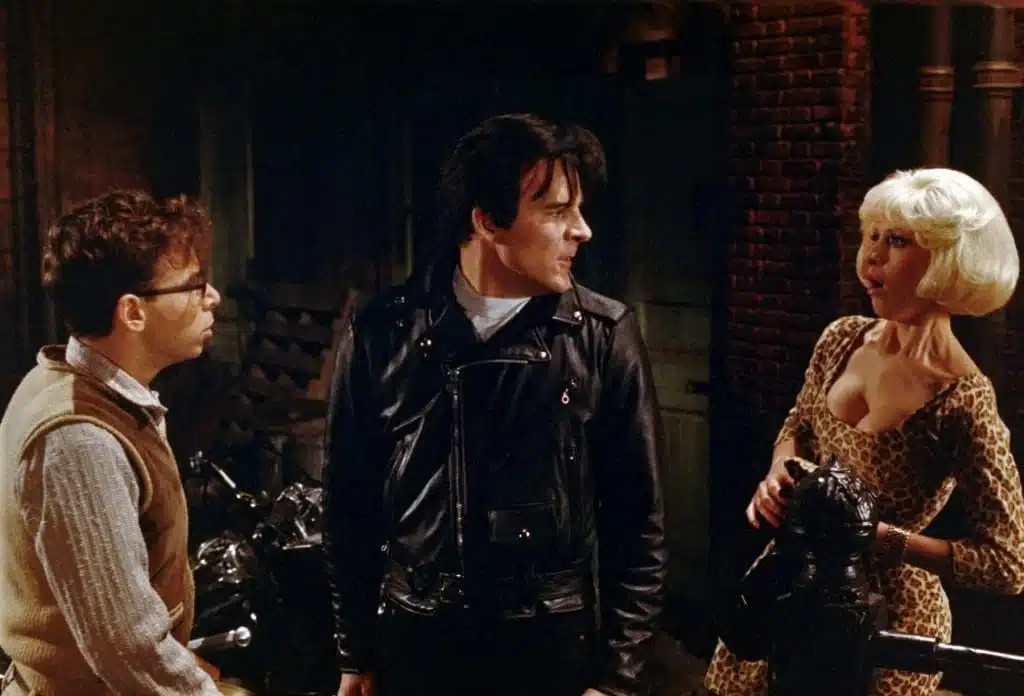
Steve Martin delivers a memorable performance as Audrey’s boyfriend, sadistic dentist Dr. Orin Scrivello.
Martin filmed his scenes for six weeks. Some of his ideas made it into his scenes, such as punching the nurse and ripping the head off a little girl’s doll. Martin also cut his hand on broken glass in a scene. This is why he kicks open a door during a scene with Ellen Greene. In a previous try, he opened it with his hand, and the glass shattered, cutting his hand.
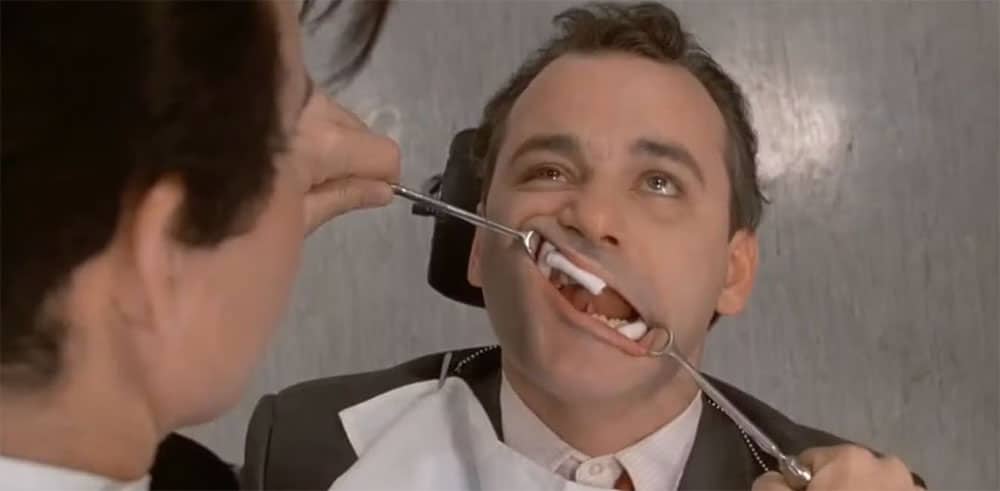
Bill Murray also has a cameo as Arthur Denton, Dr. Scrivello’s masochistic patient.
Mental Floss reports that when Murray agreed to appear in the film, he asked if he could “go off-script.” Oz told him: “Look, as long as you’re the masochist and Steve’s the sadist, I don’t care.”Murray stuck to the script during the scene where his character is in the waiting room. He ad-libbed the scene in the dentist’s chair. Murray improvised vastly different lines in each take during two days of filming. Editors faced a challenge trying to put a coherent scene together.
An interesting, fun fact about this scene is that some of the dental equipment was used in Tim Burton’s Batman. The equipment appears in the scene when the doctor works on the Joker’s face. In an odd coincidence, Jack Nicholson played the Joker.
When Nicholson made his film debut in the original Little Shop of Horrors, he played the masochistic dental patient played by Bill Murray in the remake.
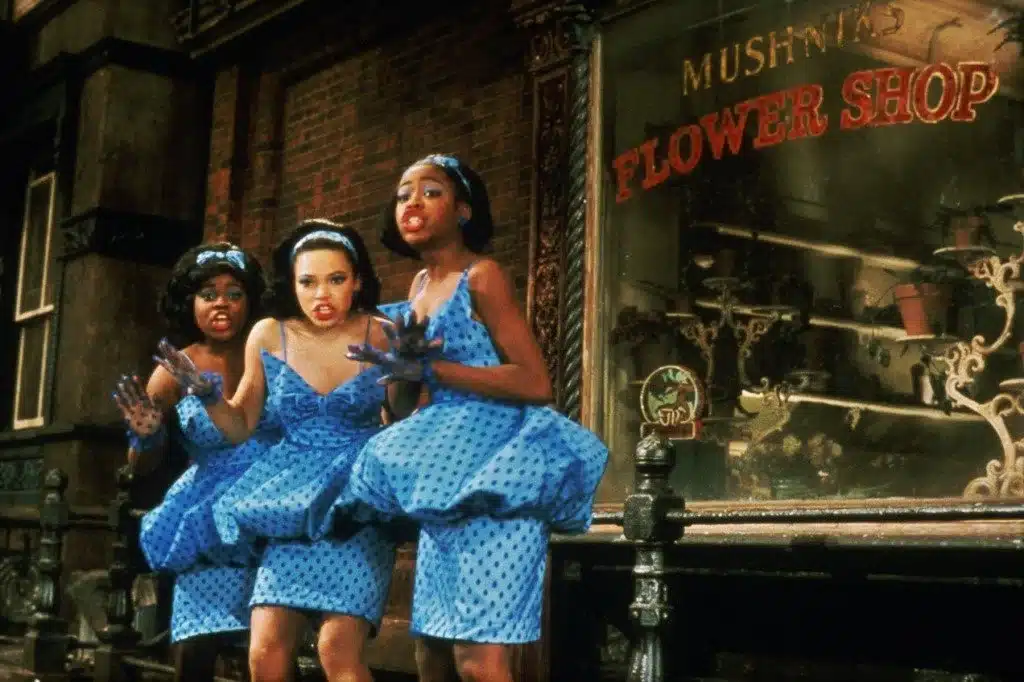
Little Shop of Horrors was filmed entirely at Pinewood Studios in England on the studio’s largest sound stage, the “Albert R. Broccoli 007 stage.”
Costing a total of $1.8 million to build, the stage is named after James Bond film producer Albert R. “Cubby” Broccoli. Production designer Ken Adam first envisioned In 1976 to accommodate the set of the Liparius supertanker for the James Bond film The Spy Who Loved Me.
The set was so large that it was difficult to heat, presenting a unique challenge while shooting. While filming the “Suddenly Seymour” number was challenging, the actors’ breath could be seen on screen. The cast had to hold ice cubes in their mouth to prevent their breath from showing.
However, the biggest challenge in making the film was Audrey II.
CGI, digital optical effects, and green screens were not an option at the time. Fortunately, director Frank Oz was experienced with puppetry. Oz’s resume included 10 years working with Muppets creator Jim Henson, voicing iconic characters such as Fozzie Bear, Miss Piggy and many other characters.
Needless to say, Oz faced quite a challenge in creating Audrey II. Throughout the film, the blood-thirsty plant grows immensely plus sings and dances.
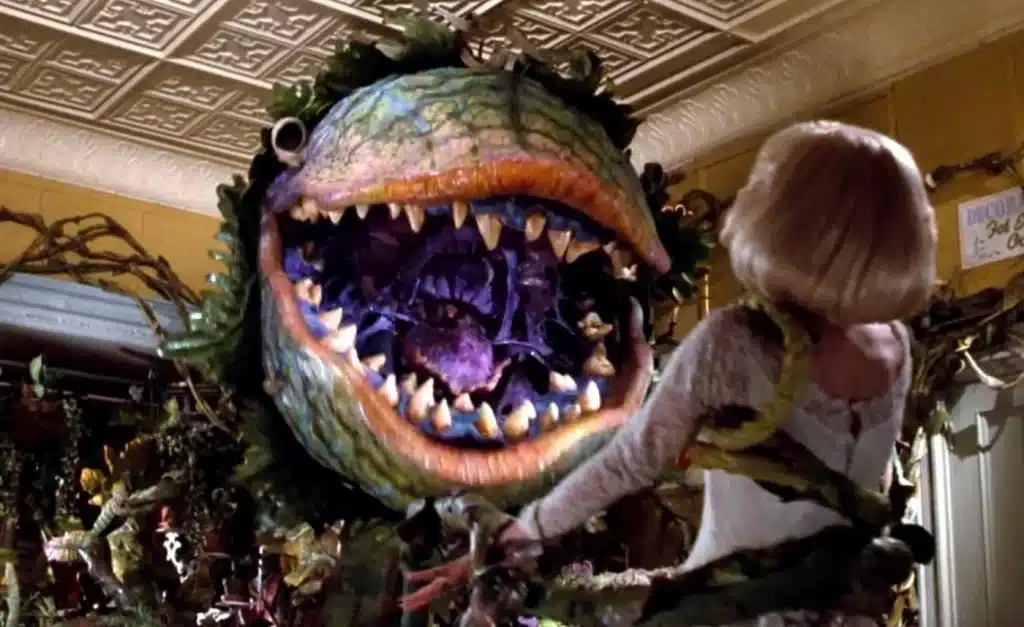
Technicians went to work building six animatronic flytraps of various sizes, the smallest of which stood four inches and the largest 12 feet tall. To aid production, three different scales of Mushnik’s flower shop were built to allow production to work on puppets of different sizes.
The 12-foot puppet required up to 60 human operators.
During the “Suppertime” number, two different-sized Audrey II props were used. A smaller prop was used when the plant was seen alone in the shop. To make the plant appear larger, the flower shop set was made smaller.
When Audrey II interacts with Seymour and Mushnik, a larger prop is used, one that matches the height of the actors. The larger prop was not equipped with lip movement and was designed only to swallow Mushnik’s mechanical limbs.
To film the scene where Audrey II grows for the first time, following Seymour’s singing “Grow for Me,” a small dolly track was concealed under the coffee can flower pot. To create the illusion of growth, the plant was slowly pulled towards the camera on the track.
Another challenge working with the Audrey II puppet was that the puppet’s foam rubber lips couldn’t move fast enough in sync with the audio during any of his songs. To compensate, the team filmed the puppets at a slower rate than average and then sped up the footage. The actors had to sing in slow motion when singing beside the puppet.
At the end of the day, the plants required maintenance to be ready for the next day with cleaning, patching, and repainting.
Mental Floss offers the following Audrey II fun fact: one of the human operators was Brian Henson, Jim Henson’s son and current chair of the Jim Henson Company. Oz said that Brian Henson was one of the puppet’s main operators during the scene where Audrey II sings “Feed Me,” which is before the plant reaches its full height.
Brian’s younger sister, Heather Henson, has a cameo as an abused dental patient.
Many of the film’s scenes had to be re-shot, including the ending, based on the test audience’s reactions to parts of the film.
One change was that the dentist’s office was originally gorier, with blood splattering on the walls. After test audiences objected to the grisly scene, it was re-shot with a cleaner office.
The film’s original ending was cut, too.
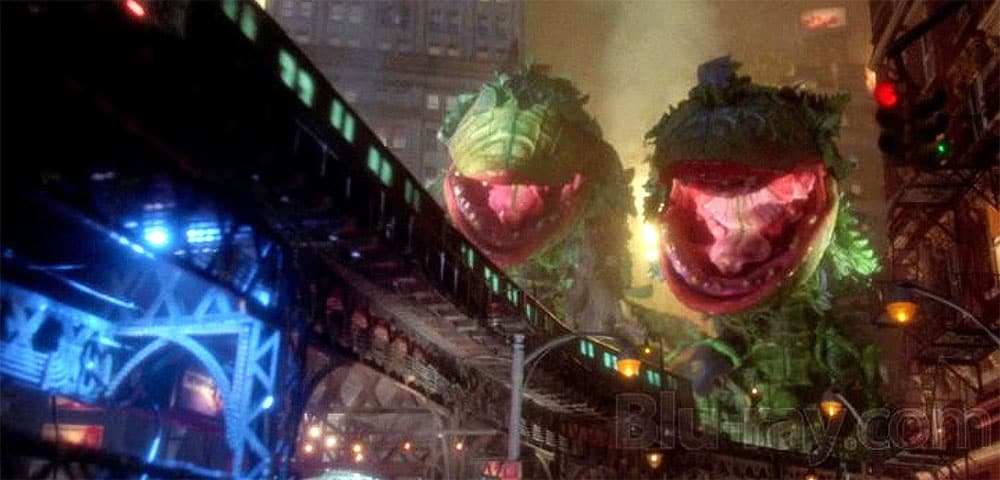
Hornet reports that the 1986 film kept the stage production’s original ending, with Audrey II eating Seymour and Audrey. With plans for world domination, Audrey II then attacks the city.
Oz’s grand finale referenced Godzilla and War of the Worlds. The director used one-fifth of the film’s budget and took one year to create the ending. This elaborate ending was cut because of test audience reactions. Mental Floss reports that in San Jose and Los Angeles, audiences enjoyed the film until the end.
Oz recalled the reaction of the San Jose audience:
“For every musical number, there was applause. They loved it; it was just fantastic… until we killed our two leads. And then the theater became a refrigerator, an ice box. It was awful.”
Oz told Entertainment Weekly: “We had to cut that ending and make it a happy ending or a satisfying ending. We didn’t want to, but we understood they couldn’t release it with that kind of reaction.”
Ashman came up with a happier ending.
Re-shoots pushed the film’s release from summer to winter 1986.
Several songs composed for the original ending were also cut, including “The Meek Shall Inherit” and “Don’t Feed the Plants.”
Hornet reports that a special edition DVD released in 1998 included the darker original ending. Days after its release, the DVDs were recalled when producer David Geffen planned to re-release the film in theaters with the original ending intact. However, the original “Everyone Dies” ending was included in the 2012 Blu-ray release.
On the subject of the film’s soundtrack, one of the songs, “Mean Green Mother from Outer Space,” was nominated for an Oscar for Best Original Song. Levi Stubbs was invited to sing the song for the ceremony, which, of course, needed to be edited for the televised ceremony.
Unfortunately, Little Shop’s song didn’t win. “Take My Breath Away” from the movie Top Gun won that night.
Many of the original off-Broadway musical songs were cut from the film.
One song that did survive is “Somewhere That’s Green,” in which Audrey expresses her desire to move from the city to the country. The same team that composed the songs for the film, lyricist Howard Ashman and composer Alan Menken, went on to collaborate on Disney’s The Little Mermaid. Ariel’s song “Part of Your World” was reportedly influenced by “Somewhere That’s Green.”
Menken is quoted saying that they “used to jokingly call this one ‘Somewhere That’s Wet.’”
A short-lived cartoon series titled Little Shop based on the film, featuring a young Seymour and “Junior,” his rapping prehistoric flytrap ran for 13 episodes on Fox Kids in 1991. Besides the short-lived animated series and inspiring a Disney song, the stage musical version of Little Shop of Horrors is currently having a revival.
If you love campy horror and cult movies, Little Shop of Horrors is the perfect story. After all, who could resist a homicidal, man-eating plant?
SOURCES:
“11 Bloodthirsty Facts About ‘Little Shop of Horrors,” by Mark Mancini, September 17, 2015, Mental Floss; “10 Behind-The-Scenes About The Making of Little Shop of Horrors,” by Jake Dee, July 29, 2020. Screen Rant; “The Weird, True Story Behind ‘Little Shop of Horrors’ (and Its Secret Lost Ending),” by Matt Baume, December 14, 2021, Hornet; Little Shop of Horrors (1986 film) – Wikipedia.


Follow Us!