

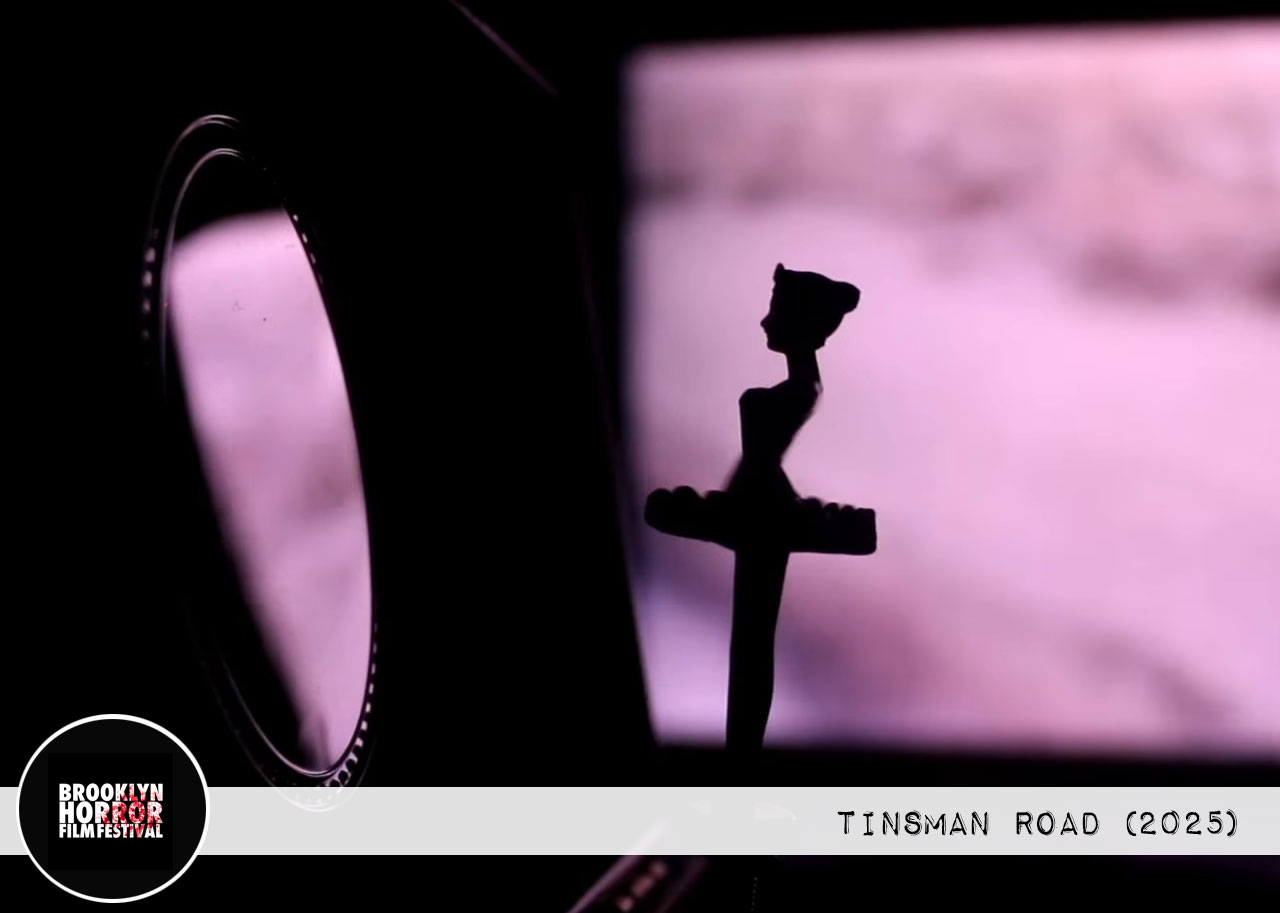
Banfitch follows up “The Outwaters” with another found-footage nightmare steeped in grief, ghosts, and the impossible task of escaping pain.

No time to read? Click the button below to listen to this post.

Writer and director Robbie Banfitch gained a legion of fans after the debut of his horror film The Outwaters (2020), a found-footage movie about a group of friends whose trip into the desert turns into a nightmare. With the New York premiere of his film Tinsman Road at the Brooklyn Horror Film Festival, it’s likely he’ll gain even more loyal followers.
Another found-footage film, Tinsman Road is a fictional story that follows Robbie (played by Banfitch himself) as he returns home for the first time since his sister Noelle (Salem Belladonna) has gone missing years earlier.
At first, his mom (Leslie Ann Banfitch, his real-life mother) seems thrilled that her wandering son is back. She even seems to be handling the worst tragedy a parent could face: the disappearance of one of her children. She believes in angels – in fact, she believes that Noelle is an angel who occasionally flickers the lights, and she believes Robbie is back to make a documentary about angels.
The real reason Robbie has come back to his hometown is to discover the truth about what happened to Noelle.
Very quickly, he learns that his mom is suffering more than she lets on; she’s awash in an ocean of grief.

Her weeping is the soundtrack to the footage Robbie is shooting. She even begins sleepwalking, usually heading into Noelle’s old, untouched bedroom or even outside. When Robbie wakes her as she starts to head away from their home, she tells him, “[Noelle’s] in the woods.”
Tinsman Road does an excellent job of walking the fine line between the terrors of the supernatural and the very human terrors lurking everywhere.
Is Noelle alive? Is she an angel, gently haunting her mother and brother? Was she the victim of a crime? Robbie is determined to get some answers, both for himself and for his mother, who is in deep pain.
Leslie Ann Banfitch’s eyes are like glowing gems, full of both razor-sharp pain and a glimmer of hope.
While Robbie is almost always behind the camera, his pain still comes through. He interviews the locals after Noelle’s disappearance, leaving out the fact that she was his sister. It is as if he is torturing himself with these interviews as he hides both his true identity and his pain.
His little family is fading as his and his mother’s sadness at missing Noelle and the anger of not knowing what happened to her overwhelms them both.
Like The Outwaters, which followed friends making a music video in the desert, Tinsman Road effectively uses the human voice and the instruments of nature to build the increasingly disturbing atmosphere.

Salem Belladonna, who also contributed to the music in The Outwaters, is the voice of Noelle.
Noelle has left behind intricately decorated cassette tapes of her singing and chanting, so Belladonna’s haunting voice and instruments guide Robbie as he searches for clues in his sister’s disappearance. (On her website, Belladonna describes herself as a “sound alchemist,” and her eerie and transformative music proves that to be an apt label.)
Robbie’s investigation soon leads him to take the same route his sister took. She was last seen heading into the woods from Tinsman Road, so he follows in her footsteps for a camping trip. Banfitch’s natural approach of using moonlight and flashlight beams during the nighttime scenes proves even more heart-pounding than similarly darkened scenes in The Outwaters.
Tinsman Road succeeds both as a frightening horror movie and as a heartbreaking look at a family reeling from a loss.
Since Robbie and his mom don’t even know what happened to Noelle at the start of the film, they face an especially cruel double sorrow, which has rarely been portrayed so movingly in a horror film. An elderly woman Robbie interviews during his search for answers tells him that there are “people who make themselves a ghost.”
In Tinsman Road, Banfitch shows that grief can turn someone into a ghost just as much as death can.
Overall Rating (Out of 5 Butterflies): 4







Follow Us!