

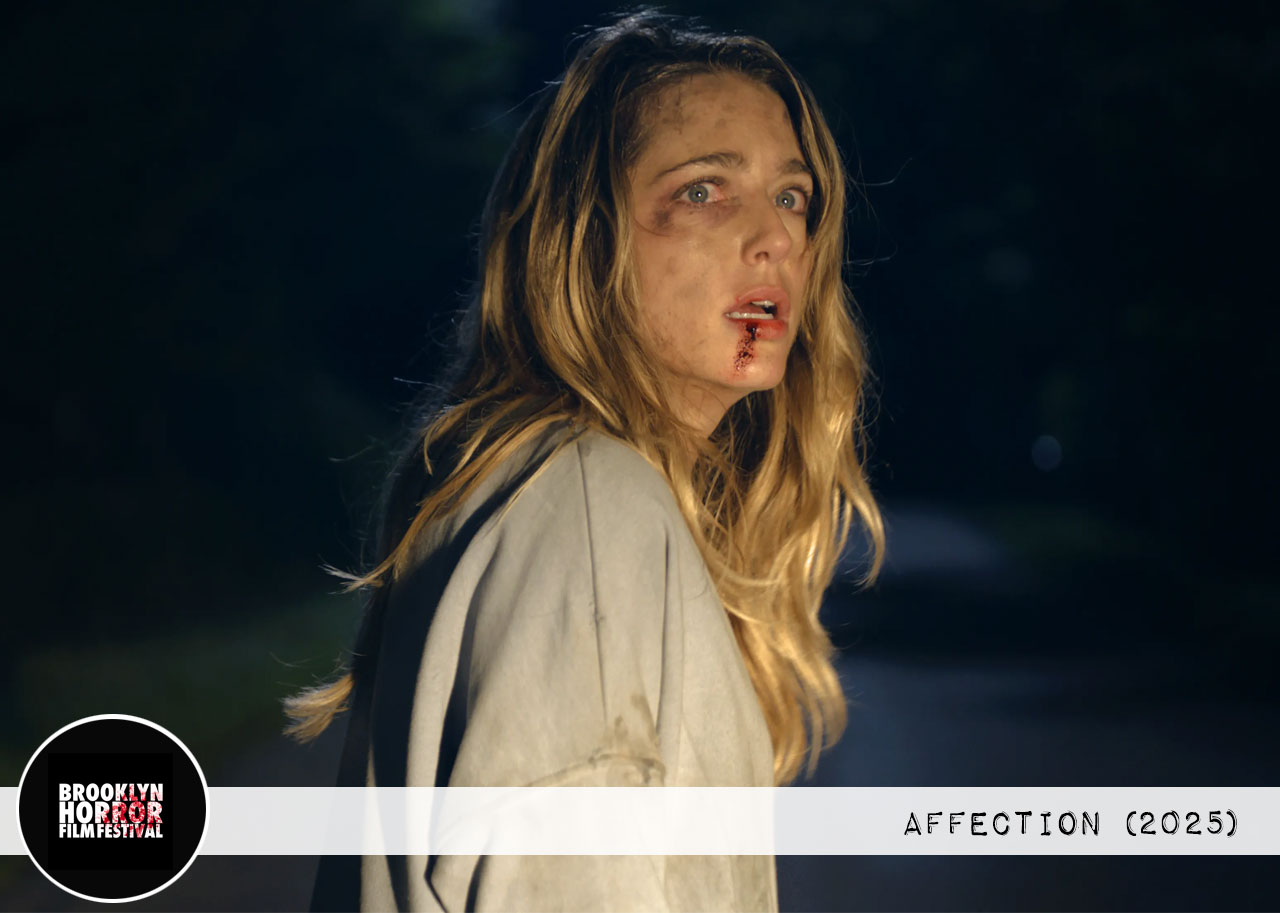
Jessica Rothe anchors this eerie psychological thriller about fractured identity, isolation, and the terrifying elasticity of memory.

No time to read? Click the button below to listen to this post.

With her breakout role in Happy Death Day (2017), Jessica Rothe established herself as a scream queen. Her boundless charisma paired with her stellar acting chops–not to mention her ability to lean into the dramatics of horror—make her a shining star in the genre.
With her new role in BT Meza’s film Affection, she cements her place in horror history.
In the psychological thriller Affection, Rothe stars as Ellie, a young woman who wakes up in a bed she doesn’t recognize with a man she doesn’t know. Her survival instincts kick in, and she tries to fight him off. The mystery man introduces himself as her husband, Bruce (Joseph Cross). He tells Ellie that she was in a car accident and is suffering from a unique form of amnesia.
Ellie doesn’t believe him. After all, she has memories of another life as a different woman with a different husband and a different child. How can she reconcile what Bruce is telling her with the memories she already has? And where is the life that she remembers?
Bruce has an answer ready for her.
When Ellie experiences memory lapses, false memories crowd in to fill in the gaps.

The memories she has of a different husband and child could be scenes from movies or based on lyrics from a song or stories she’s heard, Bruce suggests.
While Ellie isn’t quite convinced, she also has nowhere to go. According to Bruce, her doctors have recommended complete isolation with Bruce and Alice (Julianna Layne), the daughter she’s never met. As if that wasn’t a big enough red flag, Bruce then insists a distressed Ellie dance with him to glam metal band Cinderella’s song “Don’t Know What You Got (Till It’s Gone),” leading his reluctant wife around the floor, trying to fill in the gaps in her mind with tales of their teenage romance.
Instead of inspiring a connection, the dance fills both Ellie and viewers with a sense of unease.
Ellie does try to reintegrate into the life Bruce has set up for her. Despite not recognizing her daughter Alice, the two quickly form a sweet bond and spend most of their time together on the desolate farm where Bruce has settled them. (Although Ellie specifies that she works with computers, her isolated recovery is preventing her from working at all.)

The longer Ellie stays on the farm, though, the more uncomfortable she feels.
She also suffers from periodic spasms that range from a simple hand tremor to full-on seizures that rival Isabelle Adjani’s infamous subway scene in Possession (1981). Like Adjani, Rothe pushes her body to the limits with the painful-looking contortions that show that her “amnesia” is no ordinary case.
While playing with Alice in the woods, Ellie spots something disturbing. Bruce blows off her concerns about what she discovered, and her suspicions solidify.
She knows she is not where she should be…and she knows Bruce is not to be trusted.
Meza’s film explores the idea of alternate realities and alternate lives anyone could live if given the option.

As the audience, we are unsure if Ellie has a choice.
Is there a way she can return to the life she remembers? Or is the life with Bruce and Alice on the farm, far away from any civilization, the life she has to accept? Is it her amnesia forcing her mind to fill in the gaps, as Bruce insists, or is something more diabolical (or supernatural) at play?
With the same determination as Tree, Rothe’s heroine in Happy Death Day, Ellie finally learns the truth of why Bruce has isolated her and Alice at the farm. Her acting makes Affection a standout, and she rises to the challenge both physically in her seizure scenes and emotionally.
She is acting not only as Ellie, but as a woman stuck in a timeline she doesn’t understand and who is trying to understand the identity she’s been assigned.
The aptly titled film smartly contrasts her uncomfortable scenes with Bruce and her tender scenes with Alice. While Ellie doesn’t remember Alice as her daughter, there is a genuine affection between the two that heightens the film’s emotional stakes.
It’s a film that proves memories aren’t the only things that can tie people together.
Overall Rating (Out of 5 Butterflies): 3.5










Follow Us!