


We gather our forces for battle with one of Cage’s weirdest (seriously) roles, the insane “Army of One”—somehow based on a true story.
No time to read? Click the button below to listen to this post.
IN THIS CORNER: KELLY MINTZER
The Lowdown

Alright. Ok. Let’s get into it.
I had never heard of Army of One before Steph told me it was the random number generator’s torture of the week. The trailer did not inspire considerable confidence, and rightly so. To be clear, we are not talking about one of Cage’s good movies this week.
However, we ARE talking about one of his…weird…ones.
So, a little background. This movie has two versions: A 90-minute theatrical cut and a 2-hour and 40-minute director’s cut. Your girl is usually a big proponent of director’s cuts, but two and a half hours for this particular concept seemed unnecessary at best and torturous at worst.
Additionally—and not to sound in any way elitist—the director’s previous output includes Borat, Bruno, and The Dictator. I enjoyed Borat when it came out, but I’m not totally convinced I would now, remembering it feels a bit more edge-lord-y than I generally prefer.
Anyway.
The basic concept of Army of One is that a very manic, very unemployed, very delusional, and perhaps most horrifyingly, very real man named Gary Faulkner begins receiving messages from God (played by Russell Brand, who I dislike so intensely that it’s hard to be objective about his performance) telling him to find and retrieve Osama Bin Laden.
It’s a sort of intriguing premise that’s rather ramshackle in execution.
Maybe this is where the director’s cut would shine? Perhaps the narrative would feel more cohesive and less pasted together? I can’t say I have a ton of confidence, but I’ll allow the possibility.
Most troubling is the Gary of it all. I’m not sure we should be presenting men like him as lovable weirdos.
It feels kind of like Tiger King/Tommy Wiseau/that weird guy from The King of Kong (you know, the one with the tie). We focus on the quirky weirdness and overlook the very real and often very dangerous darkness lying beneath.
It is this kind of lens that lands reality TV con-men in the White House.
That said, credit where it’s due; I had a few genuine laughs, most of them courtesy of a truly committed performance from our man on the inside — which leads nicely to…
The Cage Factor:
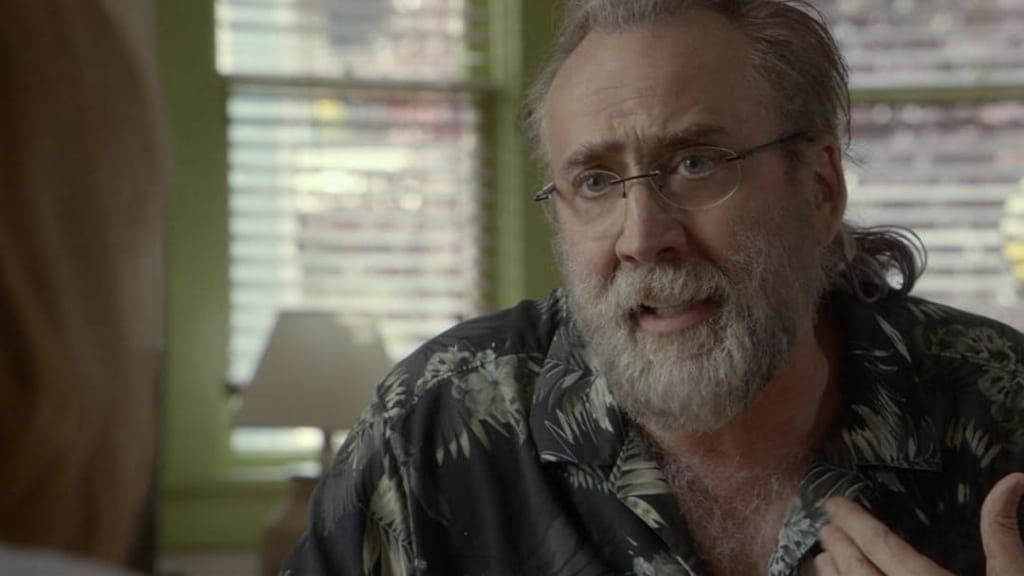
This is a rat in a cage for me. Nicolas Cage is DOING something, and he’s doing it well, but JESUS CHRIST, it’s exhausting. He talks nearly non-stop in a cartoon mouse’s voice… he delivers laugh lines well, but he’s not given nearly enough of them. And there’s enough racial/gender weirdness in this that it made me pretty uncomfortable at points. None of it really works.
That said, I bet there’s an audience for this movie. It isn’t me, but what the hell, roll the dice. Maybe if you’re a big fan of Borat or The Dictator, this will work for you. As for me, I am very happy to say I will never ever watch this again.
AND IN THIS CORNER: STEPHANIE MALONE
The Lowdown
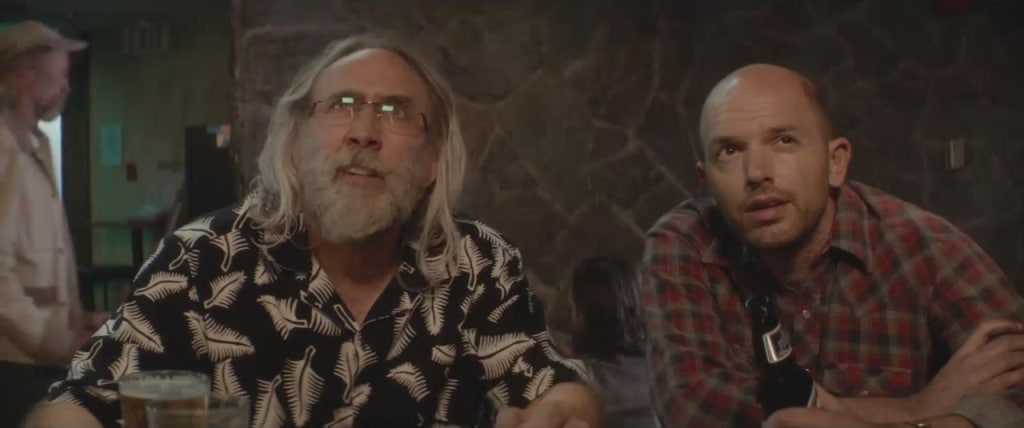
I sat down to watch a movie I had never heard of—a movie with a trailer that dropped my jaw on the floor (and not, sadly, in a good way).
Then, my lovely cohort dropped a bomb on me. Apparently, director Larry Charles disavowed the released version, calling it an unauthorized producer’s cut that butchered everything the film stood for and, in his words, “changed everything and for the worse.”
The many sins Charles cites in his introduction of his significantly longer (over two and half hours!) director’s cut—which he has posted for free on his YouTube channel for exhibition purposes only—include the film’s themes, the ending, the music, and the addition of a corny narration.
He asserts they even changed the entire point of the movie, bastardizing a “blackly comic metaphor about the meddling imperialistic ignorant greedy Theocratic delusional, violent America that we all recognize” (direct quote) to “a happy-go-lucky fable about the goodness and innocence of America.”
Woof. That’s a lot.
I’m a true-blue believer in artistic integrity and the right of a filmmaker not to have their vision unilaterally compromised. Thus, I felt compelled to watch both versions and report back on a) the level of fuckery involved in the producer’s cut and b) whether or not said fuckery actually produced a significantly inferior product.
If you want to read about my side-by-side comparison of the two cuts and how they stack up, click below.
(Otherwise, you can skip to my assessment of the final producer’s cut of the film and how it rises or falls on its own merits.)
It’s remarkable how much more Kelly and I seem to have to say about the stinkers than the shining stars in Cage’s filmography. Perhaps we find ourselves incredulous at how badly some filmmakers seem to squander the vast talents of the ever-versatile, endlessly compelling Cage.
I never EVER thought I’d be less enthusiastic about seeing SO much Cage in such a certifiably weird role. It’s a film that taps into all his trademark mania and fearlessness as an actor. It should be a slam dunk for people like me who can’t get enough of Cage in all his eccentric glory.
Instead, it tries the patience of even the most devoted Cage superfan.
Army of One is sometimes funny and oddly compelling in parts, but it never really works. It’s mostly just grating and weird (not in a good way) and off-putting—and a tonal mishmash of farce and failed “Ugly American” messaging.
Most of the supporting cast (with one glaring exception) is typically stellar. They deserved so much better.
Look, it pains me to be this blunt and critical. It’s not my style. But damn, if this isn’t an army of one messy misstep after another.
Like I said… woof.
The Cage Factor:

By golly, this one is brutal to write. Look, the objective truth is that there is almost nothing my man can’t do, and it’s rare when we see him give anything less than his absolute all. Even in the stinkers, he remains infinitely watchable, and it can be deliciously satisfying to watch him chew scenery and make incomprehensible but captivating character choices.
This is a role that is tailor-made for Cage’s unique brand of balls-to-the-wall intensity and eccentricity. There’s no doubt he’s giving a deeply committed performance, and he does an excellent job channeling the real Gary’s quirks and mannerisms. Maybe that’s the problem; it might be too good of a job. The character mostly feels like nails on a chalkboard. I think that’s intentional, but it’s wildly unfun to watch—even with Cage doing what he does best.











Follow Us!