

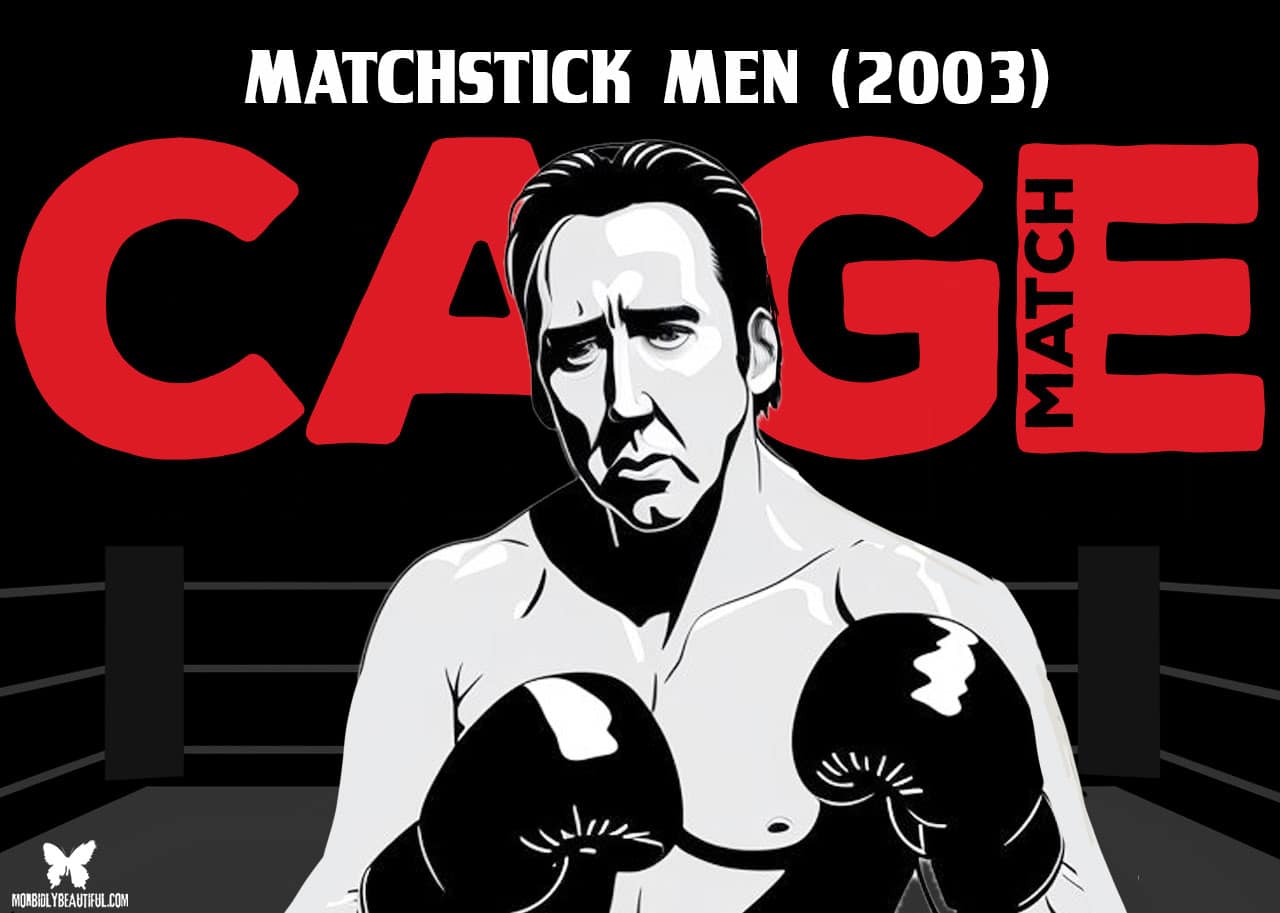
A criminally overlooked Ridley Scott gem, “Matchstick Men” is a rare con film that plays as much with your heart as it does with your mind.
No time to read? Click the button below to listen to this post.
IN THIS CORNER: KELLY MINTZER
The Lowdown

Matchstick Men is a fascinating watch. I apologize for the lack of a preamble, but it’s popping fresh out of the kitchen (“the kitchen”, in this particular instance, being my brain) right now, so I want to get right into it. It falls into that odd subgenre of movies I consider “feel good con stories”, alongside your Catch Me if You Cans and the like. I have some concerns about its representation of OCD, but DAMN… it goes down smooth as hell.
Nic Cage and Sam Rockwell (be still my heart. On the list of unconventional-looking leading men, none gives me palpitations more than Sam damn Rockwell) play a pair of conmen, running small beans scams against people who-frankly-don’t deserve it.
I will say this is the first part of the movie that stuck in my throat a little; con/heist movies are usually more fun when the ones being ripped off are big corporations or rich dicks (see also the wildly underappreciated and incredibly brilliant Logan Lucky). There’s less satisfaction in seeing our protagonists ripping off a nice old lady.
Our boy Cage has Tourettes and OCD. I genuinely and truly don’t know enough about either condition to know if this is a sensitive representation; it doesn’t FEEL like it. It seems odd, with what (granted, little) I know about medicine, to suggest that he would begin to spiral after just a few hours of a missed pill, but I’m not an MD, I don’t know for sure.
There are certainly points where it feels like both conditions are handled as comedic devices, but, at the risk of being that guy, it was 2003 and Kid Rock is playing in the background.
Cage finds out he has a 14-year-old daughter who takes a keen interest in his business while also giving him the purpose and focus he’d previously lacked. This is the kind of development I would normally find kind of trite.
However, Cage is in top form here, and he really makes it work—somehow balancing the sense of alienated strangeness with a genuine desire for meaning and love.
I’m not suggesting that Matchstick Men breaks the narrative mold.
A seasoned cinephile will call every beat as it comes; which doesn’t necessarily mean they’re the wrong beats, in fact, it might prove that they are the correct choices. They’re just not surprising in any way, including the semi-twist ending.
Wisely, Matchstick Men avoids some of the more expected trappings of generational shock and “Oh no, I’m a man suddenly living with a girl!”. Those are tired comedic tropes, and I was glad to see that, generally speaking, the movie avoids them.
It is smart and judicious in the places it deploys them; little things like Nic Cage offering his daughter eggs for breakfast and her opting for ice cream instead end up feeling more like he is divorced from human interaction in general than it being an “olds versus youngs” thing.
And then there’s Sam Rockwell, who I think I’ve made it clear I cannot be unbiased about. Nic Cage is so good in this, but Sam Rockwell still steals every scene he’s in because he has no idea how NOT to. He’s just that damn good, even when wearing a backward Kangol hat. Sam, if you’re reading this—why are you reading this?—but also, you’re perfect.
The Cage Factor:

This is a Cage Fighter for me. I’m not prepared to call the movie perfect, but it’s really fun and delightful. This is really Nicolas Cage firing on all cylinders. He’s giving an idiosyncratic, funny, touching, and honest performance. If Sam Rockwell is slightly more gravitational on screen, that is not a ding at Cage—just a testament to how fucking great Rockwell is. This movie is rad. Dated? Maybe some. But. rad.
AND IN THIS CORNER: STEPHANIE MALONE
The Lowdown

Ridley Scott’s Matchstick Men is a slick, surprising con artist film that thrives on its balance of humor, anxiety, and emotional weight.
Based on Eric Garcia’s novel, the film blends crime, comedy, and drama into a uniquely compelling character study, made all the more mesmerizing by Nicolas Cage’s tour-de-force performance. While it may not be as widely celebrated as some of Scott’s more ambitious projects, it’s a masterfully crafted film that deserves a second look—especially for fans of Cage’s more nuanced work.
At its core, Matchstick Men follows Roy Waller (Cage), a veteran grifter plagued by a cocktail of neuroses, obsessive-compulsive disorder, and anxiety-driven tics. Alongside his smooth-talking partner Frank (Sam Rockwell), Roy runs small-time scams with the precision of a well-oiled machine.
However, his world is upended when he unexpectedly meets his long-lost teenage daughter, Angela (Alison Lohman), who challenges his rigidly controlled existence.
Scott crafts MATCHSTICK MEN as more than just a crime film—it’s a character-driven drama disguised as a caper that uses the con game as a metaphor for identity, trust, and self-worth.
While the film features the classic hallmarks of a con movie—slick dialogue, clever misdirection, and a jaw-dropping third-act twist—it’s also deeply personal, grounding its thrills in the emotional turmoil of its protagonist. Unlike the high-energy, hyper-stylized heists of Ocean’s Eleven (written by Ted Griffin, who co-wrote this film with Nicholas Griffin), Matchstick Men is more intimate.
While Cage is the film’s centerpiece, Sam Rockwell delivers his usual brand of effortless charm as Frank, Roy’s protégé and occasional antagonist. Rockwell’s chemistry with Cage is electric, and he brings a welcome dose of sly humor to the film’s sharper edges.
Alison Lohman (Drag Me to Hell) is another standout. As Angela, she injects warmth and unpredictability into the story, serving as both a grounding force and a catalyst for Roy’s unraveling. Her performance is layered, making the film’s final act all the more impactful.
The script is tightly woven with clever dialogue and well-paced reveals. It’s a film that earns its narrative sleight of hand by making us care deeply about its characters before pulling the rug out from under us.
Matchstick Men is a film that understands the art of deception—not just in its plot but in how it lures you in with the promise of a con movie only to deliver something much richer.
The Cage Factor:

If there’s one undeniable reason to watch Matchstick Men, it’s Nicolas Cage. In a career defined by wildly unpredictable choices—oscillating between Oscar-worthy and full-throttle chaos—this is one of his most restrained yet deeply affecting performances.
Cage’s portrayal of Roy is a masterclass in controlled mania. His tics, compulsive habits (flipping light switches, panic attacks triggered by dirty carpet), and frenzied energy could have easily tipped into caricature. Instead, Cage makes Roy heartbreakingly real. He’s simultaneously off-kilter and deeply sympathetic, a man who meticulously organizes his life yet can’t control his own mind.
It’s the kind of performance that reminds audiences why Cage is often regarded as one of the most fearless actors of his generation.













Follow Us!