


Alongside a sensationalist book, a few films fueled the Satanic Panic of the 80s, blending cinematic terror with real-world paranoia.

No time to read? Click the button below to listen to this post.
When the faux autobiographical bestseller ‘Michelle Remembers’ sparked moral panic in 1980, it drew upon well-established cinematic tropes.
Satanism never goes out of style, at least not on the screen, as proven by the steady stream of films on the Angel of Darkness, including hotly anticipated Sinners (April 18), The Ritual (June 6), and The Conjuring: Last Rites (September 5).
Recent examples of well-received Satanic horror films range from Oz Perkins’ sadistic Longlegs, in which Nicolas Cage touts the titular line, to Colin and Cameron Cairnes‘ vintage-styled mockumentary Late Night with the Devil, all the way to the clerical cringe of The Pope’s Exorcist. Equally resilient, if far less innocuous, are crude conspiracy theories concerning devil worship.
When the Satanic Panic gripped the US in the 1980s, popular perceptions of the Lord of Hell’s fan base were already well established.
Many of these crude misconceptions about the ideals and followers of Satanism—in reality, a pretty common-sense set of socio-political creeds based on tolerance, empathy, and science—were spurred by one book. This is Lawrence Pazder’s and Michelle Smith’s sensationalist shocker, Michelle Remembers.
It is an allegedly authentic account of Smith, the future wife of Pazder, being handed over by her mother to a satanic cult that sexually abused her. In retrospect, the bestseller’s wild accusations seem hilarious. Back then, they were widely believed.
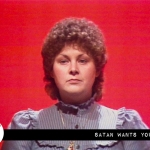
The book’s dramatic social impact and its connection to the damning Satanic Panic is sharply exposed in Steve J. Adams’ and Sean Horlo’s documentary Satan Wants You.
Since the brilliant observation focuses on the history of the book, it pays less attention to the cinematic creations that involuntarily support its claims.
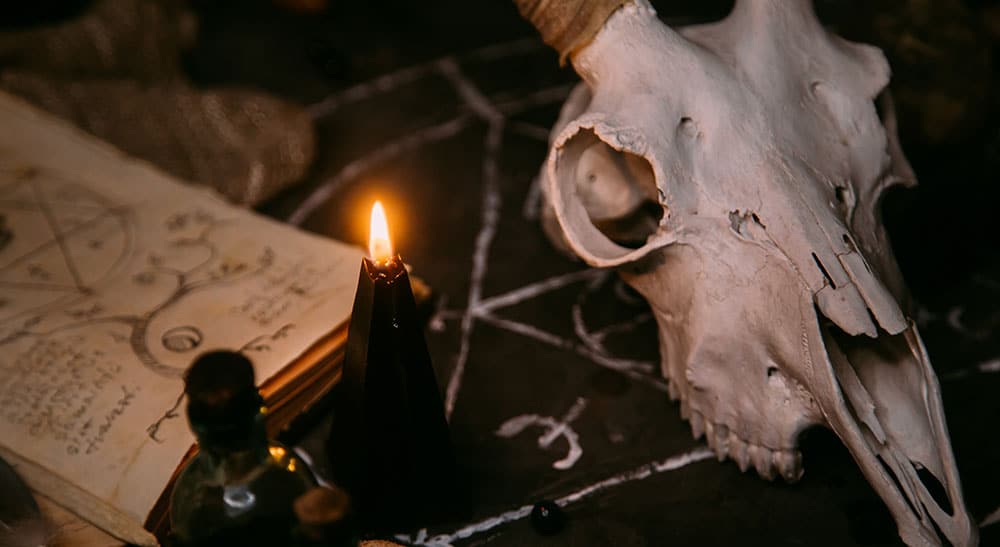
Pazder’s and Smith’s crude fabrication effectively encapsulated and enhanced semi-superstitious fears ignited by a small but influential set of horror films.
These are Roman Polanski’s Rosemary’s Baby, William Friedkin’s The Exorcist, Richard Donner’s The Omen, and Stuart Rosenberg’s The Amityville Horror. These canonical classics continue to scare as imaginative genre works and filmic foils for puritanical projections.
Because these works never directly addressed public concerns about moral corruption, they paved the way for their escalation.
Their narratives modernized ancient notions of bedevilment, evoking an atmosphere of estrangement from places and people of trust: home, neighbors, and one’s children. Their plots transport characteristic concepts of infiltration, infection, and indoctrination, which share striking similarities.
Evil triumphs, or at least persists; children are its agents. They might be the Antichrist or driven by his forces.
After Michelle Remembers, outrageous ideas such as heavy metal songs conveying sinister messages or primary school teachers celebrating black masses were considered very real possibilities. Horror fiction bore the brunt of the prudish paranoia that the genre’s most moralistic output helped to motivate.
Rosemary’s Baby (1968): Pregnancy Pandemonium
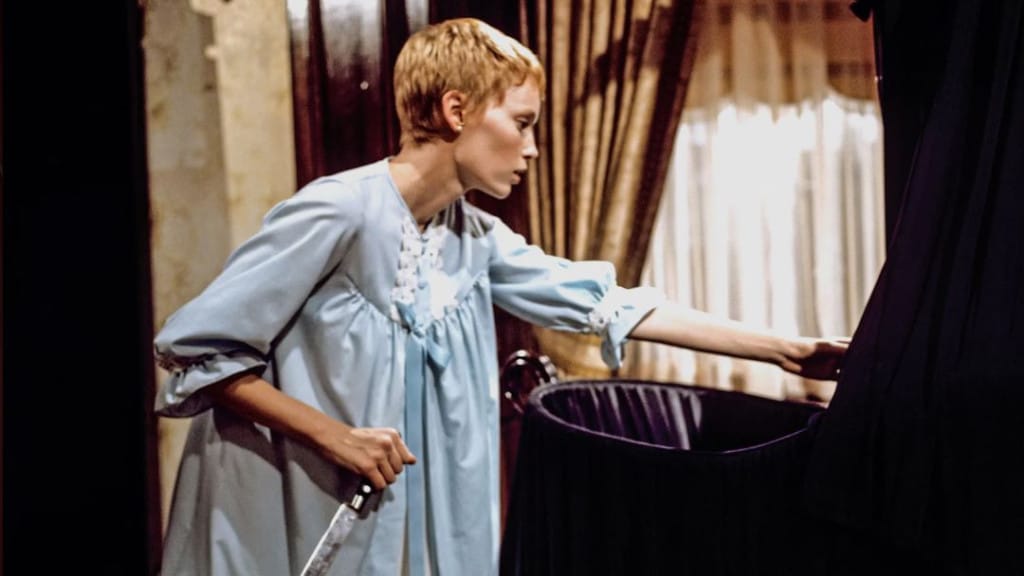
Ira Levin’s transferral of Satanism from medieval castles to New York’s upscale neighborhoods in his script and the eponymous novel serving as its inspiration wasn’t entirely new.
Val Lewton’s The Seventh Victim and Edgar G. Ulmer’s The Black Cat successfully moved devil worship to the contemporary settings of Greenwich Village and a Bauhaus-inspired modernist mansion. But Roman Polanski created a new architectural anxiety by framing the imposing Branford Building in a uniquely unsettling way.
The building’s uncanny air was reinforced a decade later when John Lennon was shot in front of it. Inside the building, prying proximity and individual isolation combine to reinforce popular prejudices about the socially disintegrating effect of urbanization. The house itself becomes the belly of the beast from which evil is born.
The everyday setting contrasts with the story’s archaic approach to pregnancy as mystic, animalistic, and transgressive.
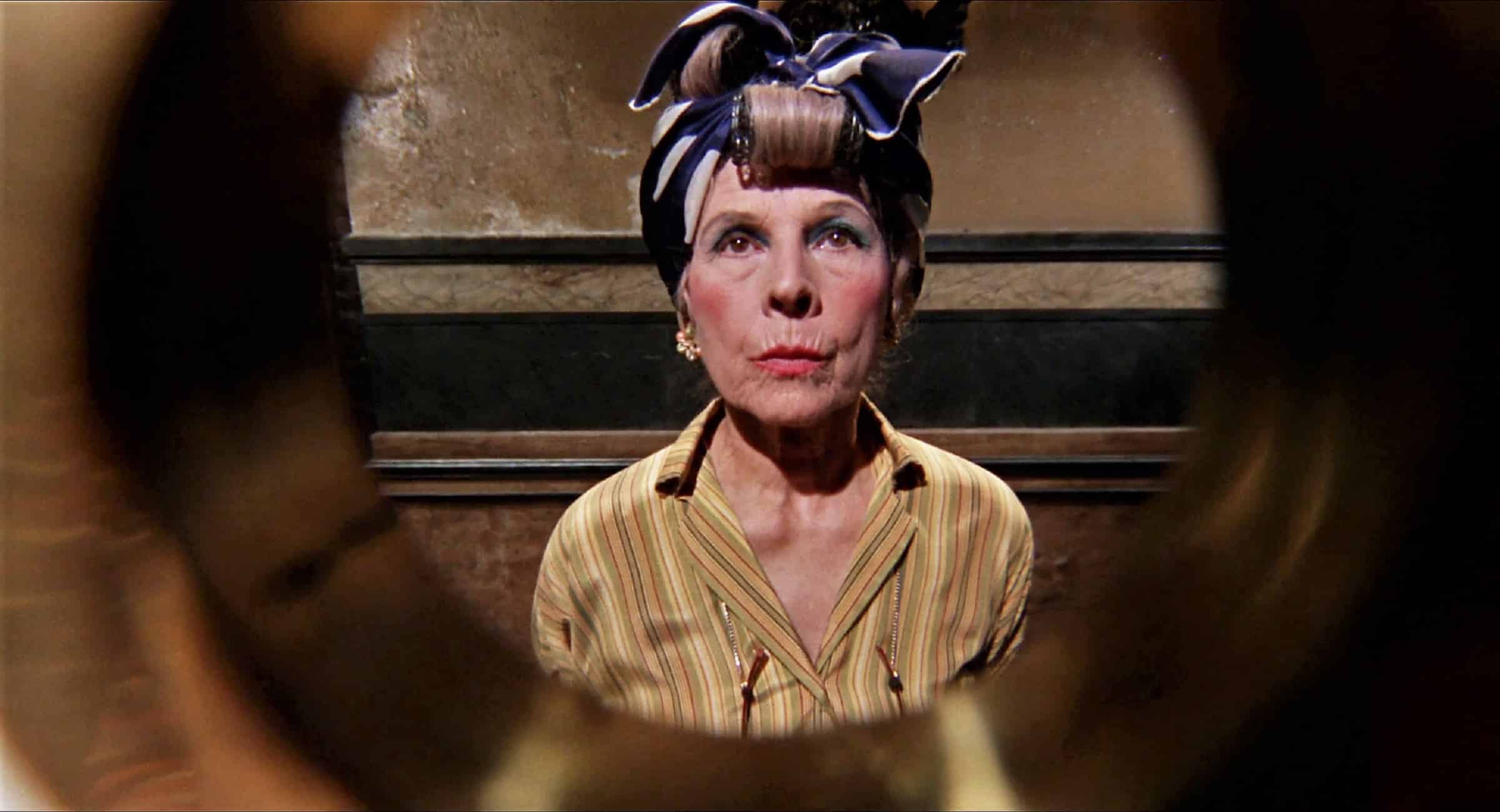
As Mia Farrow falls victim to the creepy couple next door, she becomes the epitome of the guileless female sacrifice. Ruth Gordon ingeniously impersonates a present-day version of the ancient witch. Her nefarious intentions discredit female friendship as inherently treacherous.
Misogyny also manifests itself in the eroticizing of sexual violence as well as the framing of the female body as abject. In line with ancient anatomic fallacies, the female protagonist is presented as a mere vessel of devilish spawn and lacks both the physical strength and mental stability to withstand satanic forces.
Their victory drives home a message of female weakness as procreating wickedness.
The Exorcist (1973): Putrid Puberty

William Friedkin’s provocative parable of puberty as a frightening shift in children’s behavior, body, and beliefs is a magnifying glass for the establishment’s fear of rebellious youth.
While the idea of a blaspheming, barfing Regan as a Republican nightmare might be amusing, the film’s reactionary radicalism is no joke. Conservatives can revel in the punishment of corrupted youth via the torturous exorcist procedure. Its legitimization is highly symbolic. Friedkin sanctifies religious, clerical, patriarchal, and institutional oppression.
Not coincidentally, Regan is being raised by an atheist single mother working as a movie actress. Cruel correctives seem the only means to cleanse young girls contaminated by atheism, art, and alternative families.
The failure of modern science is another essential element to reinforce the clerical agenda.
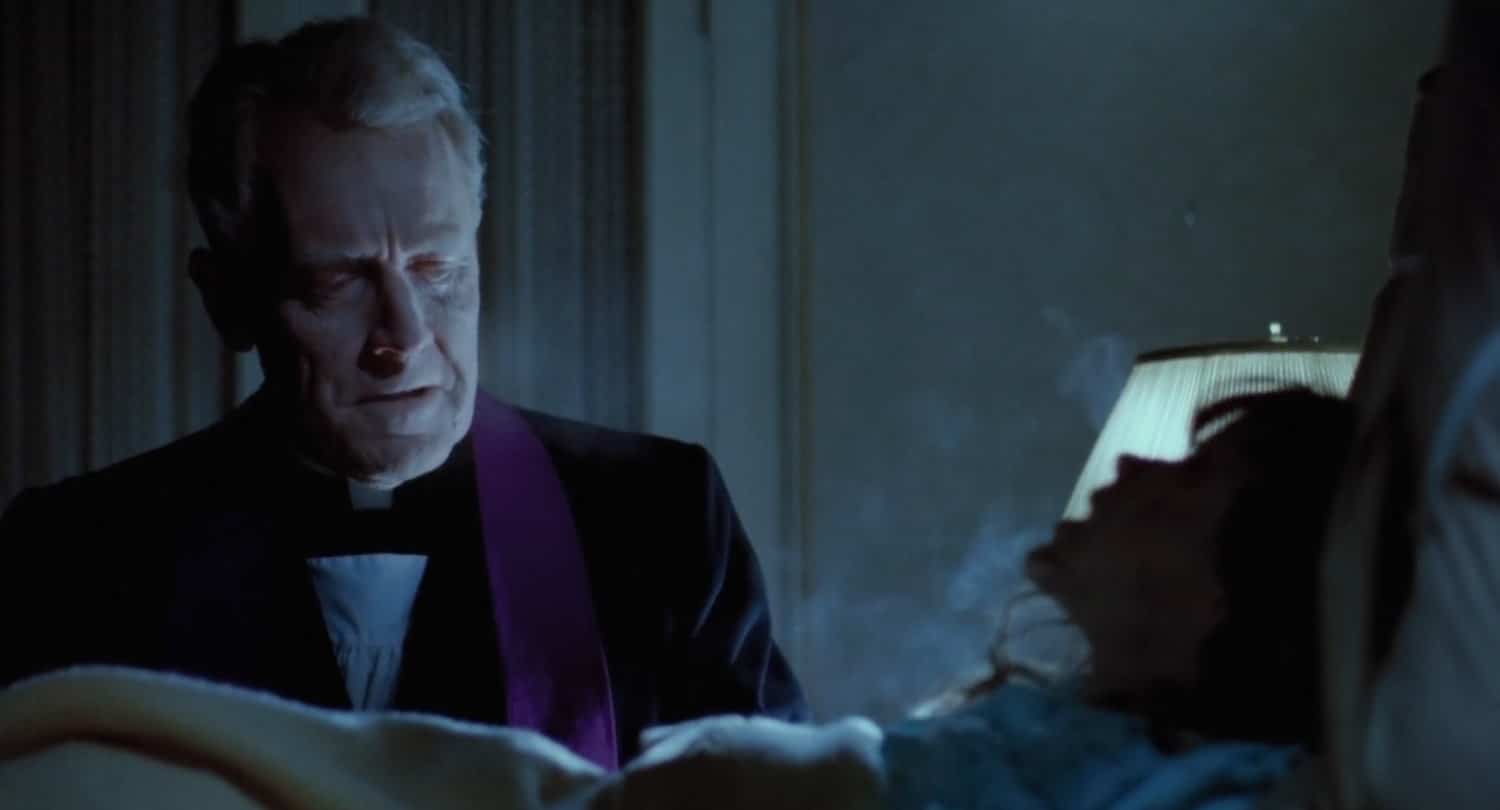
According to the patriarchal principles at the core of the story, women’s weakness in mind, spirit, and body makes both mother and daughter easy prey for the devil.
Satan prefers a male heir while using women only for their bodies, which subsequently become abject. In The Exorcist, this abomination is linked to the blurring of gender expression. Regan’s hellish voice and changed facial features are coded masculine. Stigmatizing the coexistence of traditionally male and female attributes as unnatural and even abhorrent corresponds to and encourages transphobic bias.
The iconic shock scene of her masturbating with a crucifix mixes sexualization, sanctimoniousness, and sensationalism, all of which are key elements of the Satanic Panic.
Father Karras’ brutal battle with Regan, framed as being for her own good, is uncomfortably evocative of corrective rape. True to the tradition of dismissing sexual trauma, the excruciating process leaves no scarring whatsoever and is reaffirmed by the assumption that anything is forgivable to expel the demonic powers. Even suicide, as committed by Father Karras, was to trick the demon.
Giving Father Karras the last rites suggests not empathy for self-chosen death but a carte blanche to clerical conservatives.
The Omen (1976): Hellish Heredity
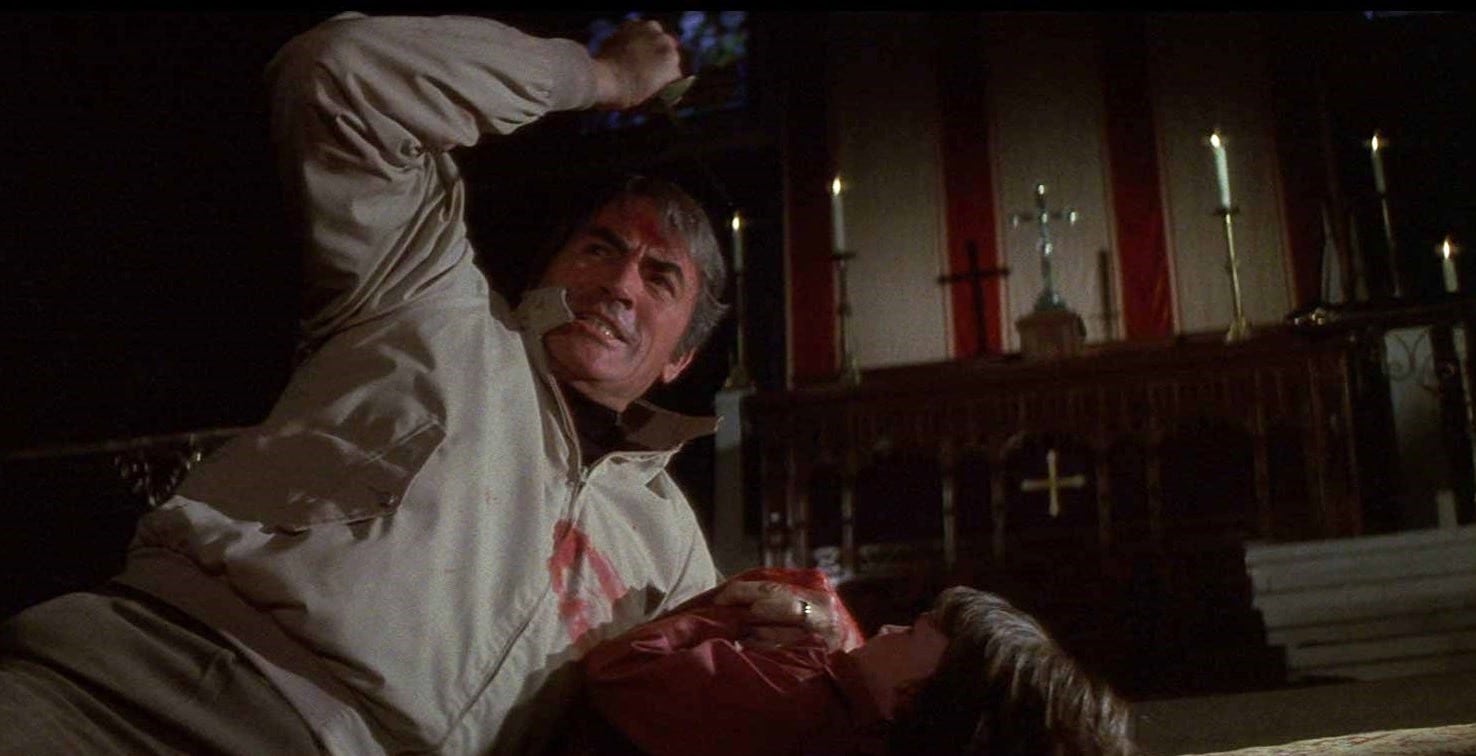
At its conservative core, Richard Donner’s occult thriller is a warning of the supposed dangers of adoption.
The latter is meant to repair the nuclear family, but instead, it eradicates it. As the ominous ending suggests, this pattern will repeat itself until the malevolent main character grows up.
Little Damien’s integration into the family of US diplomat Richard Thorn succeeds thanks to double-fold deception. Richard hides from his wife that the child is not her own, who allegedly passed away shortly after birth. At the same time, he is deceived about the baby’s occult origin. There can be no doubt about the actual father after the revelation that Damien is the Antichrist.
His sinister stare causes death and disaster.
Rather than setting up an atmosphere of ambiguity over Damien’s involvement in the deadly misfortunes that happen around him, Donner makes his guilt apparent.

Thus, the audience empathizes with Richard’s growing antagonism towards his son.
Equally highlighted is the threat of class infiltration. The hereditary succession of the upper class is interrupted by one far below them. A non-pedigree person existing among the elite is literally the devil’s work. Nepotism is presented as natural in any sense, whereas egalitarianism is seen as apocalyptic.
According to the story’s contorted classism, evil cannot come from a respected, affluent background. Unless, of course, it has been planted there.
Upward mobility is caused by and causes the destruction of everything privileged patriarchs hold dear: traditional family models, inherited political power, social hierarchies, and class constrictions. Class limits are reframed as protective borders, not only to the tragically deluded people who support disadvantaged kids, but to mankind.
The Amityville Horror (1979): Malevolent Milieu
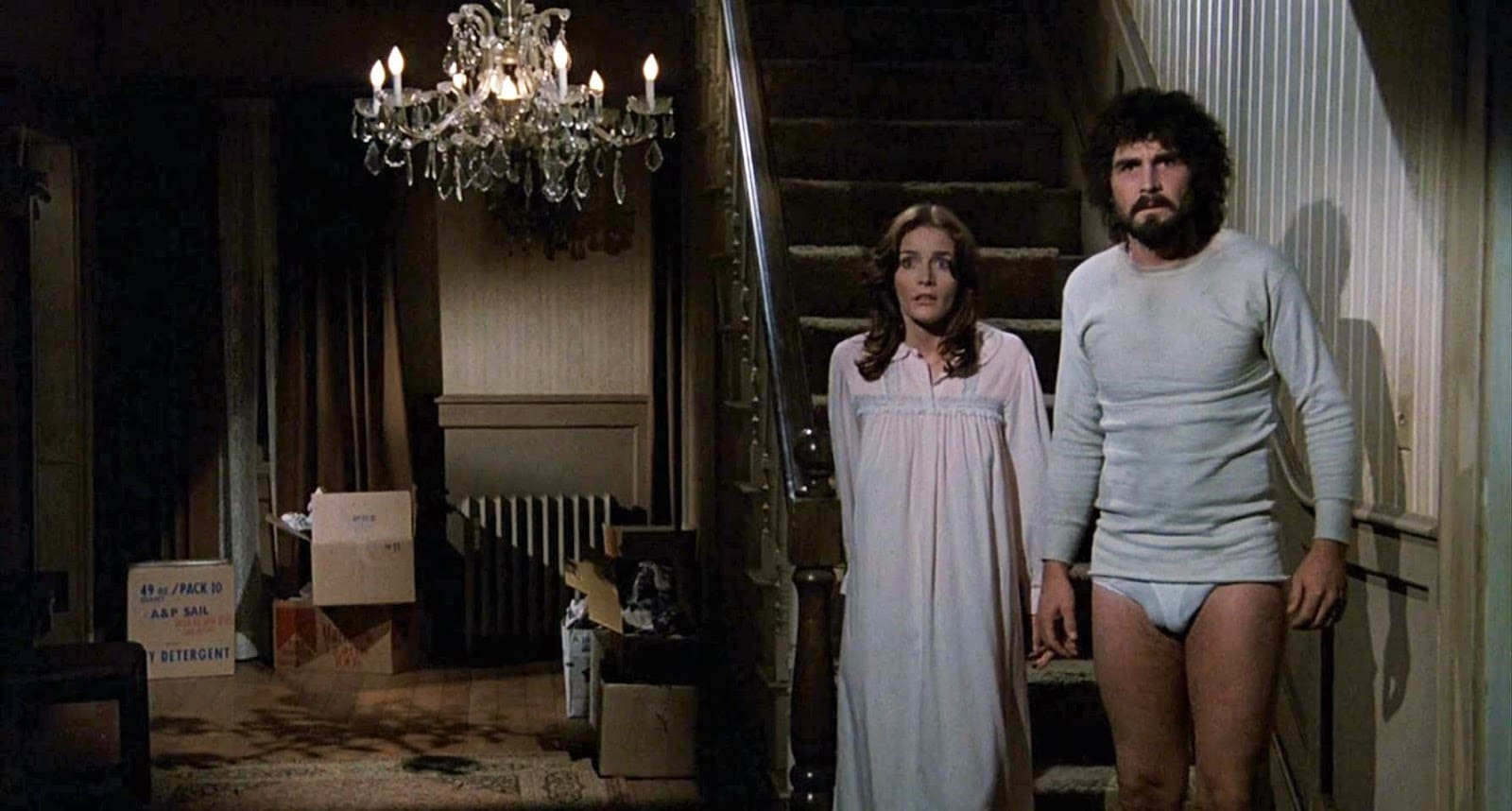
The cinematic influence of Stuart Rosenberg’s haunted house horror can be seen in films like the ever-expanding Conjuring franchise. The successful series dramatizes the real-life paranormal investigators Ed and Lorraine Warren, who built their fame upon their involvement in the Amityville case.
Rosenberg’s occult thriller features a paranormal power that doesn’t need a human intermediary, only unsuspecting victims.
These are the Lutz family, poster people for upper-middle-class respectability. After moving into the titular abode, Catholic wife Kathy even wants her new home blessed by a priest. He becomes the first to feel instinctively repulsed by the house.
Like its canonical predecessors, the story embraces religious resentment and personal prejudice, reiterating well-known lessons: When a representative of traditional values has negative feelings against someone or something, there must be something wrong with the subject of his aversion.
However, if someone has negative feelings towards clerical signifiers, the issue is with these feelings and the person who has them.
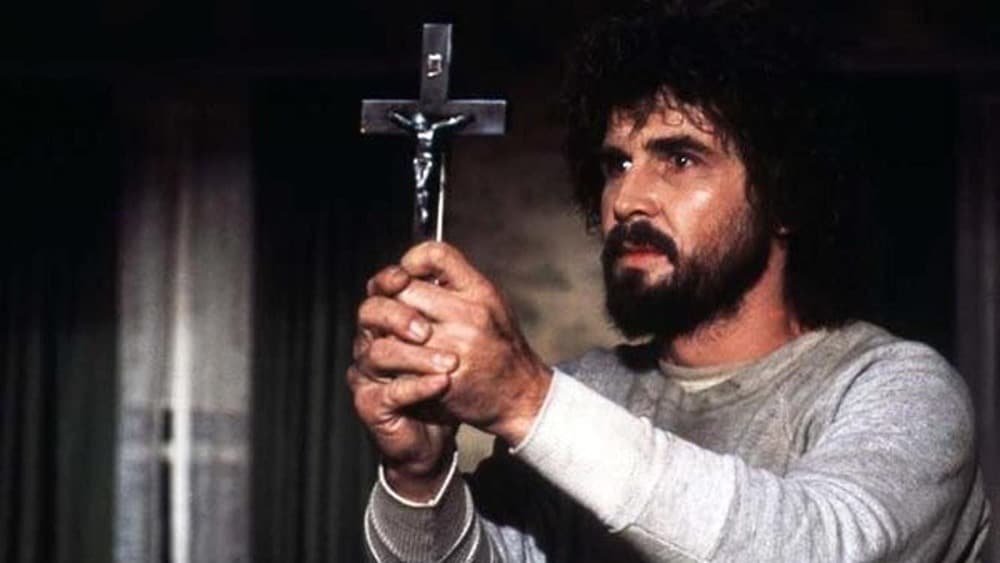
In line with this dialectic is the atheist husband and step-father George’s susceptibility towards the paranormal presence in the house. It was built by a devil worshipper, as the audience learns, and, as one of its visitors observes, it contains the door to hell.
In horror fiction, this door might be a physical reality. But it is also a metaphor for a presumed psychological perceptivity of those lacking masculine or monastic fortitude.
To become the devil’s victim or ally as George does, it doesn’t take transgressive deeds or complicit relations. Being at the wrong place at any given time was enough. The concept of a place as the devil’s domain makes the threat of satanic pollution universal and ubiquitous. At the same time, it lends more importance to the resentments against nonconforming individuals.
Not only do they themselves represent a danger, but they can also pollute a place and harm decent people, long after they are gone.
Conclusion
This cinematic quartet presents mystic metaphors for mundane fears surrounding pregnancy, puberty, adoption, and milieus. It translates the disorientation, dread, and disgust felt by a reactionary middle class in times of fundamental social change into compelling entertainment. While these films did not invite the fanatic frenzy, their stories and subtexts provided welcome fictional foils for the kind of pathological puritanism that defined the Satanic Panic.
By taking these visions literally, Pander and Smith created their own work of horror fiction. This spawned fanaticism that fed and fueled a hypocritical hunger for lurid exposés and notions of moral superiority. The main villain of the Satanic Panic was the specter of pervasive perversion.
Pervasive perversion was attachable to and would spread from any object, place, or individual: anything that conservatives didn’t like.
A common nomination of all films analyzed above is family constellations diverging from the traditional model. Another one is a lack of Christian faith. It is an allegory of what Pander and Smith were evoking themselves by fueling the Satanic Panic.
Believing in demons and devils was irreconcilable with the sophisticated self-perception of respectable traditionalist citizens. But believing in their dangerous disciples was not. In fact, it was considered a suspicious sign of ignorance not to believe in a hellish threat.
This belief provided a pretext to revel in detailed descriptions of sex, violence, and sadistic rituals while accusingly pointing the finger at others.

What makes this hypocrisy even more twisted is its fixation on children, both as victims and missionaries of moral corruption. Children were as much feared as feared for. They are only considered innocent as long as they act, look, and talk as conservatives want.
All four films justify parental paranoia: Rosemary is pregnant with the devil’s seed, the Thorns adopt the Antichrist, Regan’s mother feels her daughter’s demonic possession, and the Lutz family is threatened in a house the former owners of which were murdered by their son.
Parents who feel something is wrong with their kids must take rigorous action.
That the conservative craze put such an emphasis on condemning certain movies, music, and books while taking their own cues from films, talk shows, and books like Pazder’s and Smith’s is a bitter irony. It seems especially significant in light of more recent ramblings of an unholy union between the Devil and Democrats.
Just like contemporary illusions about child sacrifices in pizza parlors, the Satanic Panic cleverly capitalized on cinematic ideas. Though this era of supernatural fear monger may be gone, its message is still painfully relevant today: When patriarchal aggression, religious bias, and conservative hysteria become detectors for evil, they fuse into a perpetuum mobile of paranoia.
And, yes, there will be pandemonium—only it won’t be the Devil who causes it.





Follow Us!