

Cronenberg’s “Crimes of the Future” explores the dystopian nightmare that may await us if the crimes of the present continue.

No time to read? Click the button below to listen to this post.
With imagery as unsettling as the story, David Cronenberg introduces us to a new world in Crimes of the Future: one where our own pollution eradicated pain and infection from our bodies. In the absence of these things comes “surgery as the new sex” and the only true source of pleasure now.
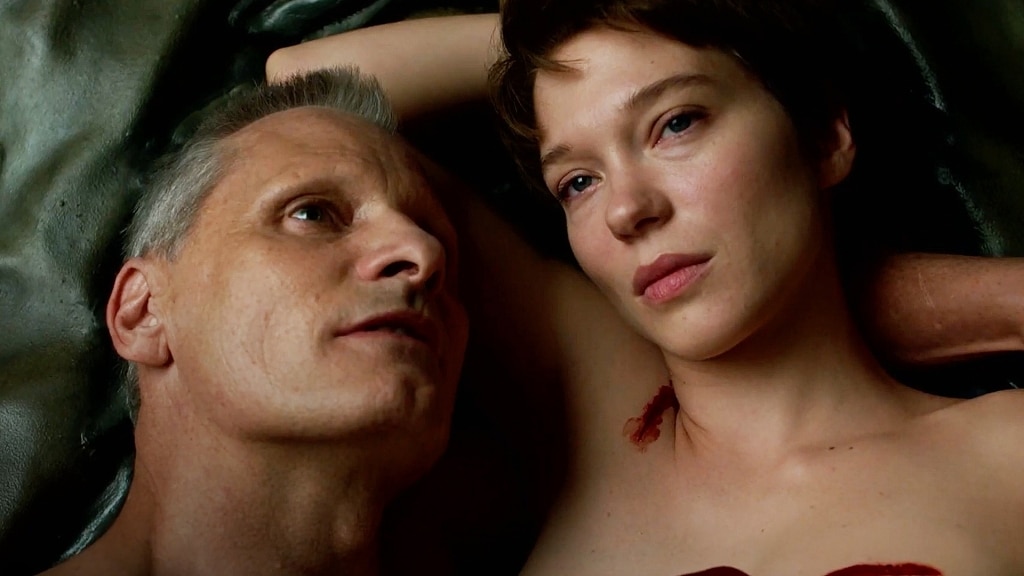
Saul Tenser (Viggo Mortensen) and Caprice (Léa Seydoux) are performance artists who exploit Saul’s ability to grow new organs. Their performance involves cutting Saul open and removing his organs in front of a live audience. His disorder leaves him in constant pain, making it difficult to eat or even breathe. He requires an array of specialized biomechanical devices to get through the day.
Saul hates the way his body rebels against him and causes him to suffer unbearably while the world around him revels in his misfortune, taking pleasure from his pain. He’s also forced to register his new organs with the corrupt government. Eventually, he discovers that his body has evolved naturally to consume plastic, which others have had surgery to replicate.
Saul is the next step in natural human evolution after humans ruined the world, something the government will most certainly destroy him for.
Cronenberg asks, who and what are we without pain?
What have we done to our world in the pursuit of our own pleasure, comfort, and convenience?
Pleasure has become distorted. Wounds in this nightmare world become vaginas, and sharp objects are phalluses. Cauterization is now the heat of passion. Desire is distortion, and voyeurism exists from another person’s pain, wishing it were you feeling it.
Crimes of the Future is horny in execution because it’s honest with itself about the nature of humans: we’re ridiculously amorous by nature. If it’s not sex, then it’s something else taking the place of sex.
In George Orwell’s 1984, the sex instinct was replaced with a religious-like fanaticism of Big Brother and community-strengthening activities. The act itself was rebranded as perverted because they wanted to stamp that desire out and make it a slightly gross thing that must be done for procreation only.
The sex impulse has to be controlled and channeled elsewhere; otherwise, it gets out of government control.
We Are the Ecological Disaster
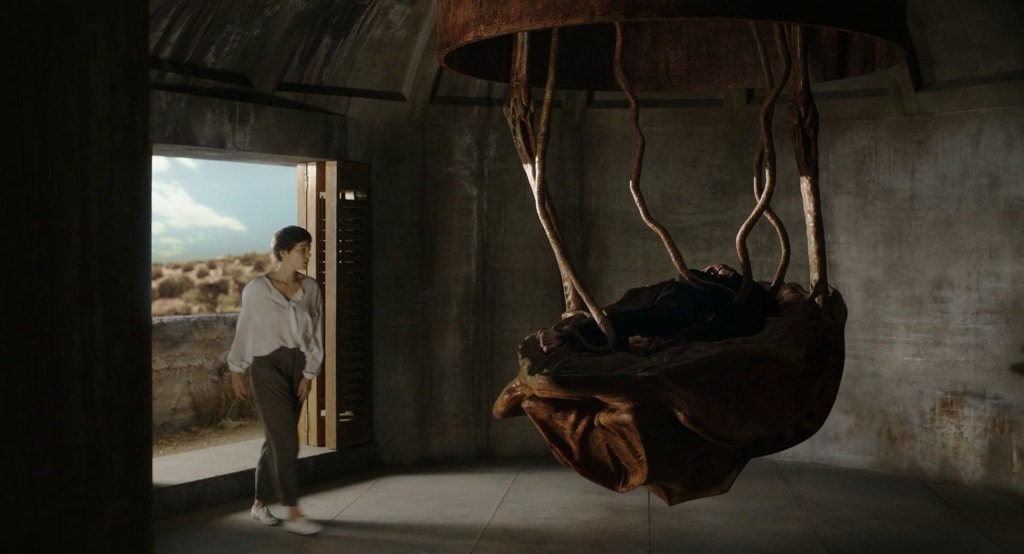
In Crimes of the Future, even the bed Saul sleeps in has to anticipate his pain, but his body’s forced evolution is outpacing it. His body is trying to fix the world, to his sorrow, rebuilding the world through the bodies that ruined it.
In Cronenberg’s future, the Earth has become an avenger. “I’ll make you eat the plastic you filled me with,” it seems to be saying.
Pain is not futile; it’s a warning system. It is meant to alert us to what is wrong and what could potentially hurt or destroy us. In Crimes of the Future, humans destroyed their pain centers and blurred the line between pain and pleasure. It’s unclear where this endless pollution is headed in the movie… or how it will end for us in the real world. In neither case is the outlook terribly optimistic.
Ecologically, the Earth of 2024 is in a downward spiral: horrific pollution from the excesses of late-stage capitalism has changed the face of our world.
In pursuing pleasure, the people of Croneberg’s dystopian film have accidentally eliminated it by destroying the environment.
It’s a devastating premise that mirrors what is happening in our real world.
Microplastics have recently been found in breastmilk and penises for the first time ever. This occurs in the literal source of all creation, meaning that our children will be born with microplastics in their bodies from the get-go. Rainwater is too polluted to drink, and the air is unsafe to breathe in certain areas. It begs the question: why? Why are we continuing to ruin the only planet we have?
When the pandemic began and people were forced inside, the earth healed temporarily in its reprieve from our destruction of it. A moment of hope devolved into a terrifying truth: humans are the ecological disaster.
In Crimes of the Future, this destruction came with a cost, just as it surely will for us.
In Croneberg’s nightmarish future, our bodies feel almost nothing, infection is gone, and some can now eat plastics. This is a comment on how we filled the world with this junk and our bodies with microplastics. Thus, the next step in the evolution of our bodies is to clean it up. In this new sexual surgery world, pollution has driven humanity into forced evolution. Earth is so toxic that it evolved to absorb the waste so man and nature could continue to coexist.
Lustful of Pain
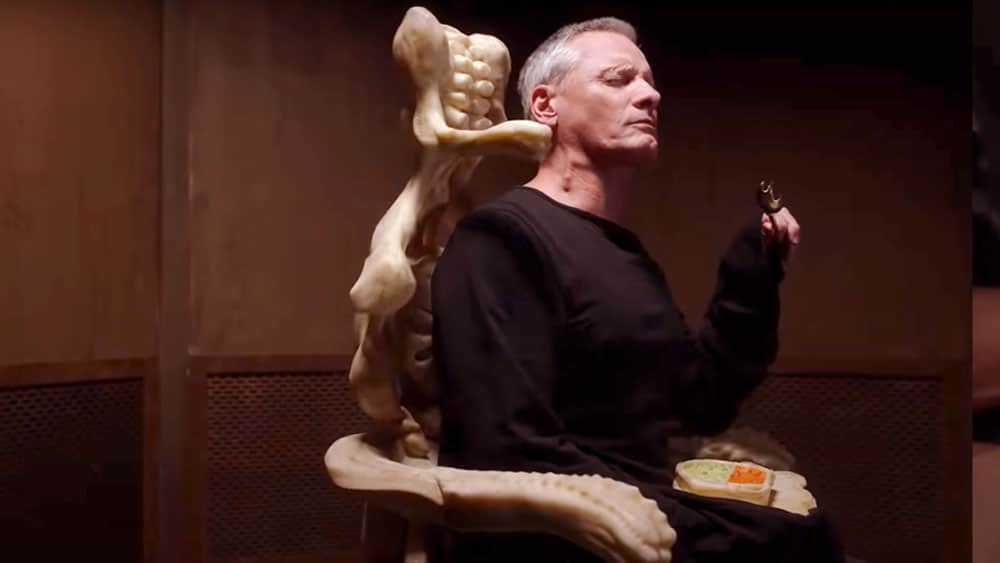
Saul Tenser lives in eternal pain, an existence marred by agony; his destruction of the new organs causes him to reject them from his body for the sake of performance. It is his way of expressing his rage that they’re there in the first place. Tenser hates his body because it hurts him. He wants this to stop. It isn’t art and is neither inspiring nor beautiful.
Pain still exists in this world, even if it’s in the negative image of what it once was, masquerading as pleasure. Saul is one of the “lucky” few who can still feel it. Even his voice is wracked with pain most of the time.
Every character in the film is lustful of Saul: they covet what he is, even if it’s a life of relentless pain and suffering. They want to try his Sark autopsy machine; they want to be part of the art; they want to have sex with him. All he wants is to sleep normally and eat a meal for once without feeling pain. Yet, they want his pain for themselves and believe on some level that it belongs to them.
Saul is at the center of an evolutionary movement but an unwilling participant.

He does not ask for what is happening to his body, but he does what he can with what he’s been given. Saul is deeply repulsed by everyone’s desire for his bodily pain.
The relationship between Saul and Caprice is very interesting; she acts like his lover but also like his mother. She is very possessive, caring about his health past the performances. It seems like love, but maybe it is simply that he is the closest she will ever get to feeling pain the way he does. Thus, she takes care of him and covets his pain for herself.
“It’s not healthy, a breakdown of the system…designer cancer” is how she explains his body to others. Yet, even when the two are alone together, she is hungry, and he passively enjoys her sexual hunger for his pain.
Saul wants to do what’s right and stop the madness. He didn’t intentionally evolve away from the human path—his body did it without his consent.
Inhumanity
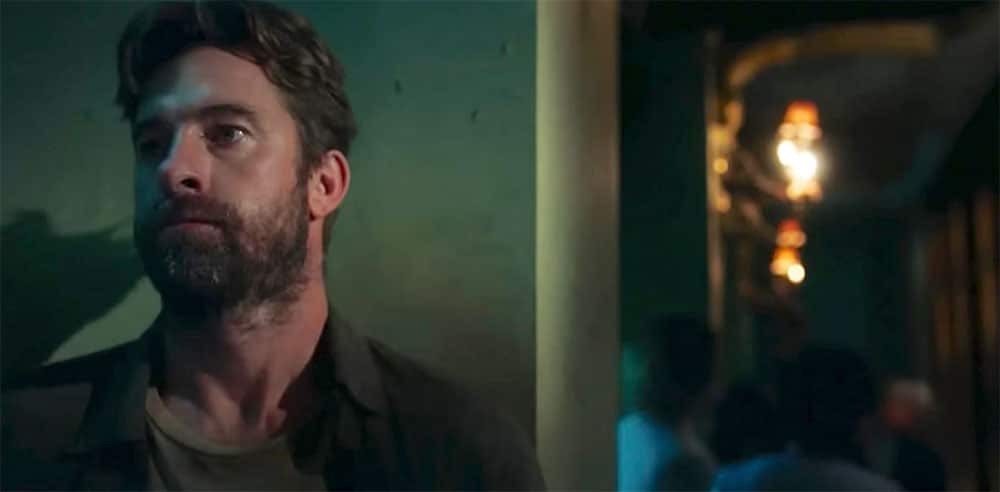
Evolutionists in Crimes of the Future have modified their digestive systems to eat plastics and other synthetic chemicals. Their principal food is a purple processed “candy bar” of toxic waste fatally poisonous to others. Lang is the leader of the cell; his son Brecken was born with the ability to eat plastic, proving the inaccuracy of the government’s critical stance on human evolution.
Lang and his people believe that the Earth is in harmony with this plastic-eating or it wouldn’t be happening at all—especially not occurring naturally like with his son. Lang is a man devoured by mad purpose and conviction that forcefully undergoing surgery to digest plastic is the only way to survive.
However, the price of this plastic consumption appears to be a loss of our humanity.
Even the mothering instinct is threatened. Cronenberg seems to say that even our most basic, strongest impulses as humans break down in the wake of forced evolution. Life becomes about nothing more than survival, and we emotionally devolve into animals that act on instinct as our bodies evolve to survive an increasingly inhospitable planet.
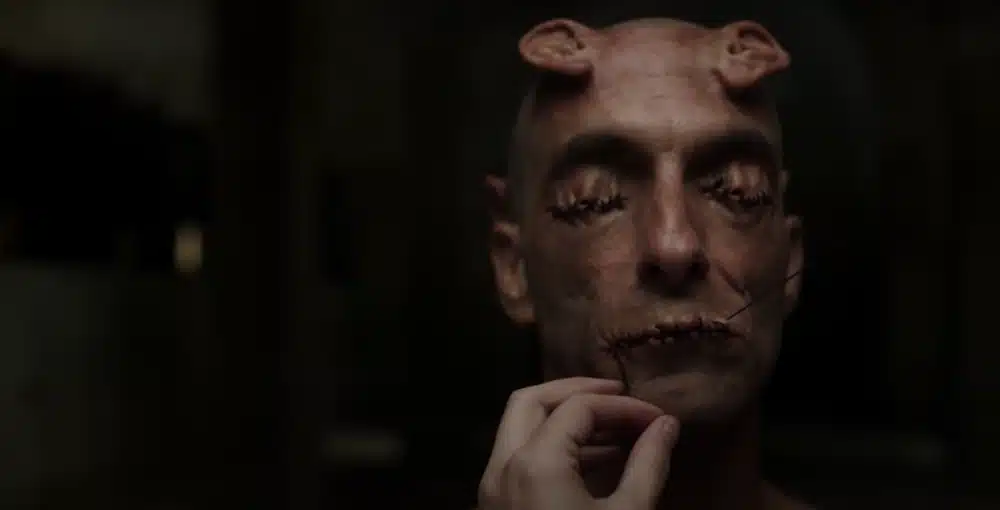
Inhumanity makes monsters of us all, as shown by a mother who smothers her eight-year-old son because he is born different, with the natural ability to consume and digest plastics as food. The boy’s father, Lang, takes on the role of a Dr. Frankenstein type. He has lost his fatherly instinct, allowing his son to be used for public autopsy and keeping his child’s remains in an ice chest.
Conclusion
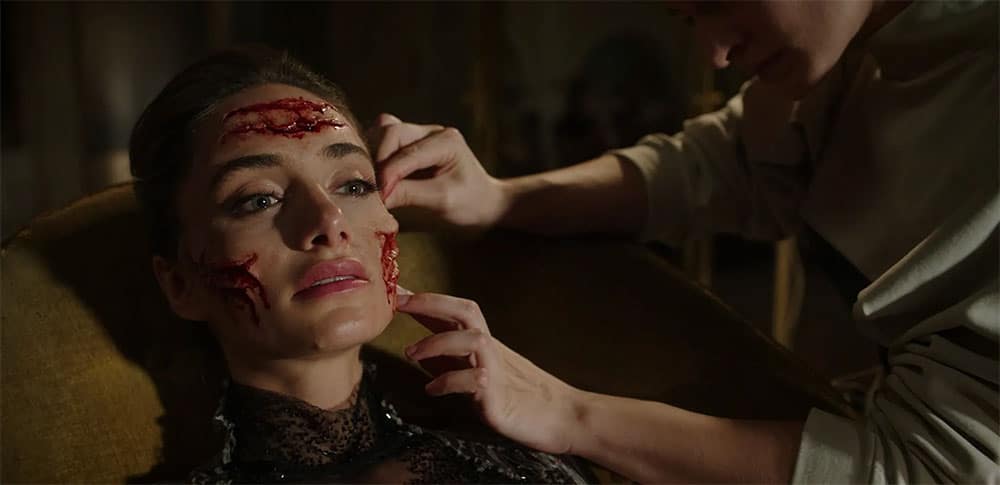
Crimes of the Future carries a powerful message.
Upon my initial viewing, I was frustrated with multiple story threads, which were opened up only to be unceremoniously hacked off without true explanation, allowing intriguing plot points to bleed out without sutures or cauterization. On subsequent viewings, however, I realized these storylines were merely meant to serve as observations of all that was happening in this world, culminating in big changes for humanity.
Ultimately, I think Crimes of the Future shines as a timely exploration of sexual instinct, pleasure versus pain, and ecological horror.












Follow Us!