

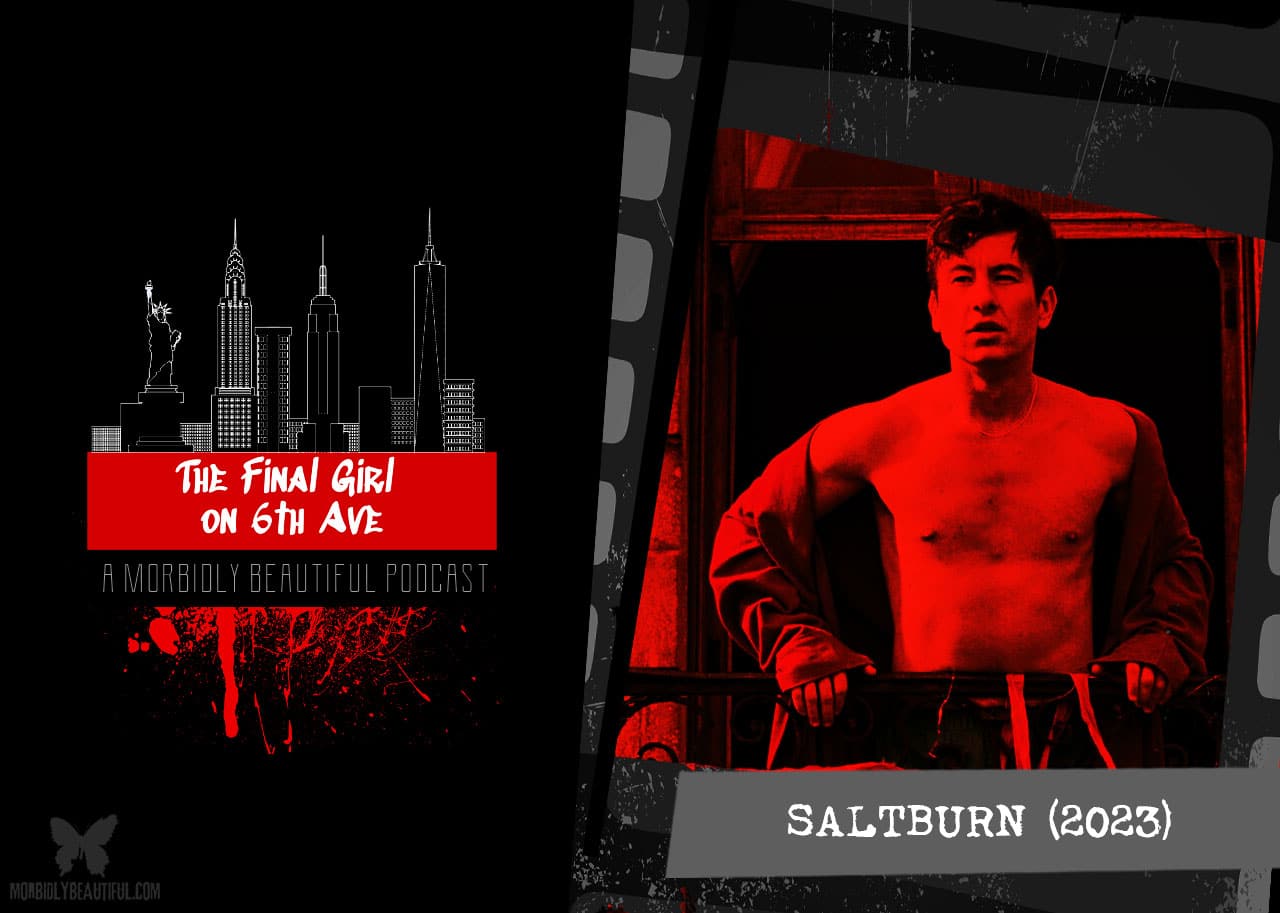
It’s the film everyone is talking about. Join us for a journey of decadence and deception as we explore the wicked world of “Saltburn”.

On this episode of The Final Girl on 6th Ave, host Carolyn Smith-Hilmmer tackles one of the most buzzed-about films of 2023 — a movie that kept audiences talking when it first landed on streaming and is still giving us all plenty to discuss. This subversive black comedy/psychological thriller film from Emerald Fennell (Promising Young Woman) stars rising talents Barry Keoghan (The Killing of a Sacred Deer) and Jacob Elordi (Euphoria, Priscilla). With its provocative blend of wry humor, considerable style, and intentionally jaw-dropping and controversial scenes, Fennell delivers a witty and undeniably entertaining exploration of class, desire, and duality. – Stephanie (Editor-in-Chief)
SHOW NOTES FROM HOST CAROLYN SMITH-HILLMER:
Ever have one of those films that you don’t really know if you can recommend to friends and family? Well, here I am, recommending one to you. Join me as I kick off 2024 with a discussion about SALTBURN, the story of how Oliver Quick becomes the last man standing in a battle no one else knows they are fighting.
Saltburn weaves a wicked tale of an Oxford University student (Keoghan) who becomes fixated with a popular, aristocratic fellow student at his university (Elordi), who later invites him to spend the summer at his eccentric family’s palatial estate.
It premiered at Telluride in August 2023 and received a theatrical release in the United States in November, followed by a streaming release on Amazon Prime Video on December 22nd. It quickly became one of Prime’s most-streamed films, anchored by critic accolades and positive word-of-mouth.
In writing the film, Fennell wanted to sympathize with unlikeable people, saying:
“The sorts of people that we can’t stand, the sorts of people who are abhorrent — if we can love them, if we can fall in love with these people, if we can understand why this is so alluring, in spite of its palpable cruelty and unfairness and sort of strangeness, if we all want to be there too, I think that’s just such an interesting dynamic.”
SOURCES/INFORMATION
IMDB: https://www.imdb.com/title/tt17351924/
The Symbolic Ending in Saltburn, Explained by Via Laurene: https://www.cbr.com/saltburn-symbolic-ending-meaning/
ABOUT THE SHOW:

The Final Girl on 6th Ave is a weekly show where host, Carolyn Smith-Hillmer, dissects an arthouse/elevated horror film. Each episode includes a detailed play-by-play of the film itself and a subsequent deep dive into the thematic elements and symbolism. Because elevated horror is sometimes viewed within the horror community as pretentious, Carolyn makes sure to use her down-to-earth tone and unique perspective to make these films less intimidating for the casual horror viewer and less ostentatious for the genre lover.
Listen to more episodes on the show’s website here.
The Final Girl on 6th Ave is a bi-weekly podcast where host Carolyn Smith-Hillmer reviews arthouse horror films in a non-pretentious way.
Lars von Tier and Horror
Lars von Trier has been called a visionary, a sadist, and a self‑mythologizing provocateur—sometimes all in the same breath. In this episode, we unpack how an anxious kid from Copenhagen became one of the most controversial figures in world cinema, and why his work looms so large over modern horror and “extreme” art‑film. Focusing on Antichrist, Melancholia, Nymphomaniac, and The House That Jack Built, we explore von Trier’s “Depression Trilogy,” his use of grief, sex, and violence, and the ongoing debates about misogyny, ethics, and audience complicity. Along the way, we bring in film scholarship, critical essays, and production histories to ask a simple but uncomfortable question: when von Trier pushes horror this far, is he revealing something profound about suffering—or just building a house out of pain?
SOURCES/INFORMATION
Biographical and career overviews
“Lars von Trier.” Wikipedia.wikipedia
“Lars von Trier – Simple English Wikipedia.” Simple Wikipedia.wikipedia
“Lars von Trier.” Encyclopaedia Britannica (biography, awards, filmography).britannica
“Lars von Trier filmography.” Wikipedia.wikipedia
“Lars von Trier – IMDb.” IMDb.imdb
“List of awards and nominations received by Lars von Trier.” Wikipedia.wikipedia
Context and Danish film culture
“Lars von Trier and Cultural Liberalism.” Danish Film Institute.dfi
Excerpt from Regional and Global Dimensions of Danish Film Culture and Film Policy (on Dogme 95 and Danish film branding).catalogimages.wiley
Critical profiles and interviews
“Lars von Trier: Behind the Curtain.” The New Yorker (profile on von Trier’s persona and controversies).mubi+1
“Lars von Trier: A Problematic Sort of Ladies’ Man?” NPR radio piece and transcript (Pat Dowell, with Caroline Bainbridge).npr+1
“The Many Faces of Lars von Trier.” BFI feature.bfi
“Lars von Trier: An Overview.” Film Festival Today (career overview).filmfestivaltoday
Horror‑specific and film‑specific sources
“The Immersive Examination of Depression and Grief in ‘Antichrist’ [Unveiling the Mind].” Bloody Disgusting.bloody-disgusting+1
“Antichrist (2009)” – film entry and production details. IMDb and Wikipedia.imdb+1
“The House That Jack Built (2018).” IMDb (plot, reception).imdb
“Manically Macabre: Lars von Trier as Horror Icon.” Horror Obsessive.horrorobsessive
“‘Terrifier 2’ and 9 Other Horror Movies Which Famously Made Audiences Sick.” Collider (section on Antichrist).collider
Scholarly / analytical work
“Lars von Trier – The ‘Sex’pression Ideology.” Academic essay (via Academia.edu PDF).academia
Caroline Bainbridge, The Cinema of Lars von Trier (discussed in NPR and academic contexts).npr+1
Career primers
“Notebook Primer: Lars von Trier.” MUBI Notebook.

Episode play icon
Lars von Trier has been called a visionary, a sadist, and a self‑mythologizing provocateur—sometimes all in the same breath. In this episode, we unpack how [...]
May 1, 2026
Episode play icon
In this episode, we explore why we willingly scare ourselves — unpacking the neuroscience of fear, the psychology of personality and anxiety, and the surprising [...]
March 1, 2026
Episode play icon
The Final Girl looks a little different for 2026… in the best way! Join in for the first episode of 2026 where we uncover what [...]
January 21, 2026
Search Results placeholder








Follow Us!