


The cinematic adaptations of “Salem’s Lot” offer a fascinating glimpse into how filmmakers reimagine timeless terror for new generations.
No time to read? Click the button below to listen to this post.
In the pantheon of Stephen King’s literary works, Salem’s Lot stands as one of his most chilling and enduring tales. Published in 1975, this novel marked King’s return to classic horror tropes with a fresh, modern twist: a vampire story set not in a distant Gothic castle but in a sleepy New England town. Here, the creeping terror of the undead blends seamlessly with the isolation and decay of small-town America, creating a haunting reflection of societal fears and personal demons.
At its core, Salem’s Lot is a tale about the darkness lurking in the most familiar of places and the fragility of a community when faced with an ancient evil.
The story follows Ben Mears, a writer who returns to the town of Jerusalem’s Lot to confront childhood trauma, only to discover that something far more sinister has taken root. As residents begin to disappear, Mears, along with a group of unlikely allies, uncovers a horrifying truth: the town is slowly falling under the spell of a centuries-old vampire, Kurt Barlow.
The novel is both a gripping horror narrative and a powerful exploration of the decay of American small-town life, making it a pivotal work in King’s early career.
Over the years, Salem’s Lot has been adapted for the screen twice, first as a 1979 miniseries and most recently in 2024 as a full-length film. The 1979 adaptation, directed by Tobe Hooper, became a cult classic, capturing the eerie atmosphere of King’s novel with a slow-burn approach and memorable practical effects. However, the 2024 reinterpretation sought to modernize the story for a contemporary audience, introducing new thematic elements and visual styles that diverge from the original source material.
This article explores the core differences between the two adaptations, examining how the 2024 film attempts to update King’s vision and whether these changes enhance the haunting legacy of Salem’s Lot or stray too far from its roots.
1. How it Begins
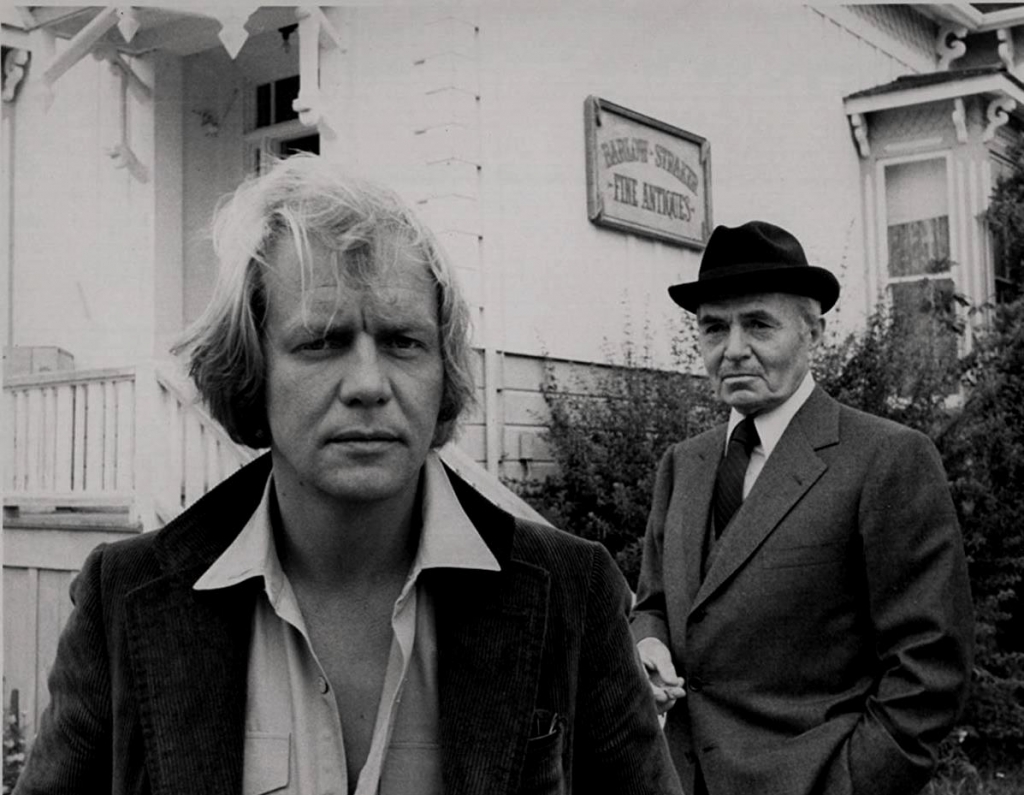
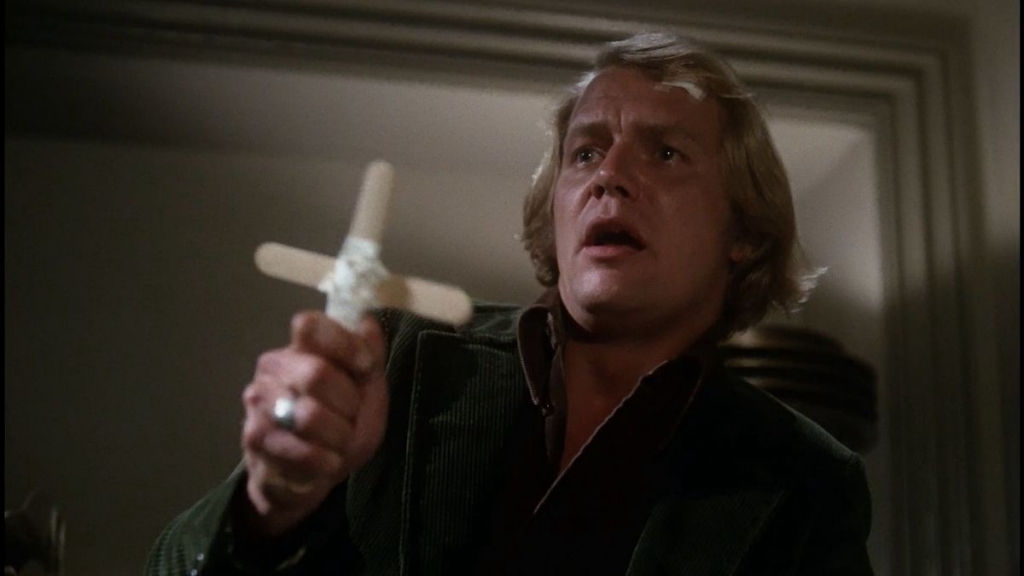
The original opens with Ben Mears (David Soul) and Mark Petrie (Lance Kerwin) in a church in Guatemala, filling bottles with holy water. The jar Mears holds begins to glow blue, indicating a vampire is nearby. Then, it flashes to Ben Mears driving up to the Marsten House and staring at it.
In the remake, the opening starts with Ben Mears (Lewis Pullman) driving on a country road through Salem’s Lot, with Gordon Lightfoot’s song, Sundown, playing until he pulls up to the Marsten House.
The 2024 remake plunges the audience into the narrative, creating an immediate sense of intrigue.
2. Setting the Stage
In the original, Ben Mears (David Soul) drives up to the forbidding Marsten House, gets out, and stands there staring at it in an almost mesmerized stupor, beads of sweat pouring down his face while eerie music plays in the background. It’s evident to the viewers that Mears is scared of the house.
In the 2024 remake, the fear is just as palpable as in the 1979 original, but it’s more subtly portrayed. Ben Mears (Lewis Pullman) drives up but stays in the car, staring at the house while thrumming his thumb against the steering wheel. This creates a tense atmosphere that keeps the audience on the edge of their seats.

3. The Marsten House
In the 1979 version, Marsten House is the center of the story. It was such a central part of the film that the original movie ran three hours and three minutes. Almost every scene referenced Marsten House and its inherent evil. To accommodate the length, they split the film into a two-part mini-series.
The remake ran one hour and fifty-three minutes and still conveyed the importance of the house. The director of the 2024 remake, Gary Dauberman of the Annabelle films, takes a more direct route. He provides the entire background of Marsten House by using a map with trails of blood running across highway routes combined with newspaper clippings during the introductory music theme, providing the whole back story in the opening soundtrack.
Both versions imply that the Marsten House is innately evil and that evil attracts evil. The weight of the Marsten House’s presence is palpable in both versions, adding a sense of dread and anticipation to the story.
4. Directors Directors, Different Visions
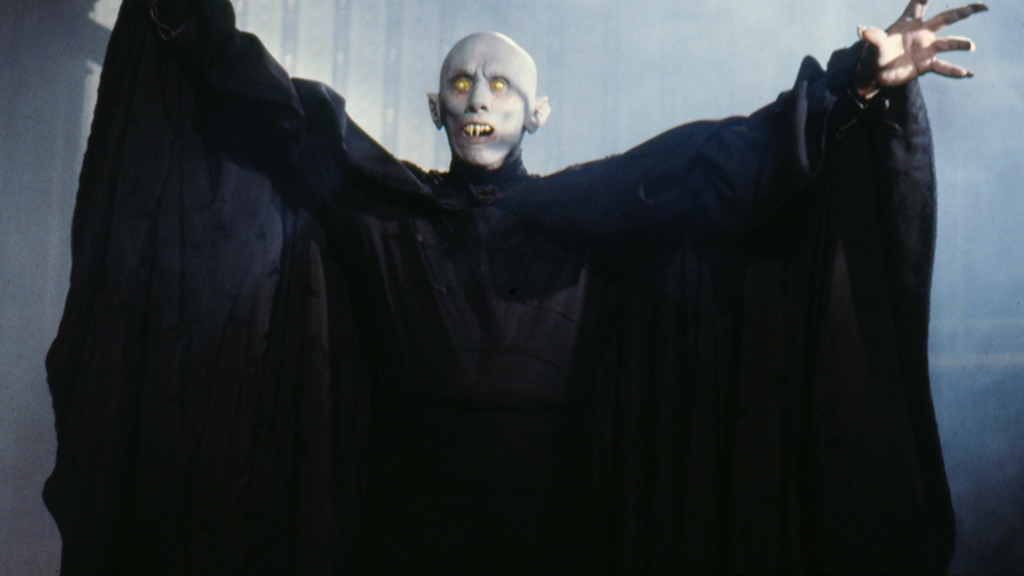
Director Tobe Hooper, most famous for his terrifying and influential slasher The Texas Chainsaw Massacre, took a slightly more subdued approach with Salem’s Lot. He spent almost 90 minutes delving into his characters’ relationships, using their actions and behaviors to show how evil from the Marsten House leaked into the town. The town’s underlying evil attracts Richard Straker (James Mason) and Kurt Barlow (Reggie Nalder) to Salem’s Lot in the first place.
Dauberman uses the town and people instead of words to tell the viewers how evil Marsten House is. In the film’s opening theme song, Ben Mears drives into town with Gordon Lightfoot’s Sundown lyrics playing. The viewer is introduced to small-town living, seeing people smiling and happy as they go about their daily lives. Mail is delivered; a milkman picks up empty bottles and replaces them with full ones. The paper boy throws rolled-up newspapers on lawns while Mears continues driving through the town to Crockett’s real estate office. By the time Mears parks his car, the viewer knows the same information that Director Hooper took almost an hour to tell us in the original film.
5. Character Shuffle
Both movies use the same characters, but the 2024 remake did a shuffle. In the original, Susan Norton (Bonnie Bedelia) is Dr. Norton’s daughter. In the 2024 version, Susan Norton’s (Makenzie Leigh) father passed away and is Larry Crockett’s assistant instead of “Boom. Boom. Bonnie Sawyer.”
In the 2024 remake, Bonnie Sawyer plays a small role in a scene at the drive-in theater where Susan says Bonnie is breaking up with her boyfriend for the 10th time. Alfre Woodard portrays Dr. Cody, who replaces Dr. Norton from the original.
6. Trimming the Fat
When Duberman rearranges the characters, he eliminates those without connection to the story, such as Larry Crockett, the man Bonnie Sawyer had an affair with in the original. The affair added nothing to the story except an additional viewing time for the movie. I was sorry to see Faithful, the black labrador, die mysteriously in the graveyard. But I still do not understand what his death had to do with the story.
Dauberman kept the main characters in the story, like Susan Norton, her mother, Anna Norton, the Glick Brothers, Ben Mears, Larry Crockett, Father Callahan, Mark Petrie, Richard Straker, and Kurt Barlow.
7. Scoring the Scares
Dauberman and Hooper both use eerie and creepy music to enhance the upcoming spooky events. In the original, Harry Sakman’s music didn’t steal the scenes but added a subtle background that enhanced the eeriness of the moment. However, it was reminiscent of the standard 70s horror music and not original.
Nathan Barr and Lisbeth Scott from the 2024 remake followed suit, using the music score to add depth and nuance to the scary scenes. They used music to make those scenes even more suspenseful, which added to the viewers’ enjoyment. The music in the remake was subtle, adding to the enjoyment of the film instead of detracting from it.
8. Showing Versus Telling
When Ben Mears and Susan Norton go on a date in the original, Mears asks what there is to do in Salem’s Lot. Susan replies, “There’s Dell’s, the drive-in, and the lake.”
In the remake, viewers see these locations instead of just hearing them mentioned. To me, this cements the characters’ interactions. Viewers know where the characters interact and bond, which adds to the believability that these characters are fully developed and not just a concept.
In the original, Mike Ryerson (Geoffrey Lewis) simply shows up at Jason Burke’s (Lew Ayres) and tells him he doesn’t feel well. This seems improbable, no matter how friendly the town is.
In the remake, Matthew Burke (Bill Camp) senses something is wrong in the town. When he goes to Dell’s and sees how empty the place is, he can’t help but be convinced his instincts are correct. He notices Mike Ryerson (Spenser Treat Clark) sitting confused in the shadows at one of the booths.

9. The Final Showdown
In the original, Mears finds Barlow’s coffin in the cellar of the Marsten House, but with only a few bodies. The rest of the town’s bodies were nowhere to be found. This raises an interesting question: where were the rest of Salem’s Lot’s townspeople? Mears and Mark pull Barlow’s coffin out of the cubby hole in the cellar, where Mears pushes a stake through his heart, killing him. They started a fire, which burned Marten’s house, and headed toward the town. Mear’s response was the city would be purified by the fire.
The remake Mears finds Barlow and all the townspeople in the trunks of their cars at the drive-in theatre. It was mentioned earlier in the movie that all the townspeople wound up at the drive-in at one point or another. So, it is at the drive-in that the final showdown takes place, where Mears and Mark have to fight Anna Norton, who is now Barlow’s guardian.
Then Mears had to fight the woman he loved, while Mark fought the head Vampire himself.
In my humble opinion, it was a much better showdown than the original.
10. How it Ends
In the original, the ending shows Mears and Mark running from the surviving vampires. A flash forward shows them in Guatemala, where Mears states the Vampires had found them. It turns out that it was Susan Norton, whom Mears stakes. He then tells Mark they have to go on the run again as the Vampires are closing in once more.
The remake ends with Mark asking Mears, “What do we do now?” Mears responds by pulling the Houdini card and saying, “We make our escape.” They drive away from the drive-in with the lyrics of Gordon Lightfoot’s Sundown playing.
IN CONCLUSION
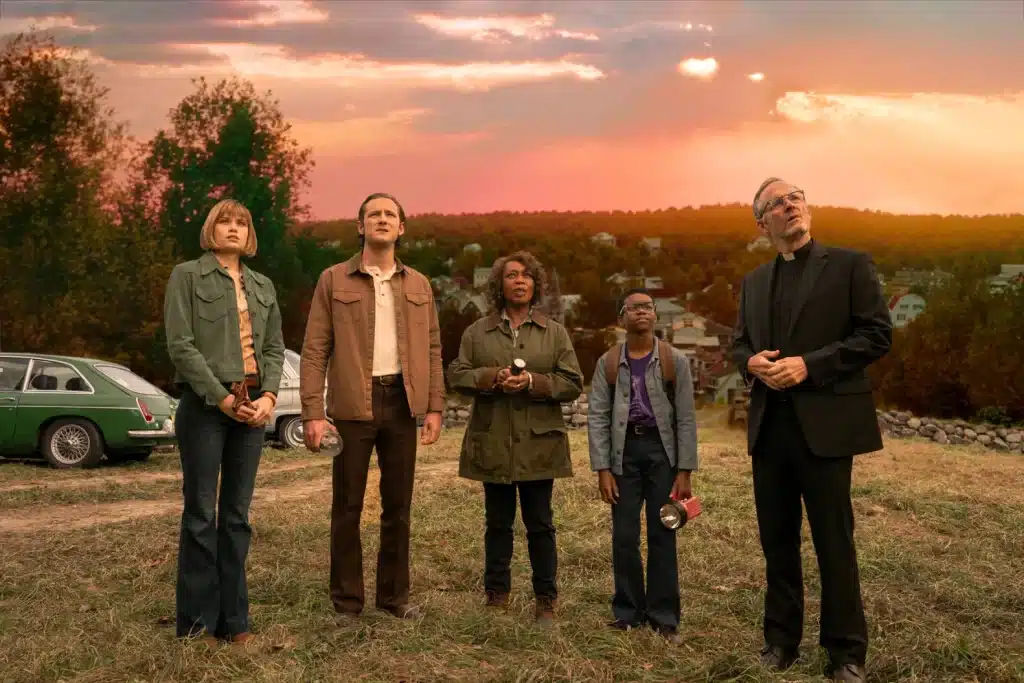
I have read the reviews and understand the critiques, but I enjoyed the remake better.
If the time spent on Bonnie Sawyer’s relationship with her husband and her affair with Larry Crockett had been added to the story, I would have been okay with it. But it didn’t add to the story, and the time wasted on that scene in the original could have been better spent on where the townspeople were disappearing to, as there were only a few bodies in the crypt—not the entire 2,000-plus that make up the town’s population.
The remake answered that question by having all the town’s cars show up at the drive-in. The Vampires used the trunks as coffins, which I thought was an original concept.
I liked the little additions that, in my opinion, added to the believability of the plot: Dr. Cody’s (Alfre Woodard) response when Ms. Glick came to life and Anna Norton’s subtle descent into madness. The town was also used to tell the story, like the bottles of milk piling up on the stairs, mailboxes stuffed full of mail, and rolls of newspapers stacking up in yards. These were all subtle hints that the town was dying, hints that the original didn’t provide.
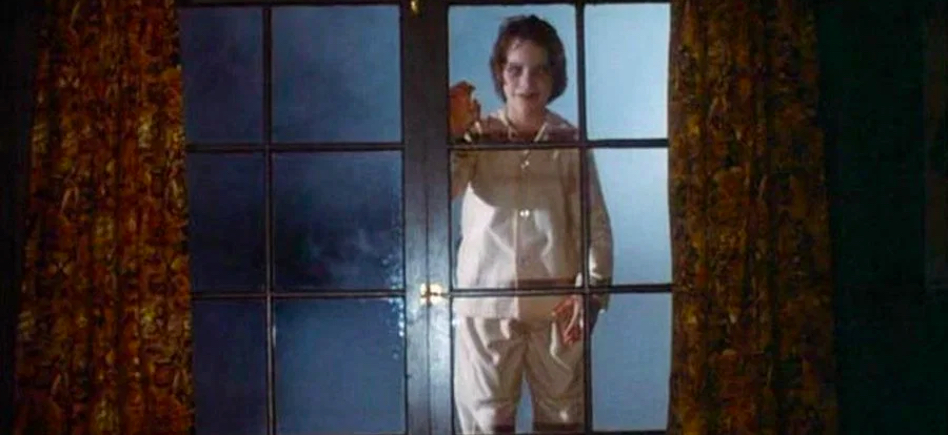
The original’s special effects were better in some areas, such as when the Glick boy scratched at the window. That was spooky as hell. But the effects in the remake are stronger than critics give it credit for.
The bottom line is that both movies are entertaining and well-made, and each has its strengths and weaknesses. Ultimately, which is a better vampire film simply comes down to a matter of personal preference.






Follow Us!