

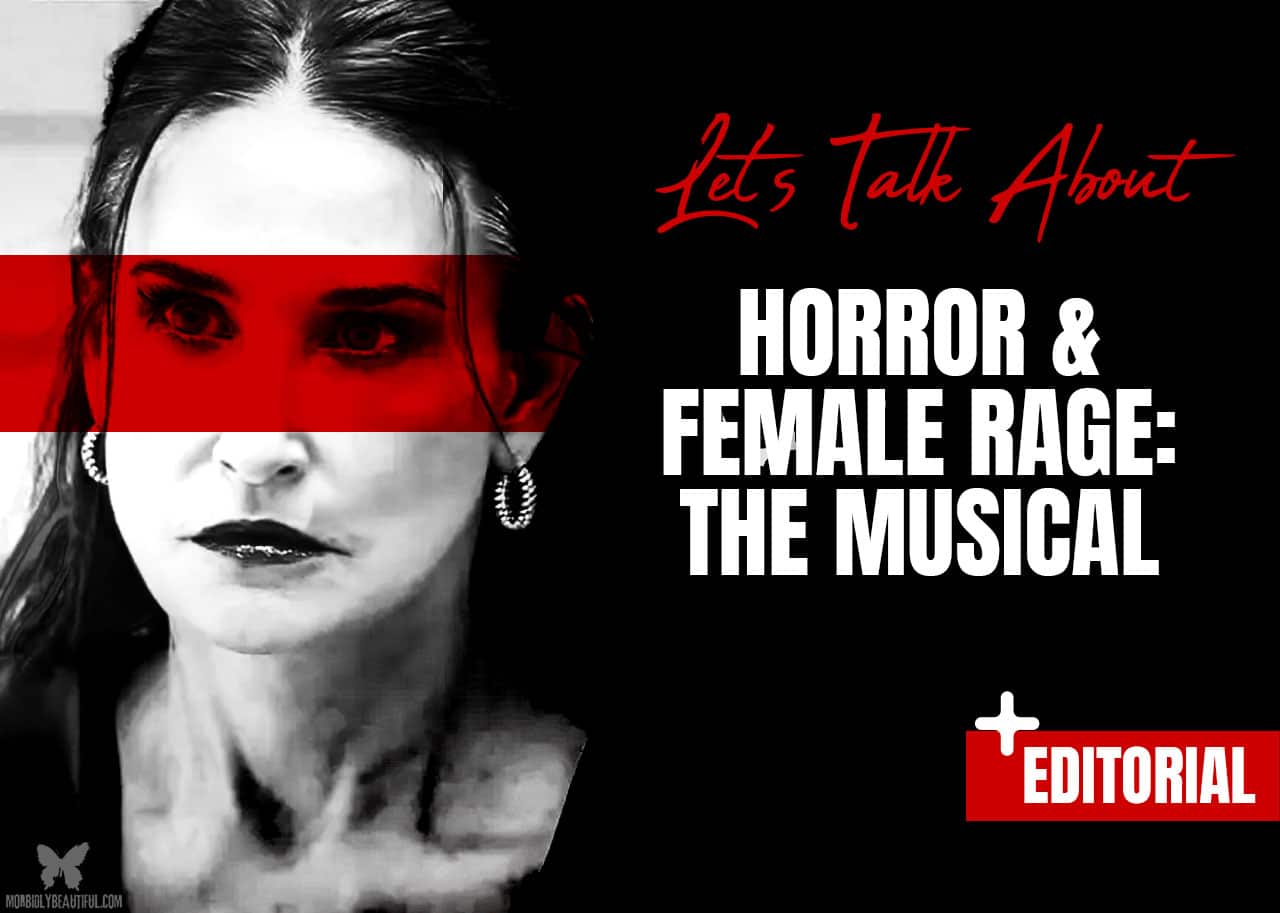
Female rage in horror isn’t just an exorcism of demons; it’s a call to arms and a potent embrace of inner strength in the face of oppression.

CONTENT WARNING
Women’s issues and experiences. When I use the term woman/women/womanhood, it is used generously and intends to include anyone who connects with this identity-based term (e.g., those who are assigned female at birth, present as female and/or have a feminine gender expression and embrace the term, may or may not mean having a uterus, etc.). I welcome corrections about anything presented here that feels harmful. However, any comments that reflect hateful viewpoints will be deleted.
This piece has been simmering in my psyche since the day Sabrina Carpenter’s horror-inspired music video for Taste was released, and my keyboard ached, begged, and finally demanded I purge the musings, given Demi Moore’s and Coralie Fargeat’s critical acclaim and mainstream recognition for The Substance.
I had so many feelings, both deeply empowering (gestures wildly at Beyoncé, Brittany Packnett Cunningham, Ali Wong, Taylor Swift, Sabrina, Gillian Anderson, and Pamela Anderson) and utterly terrifying (all things US election, local legislation across many jurisdictions aimed at creating barriers to accessing sexual and reproductive health care and services, Iranian legislation around the hijab), about womanhood in 2024.
In May 2024, Taylor Swift quipped on Instagram that the new segment of the Eras Tour featuring songs from her new album, The Tortured Poets Department, is more aptly described as “Female Rage: The Musical.”
This made me laugh (and spawned some amusing merch).
Female rage felt immediately and unfortunately familiar, and having a musical about it seems like a fun way to offer hard truths and create community a la the Barbie movie. Because I know that rage. I don’t know a single woman who doesn’t, frankly.
For me, it took time and a lot of shit experiences to be able to name it, but as I sat here to reflect on my own journey with female rage, I confirmed my ongoing laundry list started around age ten.
I didn’t realize that my sex and how I present my gender would mean that, to thrive—or simply just survive—I needed to learn how to spot predators—sexual, power, energy, financial, etc. With age and experience comes learning that spotting them isn’t enough: You have to avoid and, in some severe cases, outmaneuver them.
This leads me to the connection to horror.

We love a good Final Girl. The Alien, Scream, Halloween, and Terrifier franchises are some of the biggest. However, as Morgan Podraza is quoted in this article saying, “Cycles of representations that we see of the Final Girl in slasher franchises are really a reflection of how people think about [and] talk about real violence against women.”
We love a good revenge or “good for her” horror. Revenge. I Spit on Your Grave. Audition. The Invisible Man. However, this is “problematic because the lead up involves further female violence and brutalization,” again, something that is believable because of the pervasive nature of violence against women.
Now, let’s shift the lens a bit.
What about consciously gender-centred horror? The Substance. Death Becomes Her. ‘The Outside’ episode in Guillermo del Toro’s Cabinet of Curiosities. Or Sabrina Carpenter’s Taste music video. These pieces remind us that we’re not just fighting those tangible, external dangers. Those external dangers are the obvious threats.
We can’t ignore the internalized predator, the one influenced by cultural and systemic factors and capable of additional self-inflicted and/or lateral violence.
(Um, fuck the patriarchy and the weaponization of religion for a few reasons?)
I want to spend the rest of my time here, exploring why the horrors of beauty standards and expectations are not superficial at all.

In fact, I feel that beauty holds far too much power and asserts its dominance in unwelcome ways throughout the mundanity of our day-to-day lives.
Lately, this reality has me reflecting on this question a lot:
Can we (women) love ourselves enough (individually) to form a cohesive collective force capable of diffusing and rewiring the cultural and systemic oppression of women that not only continues into 2025 but seems to be taking on new and increasingly violent strength?
I like to believe horror can help us become more self-aware and move toward that collective impact.
Now, the horror nods in Taste were obviously copious and overt, which made me giggle with glee. However, it was the ending that I appreciated.
Carpenter and Ortega ultimately realize their rage was misplaced. When they finally connect at their mutual exes’ funeral, they realized they were so focused on killing each other and getting the validation they “won,” they never paused long enough to really assess whether the prize was worth it.
One month after Taste dropped, The Substance was released, and I saw it immediately.

I assume that most of you reading this have seen it, but in the off chance you haven’t, here’s the two sentence summary: An actress-turned-fitness instructor, Elizabeth Sparkle, struggles with her sense of self after being fired by producer who wants to replace her with a younger, sexier woman. Elizabeth uses an underground product to unleash a younger, better version of herself with unexpected and unhinged consequences.
Now, my friends and I are all in our mid-forties, and many of us are starting to navigate perimenopause. While I cannot fully appreciate the additional hurt of losing my career because of my age, this film resonated DEEPLY.
Looking in the mirror and not recognizing yourself? Having to re-learn applying make-up because the regimen from your 20s looks completely ridiculous now? Finally succumbing to buying supplements and beauty products you would have never entertained previously? Yes. Yes to all of these.
This has been extremely difficult for me as someone who has never really ascribed to the “rules” of femininity.
I don’t get regular manicures. I’ve never used Botox or fillers. I haven’t dyed my hair in years. I can count on two hands the number of times I’ve gotten a wax (anywhere on my body). My daily make-up regimen includes a whopping four products.
Yet, I have my created my own version of The Substance.

In the past two years, I have taken a nosedive off the cliff of self-consciousness as I wade deeper into accepting an aging face and body. Money is no object when it comes to skin and hair care, and my doctor-recommended supplements can barely fit in my daily pill packs. I recently caved and bought a fancy blender to make juices, smoothies, and shakes galore.
And yet… Dennis Quaid can eat shrimp like a trash panda with no consequence. The neighbour across the hall who pushes for a drink asserts his entitlement without hesitation or remorse. Sue’s partner sports a hairy backside confidently.
The Substance’s approach to presenting the desperate and judgmental cage match between young (Sue) and old (Elizabeth) self feels relatable in real, honest ways. What is intended to be horrific simply captures… a commonplace rage. The blinding rage, which prevents us from even seeing the Fred’s of the world and recognizing that the red dress and the lightest make-up application looked absolutely killer.
Digesting Taste and The Substance made me go rewatch two relatives in this beauty-centred body horror family that immediately came to mind: Death Becomes Her and Guillermo del Toro’s Cabinet of Curiosities episode The Outside.
Death Becomes Her really is about how much women hate women and themselves and often redirect that on each other when viewed through that lens of popular North American culture.
We follow the unhealthy dynamics of a toxic trio which includes two frenemies—Helen Sharp (Goldie Hawn) and Madeline Ashton (Meryl Streep)—and plastic surgeon Dr. Ernest Menville (Bruce Willis), who broke off his engagement with Helen to marry Madeline. Much like The Substance, both women turn to an exclusive product promising the fountain of youth.
Both films also tackle (sometimes literally) the stereotypical distrust and disdain between women.

Helen offers this comment when she speaks with Ernest at her book launch: “I knew it was her. She’s a woman. A woman.” This implies that Madeline deliberately manipulated and seduced Ernest away from Helen. We see Helen and Madeline attack one another with a variety of physical and psychological weapons.
Both films also consider how aging amplifies this tension.
Again, Death Becomes Her makes these connections explicitly. Right before Madeline’s transformation, Lisle Von Rhuman states, “This is life’s ultimate cruelty. It offers us a taste of youth and vitality. And then, it makes us witness our own decay.”
Then, in The Outside, instead of following a famous and falling star lead, we see this argument from the “odd duck” or ugly duckling’s perspective.
This is amusing because the protagonist, Stacey, loves taxidermy, and we watch her stuff a duck early in the episode.
The Outside follows Stacey—played expertly by Kate Micucci, who channels her best Shelley Duvall (she wields the axe this time, though)— as she tries to fit in with the women at work. She is convinced that Alo Glo, a lotion from an infomercial, holds the key to her transformation. Regardless of the starting point, the results are the same as the other entries here: Devastating self-destruction.
All of this brought me back, full circle, to the end of the Taste video. The a-ha moment that we don’t have to kill ourselves or each other to be happy or succeed is caught on-screen. That little nudge that we have to be open to those moments of connection between women.
We have to create ways to interrupt these cycles of devastation and, it’s a heavy word, but it’s what’s happening: Oppression.

Because if you hate yourself, how will you ever believe you deserve to and can take action to better your circumstances? If you hate your peers equally, how would you ever learn your rage is shared and accept there are others willing to take action with and for you?
So, to those shrugging off our pop divas as fluffy or seeing Demi Moore as a popcorn actress, I recommend looking a little bit closer. They’re offering a subtle battle cry.
What looks like “Female Rage: The Musical” on the outside feels a lot more like self-acceptance, strength, and agency on the inside.
Although The Substance didn’t dominate at the Oscars the way so many of us hoped, winning only one (Best Makeup and Hairstyling) of the five awards it was nominated for, its overwhelming success on the awards circuit and even its several significant nominations from a notoriously horror-adverse Academy, should prompt investment in more women artists, who will continue to hydrate more than our skin.
As Toni Morrison said, “This is precisely the time when artists go to work. There is no time for despair, no place for self-pity, no need for silence, no room for fear. We speak, we write, we do language. That is how civilizations heal.”
Personally, I vote we heal, learn how to rock whatever the red dress is in our own personal context, and acknowledge and uplift each others’ crowns.
And if it takes more excellent, woman-helmed and -led horror to get there, I’m all for it.







Follow Us!