

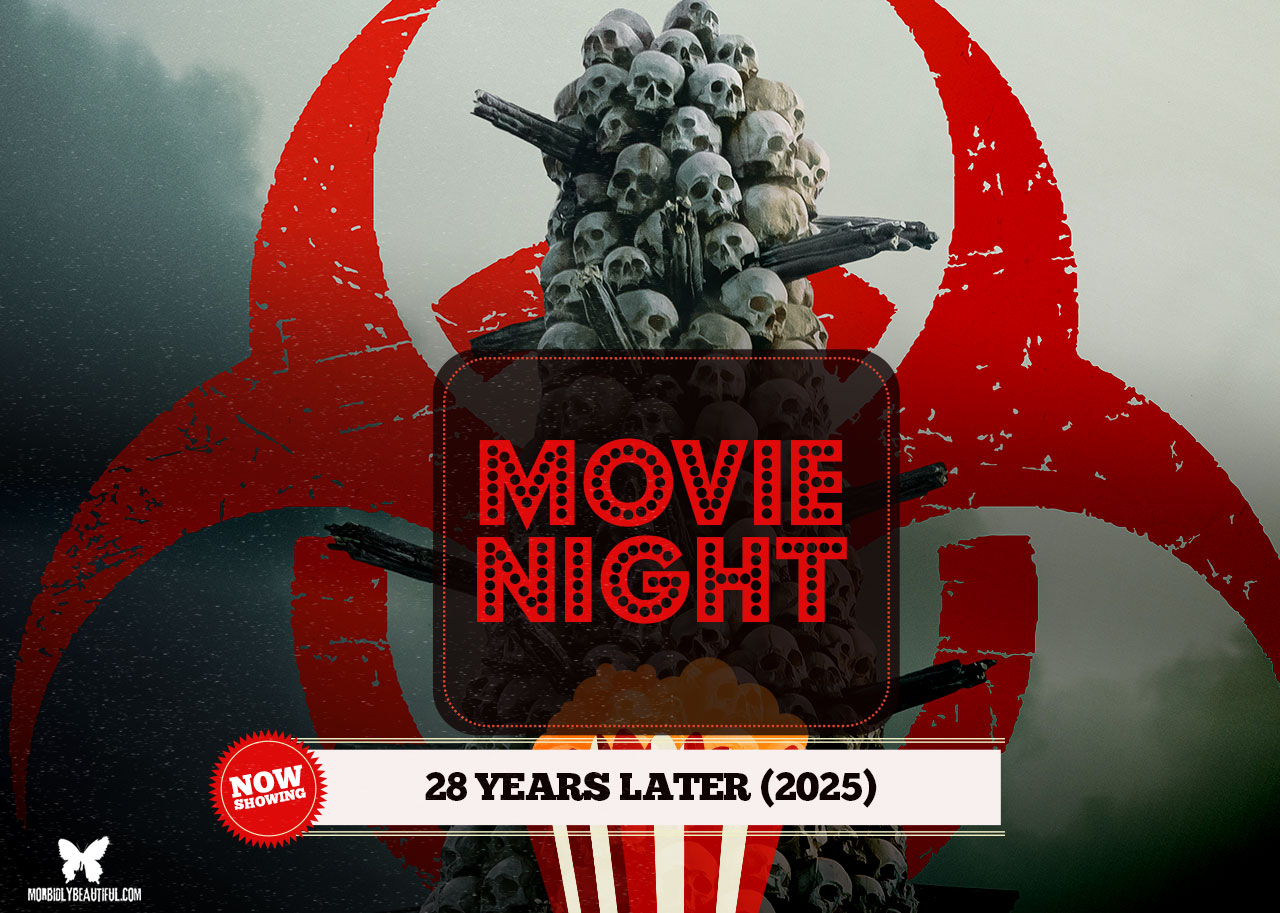
Boyle and Garland return with “28 Years Later”—a frenetic and uneven sequel with a stellar final act that teases a chilling next chapter.

No time to read? Click the button below to listen to this post.

28 Days Later (2002) and 28 Weeks Later (2007) were movies that featured budget filming techniques, large tonal shifts, and overt Britishness. Aside from the obvious inclusion of zombies that could outpace a mobility scooter, these three elements were what marked the series out as unique and earned it a cult following.
Returning over twenty years after their original effort, writer Alex Garland and director Danny Boyle are clearly keen that the third installment in the series, 28 Days Later, stays true to that DNA, even if this loyalty doesn’t always work to the movie’s advantage.
In fact, those not nostalgically hankering for the original and its now retro millennial feel may find that 28 Years Later feels strangely dated.
In a quite incredible feat, the rage virus has been eradicated from continental Europe, but the UK remains afflicted and under quarantine. As the rest of the world keeps calm and carries on, those in the British Isles live without technology and under the constant threat of the infected.

Spike (Alfie Williams), his father Jamie (an Aaron Taylor-Johnson who has clearly been hoarding the nation’s supply of protein powder), and ailing mother Isla (Jodie Comer) are part of a community that has managed to mediate this threat by relocating to a tidal island off the coast of Northumberland. Jamie, fatigued from caring for his son and sick wife, is keen for the twelve-year-old Spike to grow up and become a hunter like himself. However, his son finds his exaggerated tales of heroism hard to swallow.
When Spike decides that the only one who can help his deteriorating mother is one-time doctor and outsider Ian Kelson (Ralph Fiennes), mother and son leave the safety of the community to contend with the infected alone.
If some of these things sound familiar to zombie aficionados—or more simply, those who have seen a few episodes of The Walking Dead—it’s because they are, on the whole, things we’ve all seen before from a genre that has been milked dry.
Where 28 Years Later differs is in its delivery, and it is this that may divide audiences.

The film favours a frenetic form of editing, oddly reminiscent of Edgar Wright’s Cornetto Trilogy. While this restless formula works incredibly well for those three movies, which always lean towards comedy even when dealing with serious topics, it can feel a little strange for a film whose humour is at most dry satire.
Reinforcing this eclecticism are a surprising number of montages.
Music also accompanies many of the action scenes in a prominent way that bears closer resemblance to a music video than a film (or, at the very least, Paul W. S. Anderson’s Resident Evil franchise). This fragmented narrative gives 28 Years Later a disjointed feel that is hardly alleviated by splicing black-and-white footage from the world wars and battle scenes from the 1944 movie Henry V in between scenes of the present day.
These historical and pseudo-historical scenes are repeated with surprising frequency.
Whatever Garland and Boyle want to say about post-Brexit isolationism, the arbitrary upholding of tradition, and the interrelated violent tendencies of such a mindset, they want you to know about it.

This, along with flashbacks later in the film that recall scenes that have taken place less than twenty minutes earlier, is part of a recent trend in films to spell out their message rather than leave it to the audience to figure it out for themselves (for more, see my Companion review).
Early on, there is also some unnecessary exposition that could have been easily inferred. This literalness becomes irksome mainly because it feels like condescension.
One area in which the film is not so explicit is in its action sequences.

Despite NDAs being signed by the cast and crew on the specifics, it has been confirmed that 28 Years was filmed on modified iPhones, vaguely sticking with the tradition of the original, which was filmed on a MiniDV camcorder.
With technology having moved on rapidly since the turn of the millennium, the picture quality here is far clearer, though not always free of pixelation. The minimalism does lend the film a gritty feel that is suitable for its setting: a Britain that has been forced back in time.
Elsewhere, call-backs are more frustrating. Another technique brought forward is the quick-panning camera work used to transmit a sense of chaos, resulting in much of the action being unseen. In the original movie, this adoption was as born of necessity as it was of style. With limited budget and effects, the super-quick transitions left much to the imagination and made otherwise amateur action scenes seem grand.
This was a common technique of lower-budget movies of the time, but has since mercifully eased off. Used for 28 Years, the hoped-for frenetic energy becomes gimmicky when overused.
The caffeinated quality of these scenes is especially clear when compared with 28 Years Later’s final third.

Here, the movie collects itself, takes a breath, and offers moments of touching drama and even humour.
This final third is by far the strongest of the movie, dispensing with the pacey camera work and throbbing musical montages and allowing 28 Years Later to come alive through its characters and their interactions. Many scenes in 28 Years Later feel like they are doing little more than establishing the sequel to come. But it seems clear that the final third and its setting were always pivotal to this story. And rightly so.
They almost elevate the rest of the movie itself to the standalone greatness that the first incredible trailer promised.
If you can stomach the erratic camera work, incongruous musical accompaniment, and slightly condescending storytelling that lend 28 Years Later a dated feel, there is still a lot to like. If those callbacks to the original are in fact exactly what you are hoping for, then you may well be in dreamland.
Either way, the movie’s excellent third act sets up a tantalizing (and, surely, even darker) future installment.
Overall Rating (Out of 5 Butterflies): 3







Follow Us!