

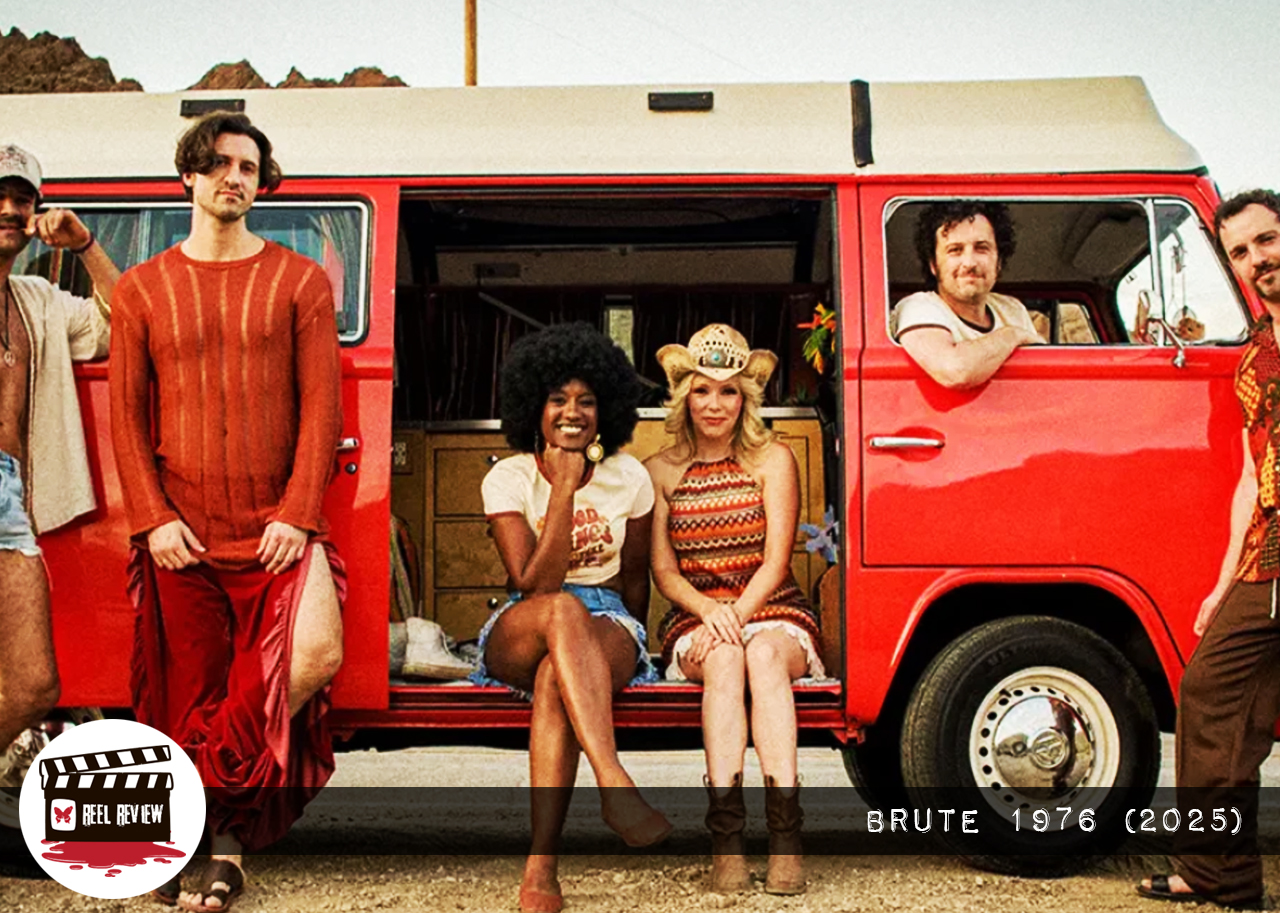
“Brute 1976” is a sweaty, savage, and unapologetically nasty throwback slasher—with all the brilliance and baggage that comes with homage.

No time to read? Click the button below to listen to this post.

The year is 1976, set during America’s Bicentennial summer. The desert sun blisters down on a ragtag group of models, photographers, and drifters who stumble into Savage, a sun-bleached ghost town that has been empty for decades.
This forgotten slice of America has become the kingdom of the Birdy family, a brood of masked maniacs who enforce their own rules with saws, drills, and a flair for carnage. What starts as a sexy photo shoot quickly devolves into a fight for survival, punctuated by the kind of grotesque kills that made grindhouse horror infamous.
Marcel Walz, working from a script by Joe Knetter, wastes no time in getting to the bloodletting.
Within ten minutes, we’ve glimpsed our killers, and by the time the title hits, we’re already knee-deep in menace. Like all good slashers, the tension ratchets up fast, and the film never truly slows down across its nearly two-hour runtime.
Brute 1976 feels tailor-made for fans of vintage slashers like The Texas Chain Saw Massacre and The Hills Have Eyes.

Visually striking, cinematographer Marcus Friedlander drenches the desert setting in grit and heat, while the unnerving droning score hammers home a sense of suffocating dread. The masks are creepy and distinct, the practical effects nasty in all the right ways, and the production design convincingly nails the Bicentennial-era vibe.
The film hits the mark more often than not.
Though some of the kills are a bit less satisfying than others, there are standout sequences that prove Walz and Knetter aren’t just recycling; they’re finding ways to push buttons in fresh, transgressive ways.
There’s one particular kill scene that stands out, a showstopper that will have genre fans talking and proves that even in a subgenre as well-trod as the slasher, there’s still room for creativity and surprises.
The cast (including Adriane McLean, Sarah French, and Gigi Gustin) turn in solid performances, giving the carnage enough emotional weight to keep things engaging. Representation also gets a boost, with a Black woman positioned as a fierce final girl, a refreshing shakeup in a subgenre that historically sidelined marginalized voices.
While Brute 1976 is a fun and relentless ride, it’s not without its flaws.

There’s a fine line between homage and rip-off, and Brute 1976 sometimes trips into imitation. The Birdy family’s motivations feel half-baked, and while the film gestures at sociopolitical commentary around race and sexuality, the execution is clumsy at best, problematic at worst. Characters exist largely as fodder for inventive deaths, which is on brand for slashers but undercuts attempts at deeper resonance.
The villains themselves are a mixed bag: the Leatherface-inspired brute is menacing and memorable, but others come across more like haunted house performers than terrifying icons.
The campy undertones occasionally undercut the grit, leaving the film hovering somewhere between deadly serious and knowingly cheeky.
However, if you’re a die-hard slasher fan, these are likely minor gripes. The film’s strengths are many, including its gritty atmosphere, fast-paced action, and glorious practical effects.

For fans of grindhouse sleaze, these are likely more than enough to make up for its shortcomings.
But it’s important to stress that this film has a distinct and niche target audience, and it’s either a satisfying treat or stale, regurgitated slop—depending on how much this type of film suits your particular cinematic palate.
Ultimately, Brute 1976 isn’t trying to reinvent the wheel; it’s celebrating a specific kind of old-school horror with bloody passion.
Bottom line: Walz resurrects the sweaty, sleazy spirit of ‘70s grindhouse, delivering a cheeky and nasty slasher that is as subtle as a power drill through a glory hole.


Overall Rating (Out of 5 Butterflies): 3.5



Follow Us!