

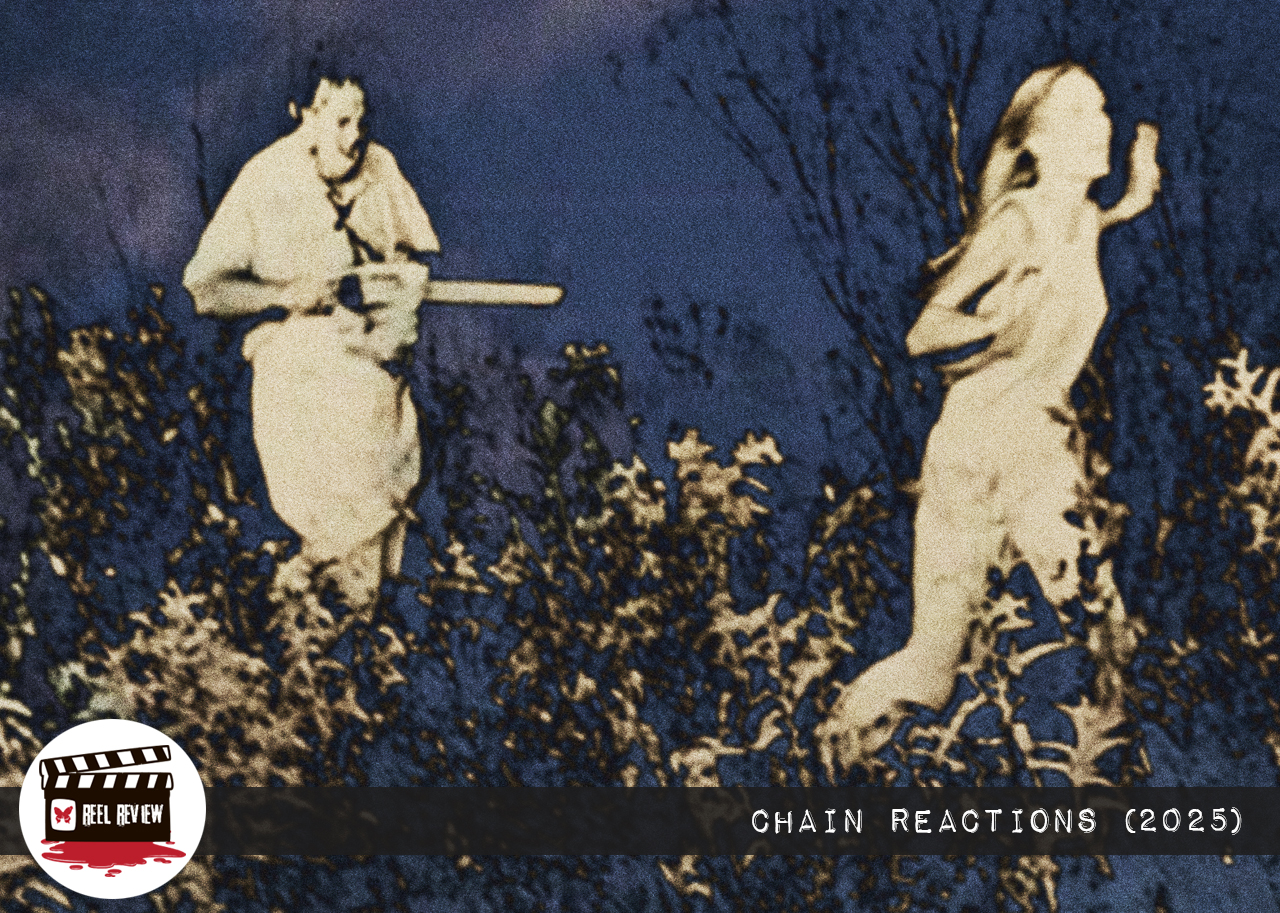
Alexandre O. Philippe’s “Chain Reactions” doesn’t rehash how “Texas Chain Saw” was made; it reveals how it rewired the people who saw it.

“The title sounds like you are chewing on flesh: Texas Chain Saw Massacre. It sounds like a guy just ripping into meat.” — Patton Oswalt
No time to read? Click the button below to listen to this post.

The review which you are about to read is an account of the impact which befell a group of five artists, in particular Patton Oswalt, Takashi Miike, Alexandra Heller-Nicholas, Stephen King, and Karyn Kusama. It is all the more interesting in that they were young when they first experienced a life-altering horror movie.
They could not have expected, nor would they have wished to see as much mad and macabre as they were to see on that movie screen. For them, an idyllic trip to the theater became a welcome nightmare.

The events of their experience were to lead them to love and be inspired by one of the most bizarre and influential movies in the annals of American History, The Texas Chain Saw Massacre.
A small independent film shot on a shoestring budget, filmed in the brutal heat of a Texas summer, was released on October 11, 1974, by writer/director Tobe Hooper.
Unknown to Hooper and the crew of friends who helped create the movie, The Texas Chain Saw Massacre would go on to become one of the greatest and most inspiring movies ever made.
While there is plenty of information and documentaries about the making of the movie, director Alexandre O. Philipe has taken a different approach to his new documentary, Chain Reactions.
Instead of focusing on the creation of the movie, Philipe spotlights five artists who have been affected and inspired by The Texas Chain Saw Massacre.

“There’s something about this family’s inability to modernize that is both, like, incredibly touching and maddening. Because they are stuck in an America that doesn’t exist for them anymore, and it’s made them insane.” — Karyn Kusama
The movie is broken into five chapters, one for each artist who gives their recollection of the movie.
Unlike most documentaries, Chain Reactions does not go back and forth among the artists. The movie is split into five chapters, one for each artist. This gives each of them their chance to tell their story, allowing their stories to breathe and unfold for the viewer.
One of the more amusing anecdotes from Takashi Miike is how he was going to see Charlie Chaplin’s City Lights, but the screening was sold out. Because he had traveled 40 minutes to see the movie, he decided to watch a movie before returning home. That movie was The Texas Chain Saw Massacre.
“In Japanese horror, there is always a story. Like the terror of dispelling a grudge based on some great wrong. But in Texas Chain Saw, there is no logic. Except those kinds of people just exist. That was shocking to Japanese audiences.” — Takashi Miike
But this documentary isn’t just about The Texas Chain Saw Massacre. It evolves and becomes something deeper.

“How lucky we are, as cinephiles, to have Texas Chain Saw Massacre as an American statement.” — Karyn Kusama
This movie explores why fans are drawn to horror and the types of violence and scares that are projected onto a screen. It becomes an examination of the psyche of a horror fan in a positive and enlightening way.
Alexandre Philipe allows the viewer to have the impression that we’re sitting across from each of these artists, allowing us to explore our attraction to horror and the impact of The Texas Chain Saw Massacre with each of them.
Watching Chain Reactions becomes a profoundly intimate experience that transcends the typical documentary format.
Chain Reactions rightfully places The Texas Chain Saw Massacre as a classic movie, cementing its legacy in horror and American cinema fifty years after it was first unleashed onto an unsuspecting worldwide audience.
Yes, I did watch The Texas Chain Saw Massacre immediately after finishing Chain Reactions.










Follow Us!