

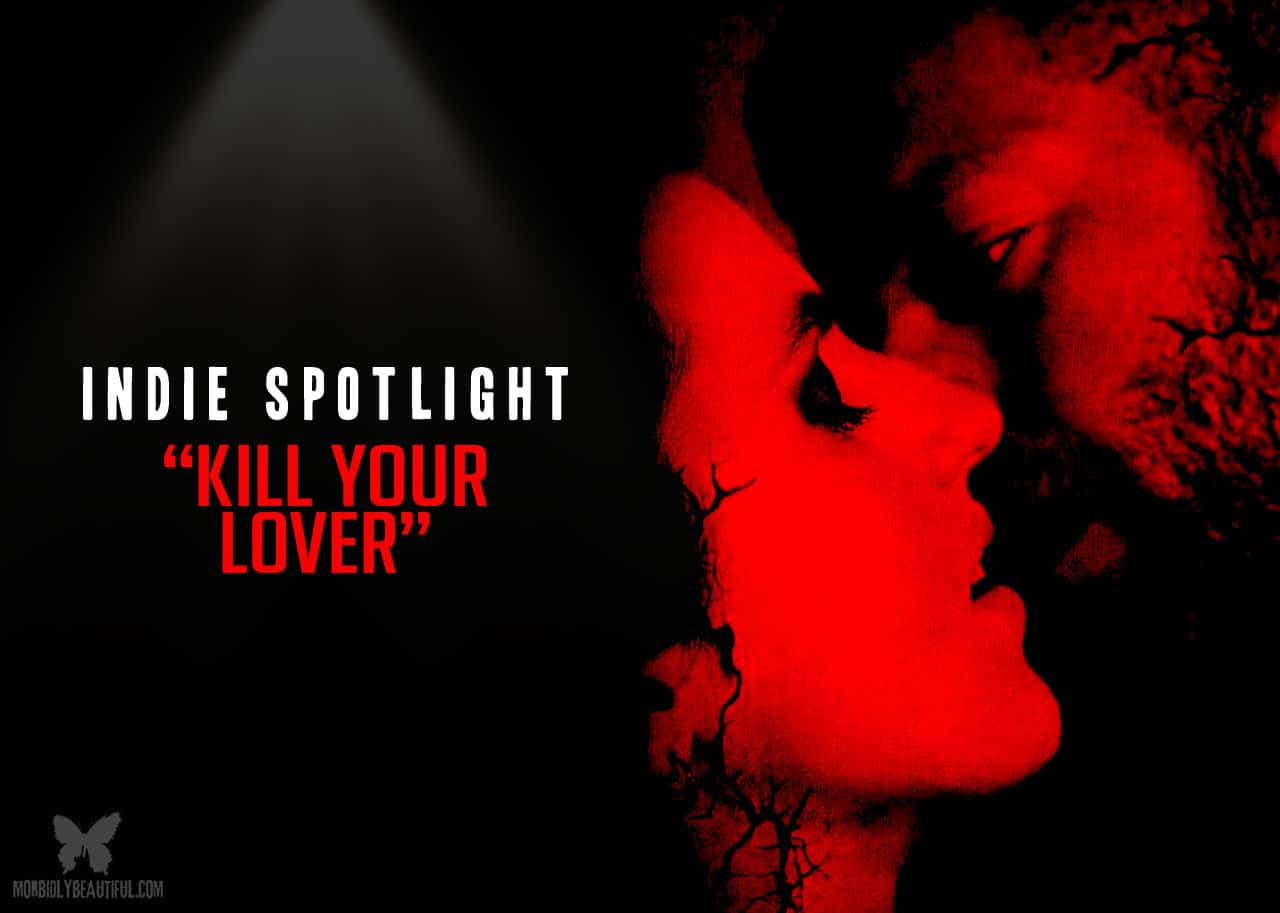
The new body horror entry, “Kill Your Lover”, offers an ick-worthy and emotionally aware take on ending a (literally) toxic relationship.
No time to read? Click the button below to listen to this post.
Kill Your Lover follows mismatched lovers Dakota and Axel as they plummet toward a painful and searing end of their relationship.
This particular breakup tale offers a bleak reminder to monitor the health of your relationship and address red flags when they bubble up. Otherwise, potentially treatable symptoms–like unclear expectations, fear and avoidance, jealousy, gaslighting, financial strain, and inequity—impact all forms of intimacy and become unmanageable….or, worse, abusive.
Writer-directors Alix Austin and Keir Stewart swabbed all (yes, all) of these authentic relationship issues and placed the samples neatly in a petri dish for the audience to observe. They made big, deliberate technical choices to demonstrate and land how these differences and choices within the couple create conditions ripe for a nasty infection.
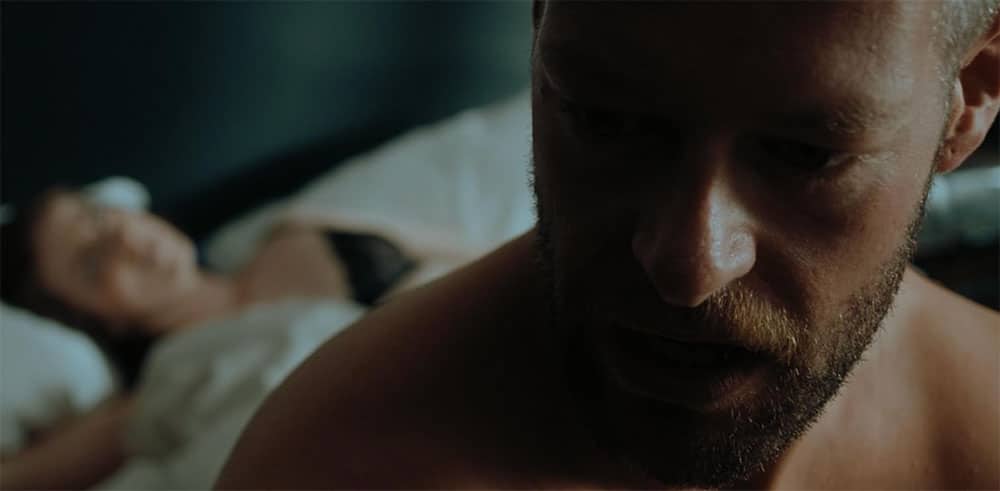
Claustrophobic sets in bed, the bathroom, and small apartment rooms. Blocking and framing for tension and the negligible space between leads Dakota (Paige Gilmour) and Axel (Shane Quigley-Murphy) at all times; even in different rooms, they are visually placed side-by-side.
In the opening sequence, we get blatant foreshadowing as we learn Dakota plays in a band called Final Girls. I read a few reviews that called Austin and Stewart’s choices heavy-handed, ‘on the nose,’ or excessive. In rebuttal, I quote Karen Smith (Mean Girls), “I’m a mouse, duh.”
Austin and Stewart firmly affixed fuzzy grey ears and whiskers on this film: It’s meant to be in-your-face.
As someone who has been in one of these unsafe and fundamentally perspective-changing relationships, subtlety, and veiled symbolism wouldn’t have been effective or representative of how violent and hurtful this kind of “love” can be. Furthermore, I applaud the emotional maturity demonstrated in both script and direction, which shows Dakota and Axel’s humanity and the complexity of what causes toxicity to thrive, replicate, and mutate aggressively.
By telling me up front that Dakota would be the Final Girl, Kill Your Lover permitted me to focus on appreciating how the crescendo and showdown with Axel would transpire instead of whether they would escalate there.
Kill Your Lover adeptly applied body horror to tackle struggles related to attachment and intimacy and delivered an important, cautionary message.
On the cautionary element, I do feel this was a conscious contribution to current popular discourse around emotional intelligence, self-work, breaking cycles, and the responsibility we all hold to unpack and develop awareness and coping skills to navigate our trauma. It’s the healthy alternative to letting it go untreated and risk harming the individual(s) in our closest proximity.
Because of the bigness of the choices made by Austin and Stewart, I would liken this to a modern myth or folktale. That’s probably why I enjoyed it so much; I’m a sucker for a story with an underlying lesson. Sometimes, that lesson is most effective when told through a dark, gruesome lens.
For me, films like this remind us of “The Useful Dangers of Fairy Tales” and give validity to horror more broadly as a genre. While I don’t connect with all the points Amber Sparks makes in the piece linked above, this passage feels relevant here:
“I think emotional distress can be useful. I think it’s important. Because rape, abuse, harassment—these things DO blindside women. We can’t be empowered if we aren’t ready….sometimes the wolf just shows up uninvited. There’s always something the writer can give their beleaguered fairy tale heroine—even if it’s just a big sharp knife.”
That’s why some stories need to be gruesome — so maybe, just maybe, some can learn through story rather than learning the hard way.
KILL YOUR LOVER feels like a way to help others appreciate just how dangerous false intimacy can be.
How much do these kinds of relationships truly burn you and leave brutal scars? The only thing scarier than the wolf showing up uninvited is realizing that you didn’t recognize the wolf until you had already let it see, hear, smell, and touch your most vulnerable places. Scarier, still, is looking in the mirror and realizing that maybe there’s a hint of the wolf in you, too.
And the honest reality is that many of us have been here. We’ve been in THAT relationship. You know, the one where passion and potential swept you off your feet but broke your ankles on the way down by teaching you hard lessons about yourself and what you’re seeking in a partnership. The kind where even those in the relationship’s orbit feel the septic vibes and know the pairing is bad news.
Dakota’s best friend, Rose (May Kelly, who nails the snarky best friend role), had been coaxing and coaching Dakota toward severing ties for a while. Even those in brief proximity could see the mess the couple had made. One of the paramedics diagnoses the toxicity in a matter of moments.
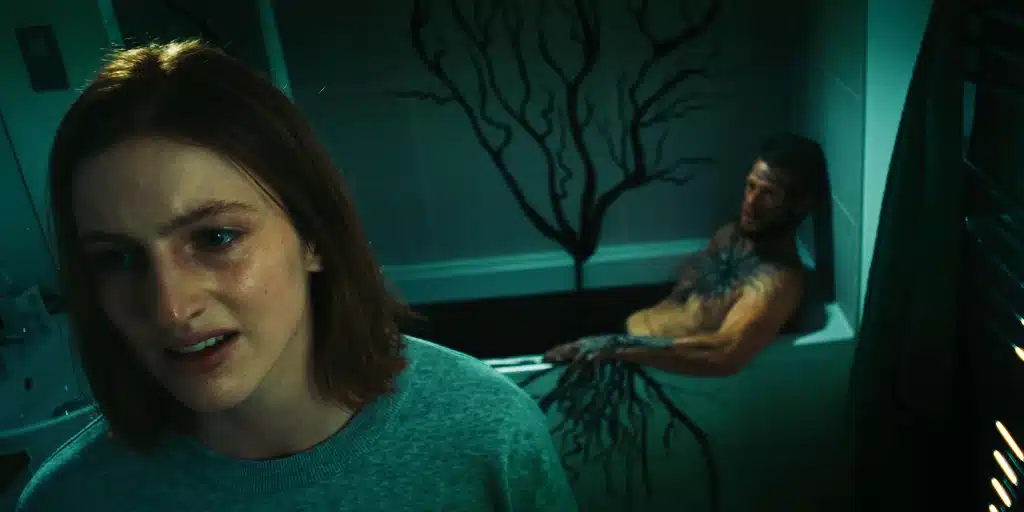
“With all due respect, Sir, you burned your partner with something that’s excreting from your pores. Your body is covered in bruises and black veins…..you’re about as far from ‘fine’ as I can imagine.”
What I really commend Austin and Stewart for is showing us how common it is to catch this sickness and how impossible treatment can be when it is given too long to incubate.

Now, if you’re one of those rare lucky ducks who always knew what you wanted from and with a partner and find yourself securely attached in every relationship you’ve ever been in, then a.) I am wildly jealous of you. b.) you likely won’t connect with this movie.
This one’s for those of us who have ignored our intuition. It’s for those who stayed so far past the expiration date in a relationship that both individuals start bringing out the absolute worst in each other, including reactive abuse.
(I think Kat Hughes’ take on this film starts getting nicely at this point, too.)
On that note, if you recently Googled “Am I in a toxic relationship?” or even “Opposites attract, but can they last long term?” I’m going to recommend watching this one without your possibly not-so-better half. It will likely get awkward, especially as the violence and gore factors ratchet up.
This feels like a good time to high-five the special effects and makeup contributions.

There were a couple of points where I uttered an audible “Ew” and mentally acknowledged the capable effort. Axel puking Slimer-esque goo on Dakota (during coerced, uncomfortable sex) was a highlight, as was most of the icky-sticky stuff surrounding Axel’s transformation and the multiple burns he inflicted.
I was even on board with the Stranger Things/The Last of Us-inspired idea that the physical walls could host this unwelcome growth.
Next, circling back to the sexual content, this film felt like a public service announcement and a reminder that hormones are a mind fuck, friends. For real. Do a little research on orgasms and their simultaneously rad and evil sidekicks, dopamine (the “feel good hormone”) and oxytocin (the “love hormone”).
Gilmour and Quigley-Murphy show us why they connected initially and physically while also helping us appreciate they never had an authentic emotional or mental connection. They neglected (even ignored) their relationship’s roots, so they ultimately reaped what they sowed: Something corrosive and destructive.
Note: I don’t recommend this one if you simply need a little nudity fix. These sex scenes aim for squirms, not squirts.
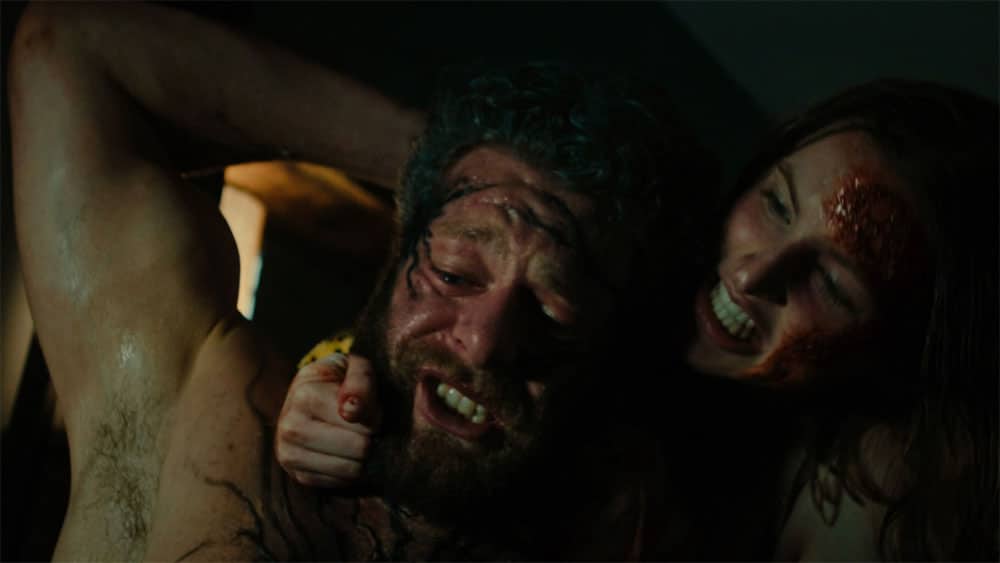
So, in the end, what was Dakota’s “big sharp knife”? I argue that at the climax, our storytellers gave her two: a glass shard from a photo with a fitting backstory and her courage and voice.
“You haven’t been perfect. But I haven’t been honest. Maybe I led you on. I couldn’t leave you because I didn’t know what I wanted.”
Oof. Again, that maturity around the script and delivery. Gorgeous.
Kill Your Lover can build awareness of how to avoid, identify, treat, or heal from this kind of infection — and remind all of us that sometimes, ripping someone’s heart out is the most compassionate thing to do.
Overall Rating (Out of 5 Butterflies): 4











Follow Us!