

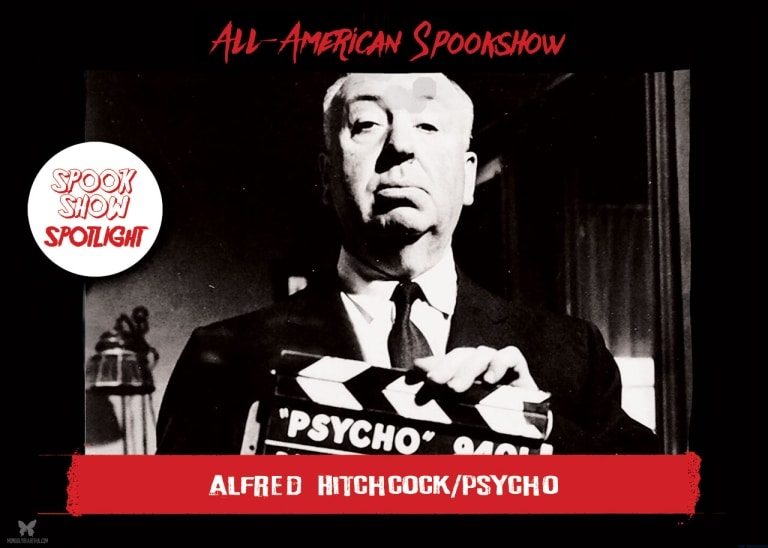
Before masked killers stalked suburbia or horror became prestige cinema, Alfred Hitchcock’s elegant nightmares rewrote the language of fear.

“Alfred Hitchcock” by twm1340 is licensed under CC BY-SA 2.0.
By the time Norman Bates pulled back that shower curtain in Psycho, Alfred Hitchcock wasn’t just reinventing horror—he was rebranding fear itself. Long before slashers stalked suburbia or A24 gave us elevated dread, the portly Brit with a razor wit had already etched his silhouette into the genre’s DNA. Hitchcock didn’t invent horror. But he did something more enduring: he made it respectable, seductive, and dangerously fun.
He was the first to show that horror didn’t need a monster to be monstrous. A nervous glance, a tightly framed hallway, a perfectly timed silence—these became his signature scares. And they’re still with us.
What set Hitchcock apart wasn’t what he showed, but what he withheld. He weaponized implication like no one before him. The infamous shower scene in Psycho never actually shows the knife entering the body, yet audiences swore they saw it. That’s Hitchcock in a nutshell: using the mind against itself. He understood that the most potent horror lives not on screen, but in the spaces we’re forced to fill.
This art of restraint is echoed in today’s most effective psychological horrors. Think of the unseen presence in The Babadook, the silence in The Others, or the slow, suffocating tension of The Witch. These films owe as much to Hitchcock as they do to their supernatural elements.
Long before slasher films churned out virginal survivors, Hitchcock was obsessed with women in peril—and often with the murky line between victim and accomplice.
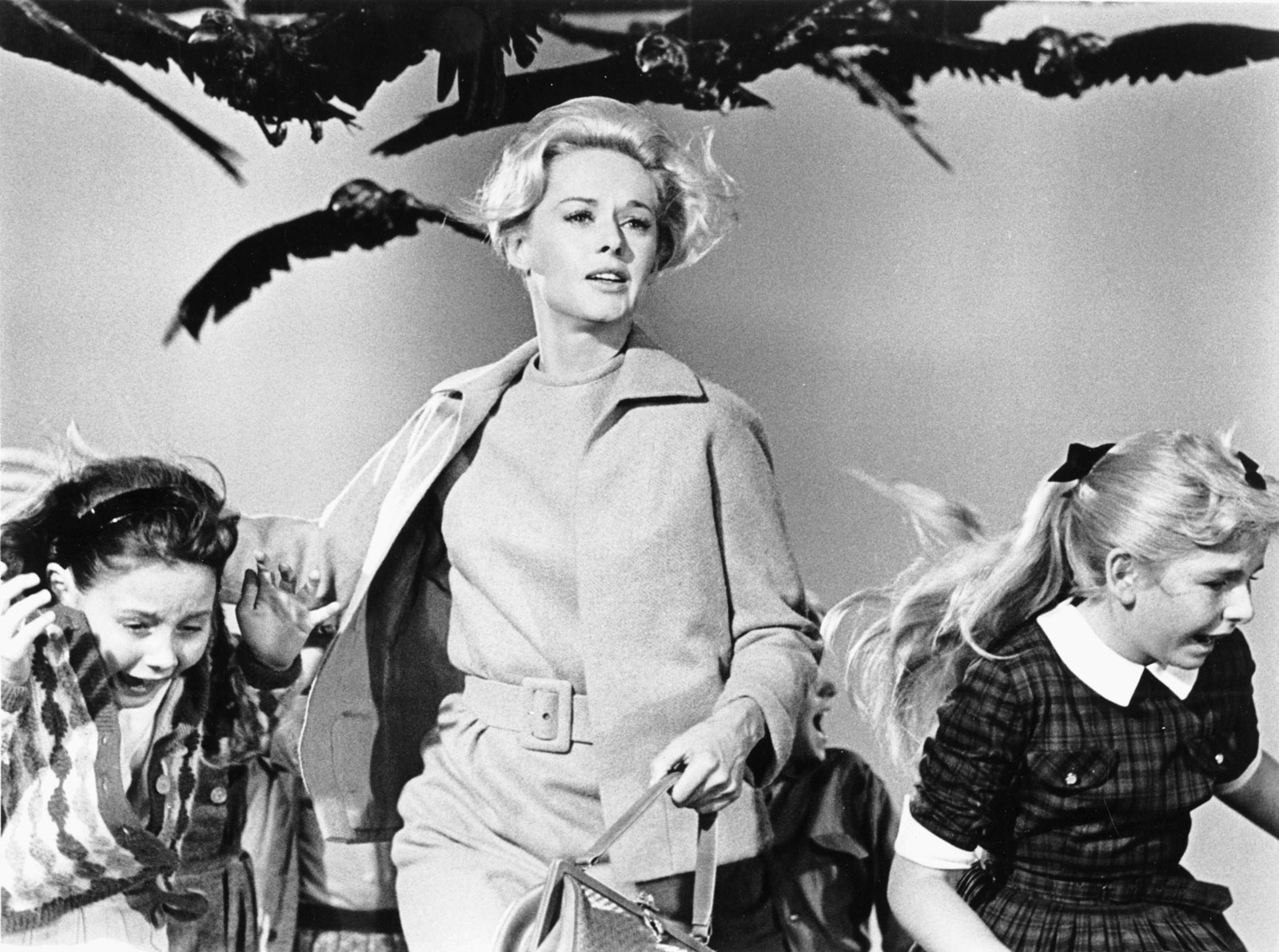
From the guilt-plagued Melanie in The Birds to the icy cool of Kim Novak in Vertigo, Hitchcock’s women were rarely simple damsels. They were avatars of anxiety, desire, repression, and sometimes, revenge. Today’s horror heroines—complex, fractured, and often deeply haunted—are part of that lineage.
Hitchcock’s complicated (and, let’s be honest, often problematic) treatment of women on and off screen continues to fuel debate. But even those critiques highlight how deeply embedded his tropes are in genre storytelling. To wrestle with Hitchcock is, in many ways, to wrestle with horror’s very foundation.
Of course, no discussion of Hitchcock would be complete without acknowledging the darkness behind the curtain. His on-set treatment of actresses like Tippi Hedren has become the stuff of infamous legend, casting a shadow on his artistry. But it also raises important questions about power, obsession, and the ways horror has historically been shaped by real-world control and coercion.
Modern horror auteurs—from Jennifer Kent to Jordan Peele—grapple with these themes not just on screen, but in the making of their films. There’s a growing shift in who tells the stories and how they’re told. Yet even in that evolution, Hitchcock’s fingerprints linger.
Ultimately, Hitchcock’s films taught us that suspense is a slow, delicious poison—and that true terror often comes from watching, waiting, and not knowing.
PSYCHO (1960)

Psycho wasn’t just a shock to the system—it was a cultural detonation. In 1960, horror was still tethered to Gothic castles, atomic-age creatures, and theatrical monsters. Then came Hitchcock with a roadside motel, a bottle of chocolate syrup, and the audacity to kill off his star halfway through the film.
What he delivered wasn’t just a murder—it was a rupture. With Psycho, horror got personal, paranoid, and uncomfortably close to home.
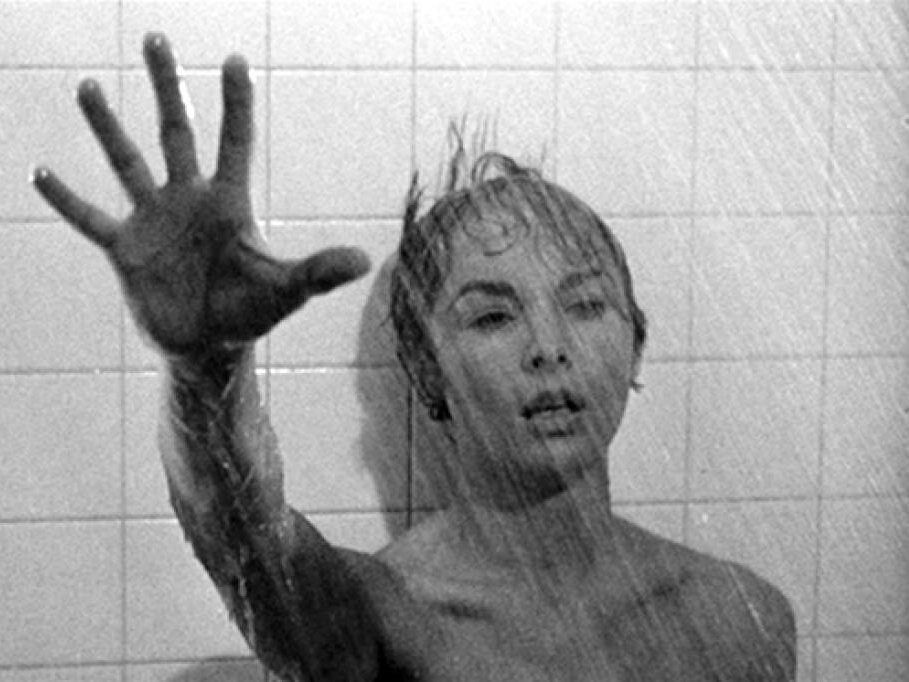
Marion Crane’s death in the shower wasn’t just terrifying, it was disorienting. Hitchcock violated narrative rules as brazenly as Norman violated personal boundaries. Suddenly, no character was safe. No space was sacred.
In that infamous shower scene—arguably the most studied 45 seconds in horror history—Hitchcock taught a masterclass in misdirection, editing, and primal fear, proving you didn’t need gore to scar the psyche.
But the real genius of Psycho is how it shifts the horror inward.
Norman Bates isn’t a monster hiding under the bed—he is the bed, the room, the house, the mother. He embodies the horror of the divided self, the terror of repression gone septic. In the age of Ed Gein and true crime headlines, Psycho made horror feel uncomfortably real. And in doing so, it laid the foundation for decades of slasher killers, twist endings, and psychological terror that still feeds the genre today.
ABOUT THE SHOW
The Spookshow is a collection of guys (and, now, one incredible lady!) with varying degrees of Horror fandom. Since 2018, we’ve reviewed Horror, Cult, Action flicks, and, of course, total crap, so you don’t have to, but we encourage you to nonetheless. If you’ve listened to us before, thank you! If you’re new to our brand of stupidity, then welcome. We want you to enjoy watching these films with us; join us in having fun with them & learning about them as well.
Part of the Morbidly Beautiful Podcasting Network! Go to the all-new www.aaspookshow.com & join our Patreon for bonus episodes & content over at https://www.patreon.com/aaspookshow & follow us on Twitter @AASpookshow as well as Facebook, Instagram, TikTok, Slasher & our YouTube channel by searching All-American Spookshow Podcast. Email us at [email protected] with questions & comments, and be sure to leave us a 5-star review on Apple Podcasts & Spotify!
LINKS: https://linktr.ee/aaspookshow
Horror/Cult Movie Podcast & YouTube Channel!
Creature from the Black Lagoon (1954)
The ‘Universal Summer’ continues, as Donny picks another true horror classic, “Creature from the Black Lagoon” (1954)!
Part of the Morbidly Beautiful Podcasting Network! Go to www.aaspookshow.com & join our Patreon for bonus episodes & content over at https://www.patreon.com/aaspookshow & follow us on X @AASpookshow as well as Facebook, Instagram, TikTok, Slasher, Threads, Bluesky & our YouTube channel by searching All-American Spookshow Podcast.
Email us at [email protected] with questions & comments, and be sure to leave us a 5-star review on Apple Podcasts & Spotify!

Episode play icon
The ‘Universal Summer’ continues, as Donny picks another true horror classic, “Creature from the Black Lagoon” (1954)! Part of the Morbidly Beautiful Podcasting Network! Go [...]
July 6, 2026
Episode play icon

The nominees for the 2026 Fangoria Chainsaw Awards have been announced, so we decided to dive into the ballot and make some predictions! Go vote [...]
July 3, 2026
Episode play icon

The ‘Universal Summer’ continues, as Tiana picks one of the best ‘body horror’ flicks in recent years, “The Substance” (2024)! Part of the Morbidly Beautiful [...]
June 29, 2026
Search Results placeholder

Follow Us!