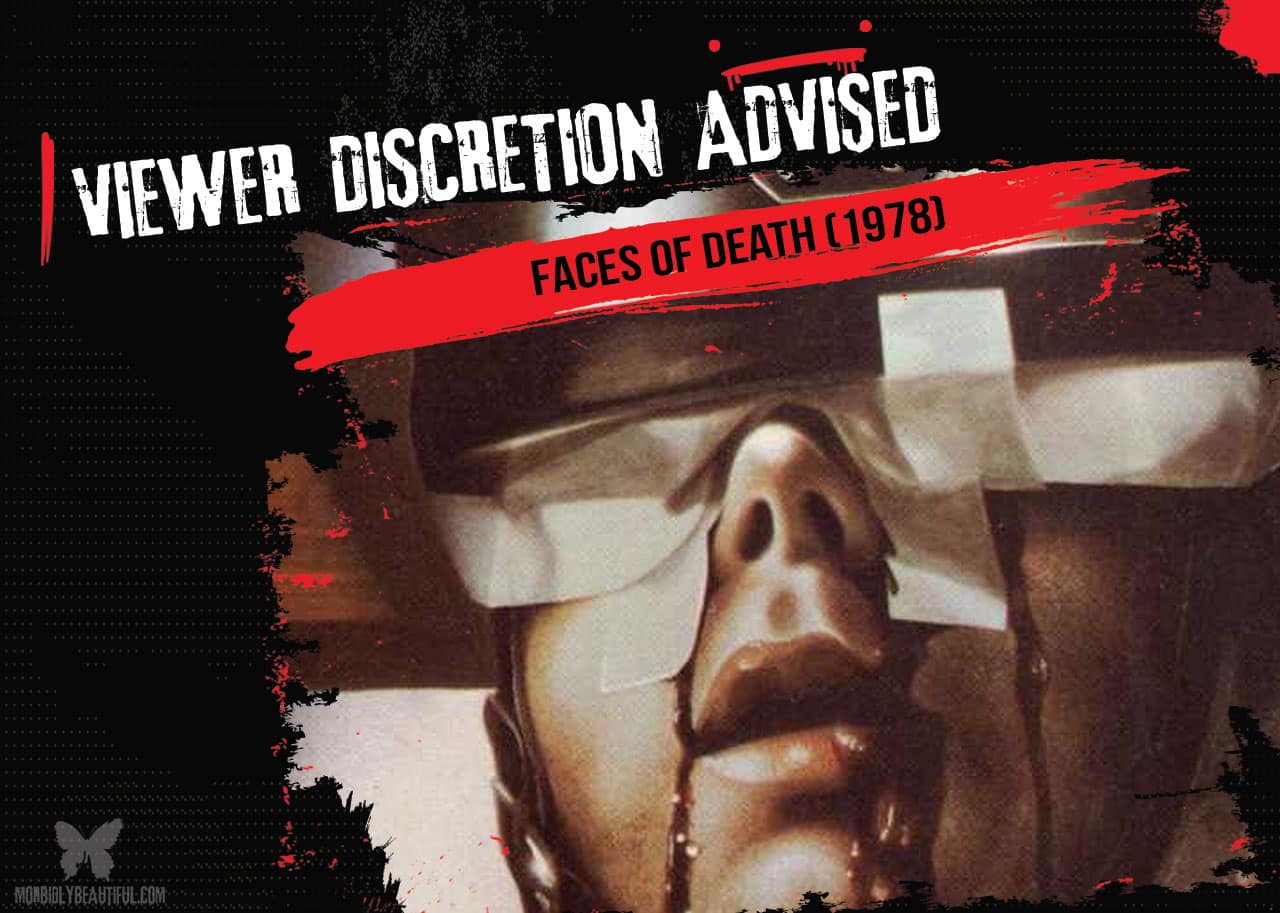
Viewer Discretion Advised: Faces of Death (1978)




Suffering from a recurring dream that has left him pondering the various “faces of death,” jaded pathologist Francis B. Gross (played by Michael Carr) oversees a collection of death footage in the hopes of further understanding the various methods in which our lives come to an end.
Heavily inspired by Italian mondo films like 1962’s Mondo Cane, which was an exploitive subgenre that thrived on graphic and taboo stock footage from around the globe, director John Alan Schwartz’s groundbreaking 1978 sensation would go on to open the door for a wave of American “shockumentaries” that invaded the darker corners of the VHS market. Derided by critics yet amassing a devout cult following, the contentious Faces of Death would purport to be “banned in 46 countries”, a claim that has been hotly debated since it premiered.

Often credited as one of the most notorious shock pieces of all time, the staggering success of Faces of the Death spawned a franchise that ran from 1978 until 1987, culminating in the highlight reel The Worst of Faces of Death, all of which were penned and directed by Schwartz.
Despite its popularity – particularly in Japan, where it played under the title Junk – Faces of Death found itself a target in various markets. It made the U.K.’s famed “video nasty” list and wound up banned or severely truncated in places like Australia, New Zealand, and Germany. The emergence of the home video market ensured that Faces of Death remained in the public eye, with the film a hot commodity in the aisles of video stores across the United States.
While various portions of the film have been revealed to be staged by its creators, less than half of Faces of Death contains authentic footage of both human and animal death. This has certainly softened the impact of Schwartz’s picture, but this wasn’t always the case.
In 1985, a California teacher at Escondido High School played the film for a packed classroom, resulting in a lawsuit brought by the families of two students who were said to have “developed an unnatural fear of dying” after the mandatory screening.
About a year later, Rod Matthews, a teenager with a history of mental illness out of Canton, Massachusetts, horrifically murdered a fellow classmate, Shaun Ouliette, after viewing the film. He informed authorities that Faces of Death left him with an overwhelming desire to know what it felt like to take a life. He wound up sentenced to life in prison with the possibility of parole after fifteen years.
In November of 2024, Matthews was paroled under strict conditions that included “GPS monitoring, drug and alcohol testing, a curfew, and mental health counseling” (CBS News)
Despite its deleterious perception, Faces of Death remains in circulation, forever at the ready to be cued up during the witching hours of teenage sleepovers. It’s available to stream on Shudder and the Blu-ray is just a click away on online retailers like Amazon and DiabolikDVD.
In 2021, a remake was announced by Legendary Entertainment, with rumors of trendy names like pop-superstar Charli XCX attached to the project. A release date has yet to be unveiled.

You know the feeling. You’re driving down the road, maybe on your way to work or an appointment. You begin seeing the brake lights illuminate in front of you, and traffic grinds to a halt. When it becomes clear there’s a crumpled heap of a vehicle in your line of sight, sickly curiosity gets the better of you, and as you glide past the scene amongst the flashing lights and the bustle of uniformed responders, you rubberneck in the hopes of catching a glimpse of something that unsettles and intrigues in equal measure. There’s a flutter in your stomach and a surging combination of anticipation and fear as we long to bear witness to our immortality.
Depending on your timing, our inquisitiveness gets what it wants.
A few years back, the topic of car accidents and general squeamishness came up at work, with my volunteering that I personally don’t like the sight of blood to my co-workers. One of our outside sales representatives went on to tell us about a nasty encounter he had on a highway. He was on a business trip and caught in halted traffic on a highway ramp. As he inched in range of a responding officer, our sales representative was advised not to glimpse over the side of the ramp.
He did.
What he saw were the remains of an individual who had jumped off the ramp and right into the path of an oncoming eighteen-wheeler. The remains didn’t even resemble a person. He said he wished he hadn’t snuck a glance.
It’s a safe assumption that there is at least a small part of that wants to glimpse the grizzly things that civilized society tries in vain to keep hidden.
Death is such a taboo subject in American society, and we are fairly sheltered from the grim certainties that lie in wait. Sure, you can argue until you’re blue in the face that you don’t want to see the aftermath of that accident, but deep down, there is that voice that is whispering at you to look.
You want to see the face of death.
This is most certainly the ghoulish appeal of films like, well, Faces of Death, which is probably the safest of all shockumentaries available for your “viewing pleasure” (is that the right term?).
Personally, I’m not much of a fan of Faces of Death. I find Francis B. Gross’s quest an uneven and sporadically boring affair, with the power it once wielded greatly diminished under the revelation that much of it is a scam. Bravo, internet age, and the tumbling sands of time! But maybe it’s pure desensitization that’s skewed any morbid enjoyment that would be syphoned off Faces of Death, with other shock-u-ramas clawing their way into the public eye with far stronger potency and insensitivity.
I believe its these two issues that work in tandem to prevent anything to really be taken away from all the gruel served up by Schwartz. At least that is what I initially thought.
Still, to the dismay of many (including myself), FACES OF DEATH manages to be classified under “influential”.
Without it, we’d have never gotten efforts like The Killing of America, Traces of Death, or Rare: A Dead Body, to name a few. And we certainly wouldn’t have been graced with splatter websites like Rotten and all the other dark digital avenues one can peruse in an effort to test their squeamish level. Hell, we probably wouldn’t even have the Museum of Death (complete with TWO locations!), where tourists can wander through a collection of artifacts linked to the world’s most infamous serial killers.
As a piece of stunt filmmaking, Faces of Death demands that we give it credit, even if the spirit gum used to fasten down the line between imaginary and reality is starting to separate. There are more than a few moments that are sure to trigger a good dry heavy, most specifically the famed “monkey brains” sequence made possible with quick edits and the help of some rotten cauliflower served up to the actors.
But I feel like this sequence alone is probably the key to unlocking the allure of Faces of Death, particularly in America.
Before the arrival of Faces of Death, the American public rarely had access to “death reels” of this sort. During World War II, the public did peep the harsh reality of the battles raging in Europe and the Pacific, and in the 1950s, driving schools unveiled Signal 30, designed to scare the bejesus out of teenagers by showing them contorted cadavers stuffed inside wrecked heaps of metal. The ‘60s saw front-line footage out of Vietnam and several assassinations played out in the public’s living room, further paving the way for a full-blown sizzle reel like what Schwartz cooked up.
In this modern age, nearly every human on earth is armed with a camera, pulling back the white sheets on the things that were kept hidden in film canisters.
We glimpse the horrifying aftershocks of mass shootings, terror attacks, and various other flashes of the grim reaper in the form it so chooses to take. It’s merely one or two clicks of the mouse (or taps of the finger) away. And we can react in real-time behind a keyboard.
Even more alarming is the fact that we barely even have to go looking for this stuff anymore. In fact, the public has been trolled by it, most specifically with the horrifying suicide of Ronnie McNutt, which was live-streamed over Facebook in 2020. Despite one of his friends trying to intervene, Facebook allowed the livestream to continue, with an inebriated McNutt brandishing a rifle while the police attempted to reach him outside.
In the wake of McNutt’s demise, footage of his death became viral, making its way onto platforms like TikTok and Snapchat, where it was passed around to unsuspecting parties who found it nestled into various “For You” reels.
With this type of stuff barely kept hidden, Faces of Death has become even more of a relic than it already is.
During its heyday, when it played late at night at your buddy’s sleepover, FACES OF DEATH could almost have been considered a rite of passage.
You remember the drill, huddled around a grainy television in your friend’s half-finished basement with three or four of your closest chums. You were all putting on a brave face, but deep down, everyone was a little uneasy, desperately wanting to seem like they had nerves of steel. Once it rolled, none of you noticed the gaffs or the fact that certain scenes had multiple camera angles, which called its validity into question.
All that mattered was the perception that life was all chocolates and rainbows, which was shattered at the glimpse of open-heart surgery.
Then again, maybe this actually counted for something. Maybe we needed to be shaken out of our innocence and learn that bad things do, in fact, happen. You could compare it to the awkward sex talk that everyone gets when they are growing up. However, the birds and the bees seem like an easy pill to swallow when compared to glimpsing the blood-soaked remains of PSA Flight 182.
You wouldn’t initially believe it, but when your eyes behold the fiery devastation and the blobs of bloody flesh that barely resemble that of a person who just moments earlier had a family, career, and life, your late-night endurance test transcends, acting tough for Tommy and Billy. You won’t let it show, but you’re most certainly filled with immense sorrow and the icy chill that our time here is limited.
When Mom and Dad try to tell you that, it undoubtedly bounces off of you like you’re made of rubber. But then you see it, and you understand that we are not invincible. And that certainly haunts each and every one of you when you burrow into your sleeping bags and try to drift off to sleep.
Despite my dislike for FACES OF DEATH, I’m of the belief that there is a generation out there who were affected by it.
Even if the eye-rolling moments like the interview with assassin Francois Jordan, the paranormal investigation, and the cannibal cult don’t linger in the way that Schwartz would like, the footage of Holocaust victims and time spent inside a morgue with Dr. Thomas Noguchi (who would also appear in the far superior The Killing of America) give way to solemn reflection.
Yet it all comes back to those folks seated around the table while they feast on freshly bludgeoned monkey brains.
As the curio ritual turns rancid, and the grins of the dining party morph into shock and repulsion, we realize that we are those seated around the table. Cautious amusement turns to shock, and Gross calmly explains that in various civilizations, it is believed that this ritual and the consumption of the brains brings the diner closer to God.
Maybe that is why that sales representative looked when he was warned not to. Maybe that is why we can’t help but try to see the aftermath of that car accident. Maybe that is why we seek stuff like Faces of Death out.
Time is precious, our bodies are fragile vessels, and death ultimately comes for us all.

She’s a lover, he’s a fighter. Together, they’re CHEER AND LOATHING. Tune in to hear your hosts, Stephanie (Cheer) and Casey (Loathing), clash over the films they love — and the ones they love to hate.
In this holiday extravaganza episode of Guilty Pleasures, join hosts Stephanie, Kelly, and our newest addition, Jonathan (Jack was tied up in tinsel and couldn't join us), as they unwrap the bizarre and unhinged world of holiday cinema. They dive into the depths of Elves, a film that's as chaotic as it is entertaining. It's a sleigh full of questionable decisions, diabolical dialogue, absurd plot twists, wildly offensive antics, and unhinged holiday mischief.
And that's not all! In the second half of the podcast, join your festive cinephile friends for a look at four more ”nutty as a fruitcake” holiday treats: A New York Christmas Wedding, Elf Bowling, A Medea Christmas, and Jack Frost. Plus, we each offer a bonus Christmas flick guaranteed to make you say, ”Ho, Ho, HO-LY Hell!”
Expect laughter, disbelief, and a spirited debate about what truly makes a movie a guilty pleasure. Don't miss this festive journey through the weirdest corners of holiday films!




Follow Us!