


Whether you love or leave “Color Out of Space” may depend on how much you dig Lovecraftian horror; hear from both sides of the fence.
No time to read? Click the button below to listen to this post.
This week’s Cage Match (as chosen by the random number generator from Cage’s entire filmography) was one of his newest films, Arcadian. For this week’s People’s Pick, you chose between two other films where our hero battles an alien threat: Color Out of Space and Jiu Jitsu. For the love of Lovecraft and alpacas, we’re getting weird with Color Out of Space.
IN THIS CORNER: KELLY MINTZER
The Lowdown
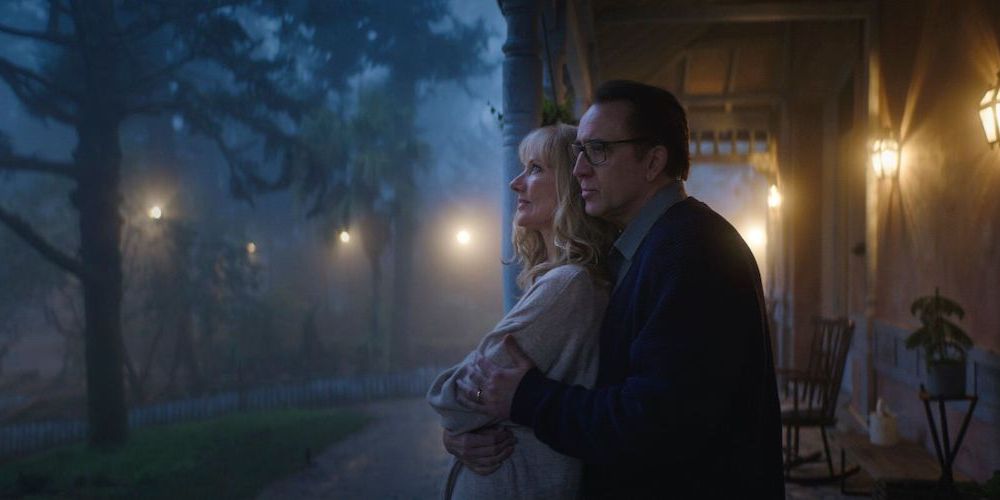
Horror will forever carry the fingerprints of virulent bigot H.P. Lovecraft; there’s no way around it. While his work has never appealed to me — in addition to being racist, I find it rambling and masturbatory — so many of my favorite creators love him and his monsters. The impact of his imagination is his greatest legacy, not his actual words (says me; I know many would disagree, and they’re not less right than I am).
All of this is to say I’m never that excited to see a new Lovecraft adaptation. So, my excitement wasn’t exactly at an all-time high for Color Out of Space. While I can’t say I’m likely ever to revisit the film (cosmic horror doesn’t do much for me), I am pleased to report that Color Out of Space goes down pretty smoothly.
The setup is relatively familiar; a meteor hits a remote area (that’s how The Blob starts, for god’s sake) and releases terror and chaos on the likable family who discovers it. Throw in a touch of eco-terror and cosmic horror, and you have a recipe for a pretty engaging two hours.
While the cosmic horror leaves me relatively tepid (I don’t know, tentacle monsters just aren’t relatable to me), I really appreciate the claustrophobia and alienation of it; it’s the same sort of paranoia and fear that Body Snatchers created.
The fear the family begins to feel, particularly of Nic Cage’s good-guy family man turned into a monster, speaks to a greater underlying terror I think we all feel at some point if the people we love have a secret darkness.
What if the folks we trust to keep us safe become our predators?
The movie’s aesthetics are top-notch. The titular color is quite lovely, and the passive-aggressive part of me likes to think that Lovecraft would really feel a sting in his balls at the bisexual lighting.
So, while the film has not at all changed my perspective on Lovecraft, I can comfortably say it’s a better version of his work than he ever achieved.
The Cage Factor:

I’m going with Cautious Cage, not as a reflection of the man himself’s performance. This is Nic Cage in a gear I deeply enjoy; he channels his inner dorky dad beautifully, likably, charmingly, and seamlessly shifts his performance to something darker and more sinister. It’s a really solid performance; I just don’t find the movie to be essential overall.
So, in as much as this review can be of use to future generations. I’ll say this: if you dig cosmic horror, then yes, you should watch it. If you’re a Nicolas Cage completist, absolutely watch it. It’s not at all a bad way to pass an evening. I just can’t muster a passionate response to it.
AND IN THIS CORNER: STEPHANIE MALONE
The Lowdown
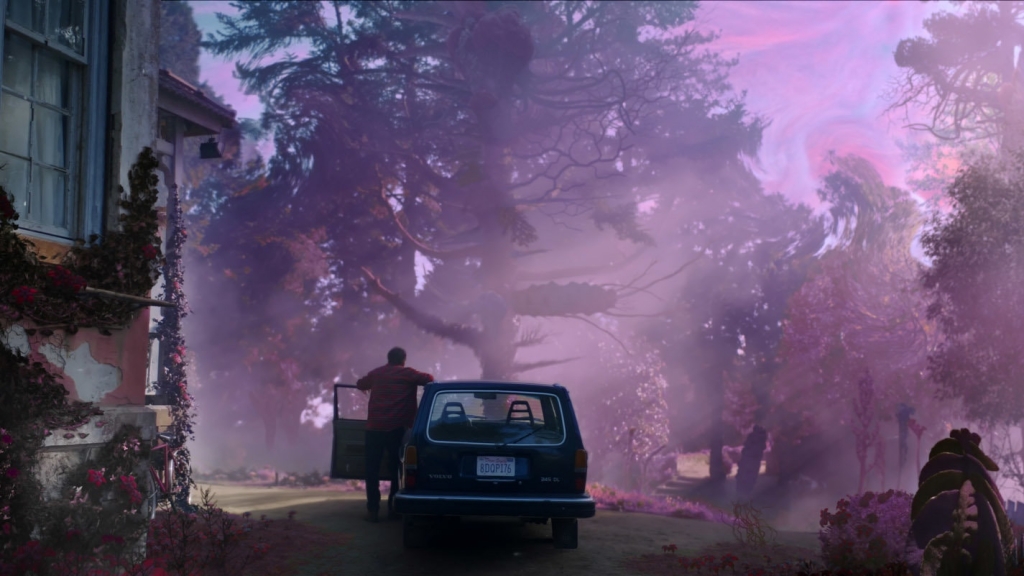
This review will serve as a nice counter-opinion for horror fans who, like me, adore Lovecraftian horror (sure, the man himself is a monster — not the fun kind, but his nightmarish and nihilistic creative vision is inspired).
Color Out of Space (2019) is a mesmerizing and deeply unsettling cinematic experience that stands as one of the most successful adaptations of H.P. Lovecraft’s work to date. Director Richard Stanley‘s return to feature filmmaking after a 23-year hiatus is nothing short of triumphant, delivering a film that captures the essence of Lovecraftian cosmic horror while adding a modern, psychedelic twist.
At the heart of the film’s success is Nicolas Cage’s tour de force performance as Nathan Gardner, a family man whose life unravels following the impact of a mysterious meteorite on his farm. It’s a masterclass in controlled chaos, seamlessly transitioning from a caring father to a man driven to the brink of madness by an incomprehensible alien force.
The film’s visuals are nothing short of spectacular, with cinematographer Steve Annis crafting a kaleidoscope of otherworldly colors that seem to defy the laws of nature.
The titular “color out of space” is brought to life through a mesmerizing blend of practical effects and CGI, creating an alien presence that is both beautiful and terrifying. The way the color infects and transforms the landscape, warping reality itself, is a visual feast that pays homage to Lovecraft’s descriptions while pushing the boundaries of modern cinematography.
Stanley’s direction shines in his ability to balance these stunning visuals with moments of intense, visceral body horror.
The movie is an excellent entry point for those unfamiliar with Lovecraft’s work. It captures the essence of cosmic horror – the idea that the universe is vast, uncaring, and filled with forces beyond human comprehension – in a visceral and accessible way.
Ultimately, Color Out of Space is a triumph of Lovecraftian cinema, blending stunning visuals, powerful performances, and genuine cosmic horror into a unique and unforgettable experience.
The Cage Factor:

Nicolas Cage’s performance in Color Out of Space is one of the most frequently discussed aspects of the film. He brings his signature eccentricity, delivering a potent combination of grounded realism and over-the-top mania, effectively mirroring his character’s gradual descent into madness. As he is so often, Cage is the spark that sets this film ablaze. His performance is funny, endearing, and unnerving. There’s perhaps no one better suited to bring Lovecraft’s creeping dread and otherworldly chaos to the screen.
It may be one of the best of his career, and his list of unforgettable performances is impressively long. He brings his trademark intensity when we need it most, but he’s also relatable and vulnerable during the film’s emotional scenes. It’s a compelling and tragic unraveling punctuated by a hilariously random obsession with alpacas that equates to cinematic gold.












Follow Us!