


In “The Faculty”, Robert Rodriguez weaves a chilling narrative of alien invasion into a critique of authority, conformity, and adolescence.

No time to read? Click the button below to listen to this post.
EDITOR'S NOTE
The following article contains an in-depth analysis of the 1998 film directed by Robert Rodriguez (and written by David Wechter, Bruce Kimmel, and Kevin Williamson of Scream fame), The Faculty. As a result, you are strongly encouraged to watch the film, which is currently available on Fubo or Paramount Plus (or to rent on VOD), before reading this analysis to avoid any significant plot spoilers.
School is back in session. Bring on the mind control. Alien movies, in general, are usually about the same thing: the process of gaining control over humans through isolation, takeover, and absorption of humans into themselves. What better backdrop for that than a high school in the ’90s?
Difference is not encouraged, nor is individuality. Every person moves in the same circles in this small society as in the bigger ones outside the high school hallways.
Summary (Spoilers Ahead!)

Strange things are happening at Harrington High, somewhere in Middle America, Ohio. A quiet alien invasion is beginning at the school, but no one is keen to believe it. With the systems of control in place to govern unruly teens and how kids are taught to obey authority figures, it’s fairly easy to manipulate the young people — getting them alone one by one to be assimilated. The outcasts of the school—who usually exist separately from each other sociologically—band together to save the world.
The big reveal in The Faculty is that the new girl, Marybeth, is the alien and views humanity as something horrible that needs to be subjugated to continue; that their “freedom”, to her, is a form of slavery. One of the last kids to survive, Casey, saves the day after each character is assimilated, killing Marybeth by injecting her with drugs that dry out the alien husk. Everyone under her grasp is then released from the alien’s hold.
The Cast

Zeke (Josh Hartnett) is a troublemaker with too much time on his hands. He is incredibly smart, not being challenged, and getting no real attention from his parents, which culminates in illegal activities. Zeke uses his brilliance against the school and society at large. He is romantically interested in the new girl, Marybeth Louise Hutchison (Laura Harris), a sweet Southern belle who moved recently.
Marybeth was a good villain because she was so sweet, which deflected focus. However, she was also new, so it makes sense that everything only began once she began stalking her prey in the halls.
Casey (Elijah Wood) is the bullied “Stephen King” kid who figures out the takeover plot almost immediately and is dismissed, even punished, for what he can see happening around him. The hierarchy of popularity bullies him physically and emotionally; he is a true outcast, existing on the fringes.
Stokely (Clea Duvall) is a character who claims she is a lesbian to ward off people, which is deeply problematic at best. She wears black and lies about her sexuality to cover up the truth: Stokely wants to be accepted but has faced rejection from other people when she tries. Stokely also exists on the fringes, choosing to be exiled because she doesn’t fit in, so she rejects the small high school society.
Though she is openly hostile towards him (and everyone), Stokely is romantically interested in Stan, a popular jock. After the takeover, she abandons her black clothing and dates Stan.
Stan (Shawn Hatosy) is a genuinely nice guy until someone isn’t to him. He distracts his friends, who begin to bully Casey and appears to care about other people, all of which play against his stereotype. He also desires to be something other than what he’s been labeled as since preschool; Stan wants to go to college by getting his grades up instead of it being handed to him because he’s naturally good at sports.
This, in itself, is a rejection of the high school order.

Delilah (Jordana Brewster) is the popular girl of The Faculty who is easy to hate. She’s way too obsessed with the way she looks and overestimates her own importance. She is a perfect example of kindness being perceived as the currency of the weak and cruelty being a sign of the strong. Delilah is often mean to Casey simply because she can be. She also throws off expectations by being the editor-in-chief of the school paper, something other popular people might not value, but she clearly does.
My main takeaway from her character is that she’s layered; her bitchiness is probably a defense to cover her own vulnerability, though her character operates fully as a cog in the machine of high school.
She also mercilessly bullies Stokely and is openly homophobic. Casey is one of the few that sees Delilah as a fully-formed person instead of the facets she often presents to people. They end up together only because Casey saves the world; in no other context would these two date.
Ms. Burke (Famke Janssen), a teacher, is an interesting character; she is mousy, meek, kind, but stepped on. When she becomes infected with the parasite, it makes her assertive/aggressive in the extreme and more interested in her looks. Meekness is then viewed as something to be taken advantage of in the currency of cruelty.
Zeke is horrible to her and sexually harasses her, but at the end of the movie, it’s implied that they end up together, which is disgusting considering the grooming and power imbalance.
The Faculty subverts its own tropes with who ends up with who, how their characters develop as more complex, and is much more layered than you’d expect for a teen alien movie.
The Parasite
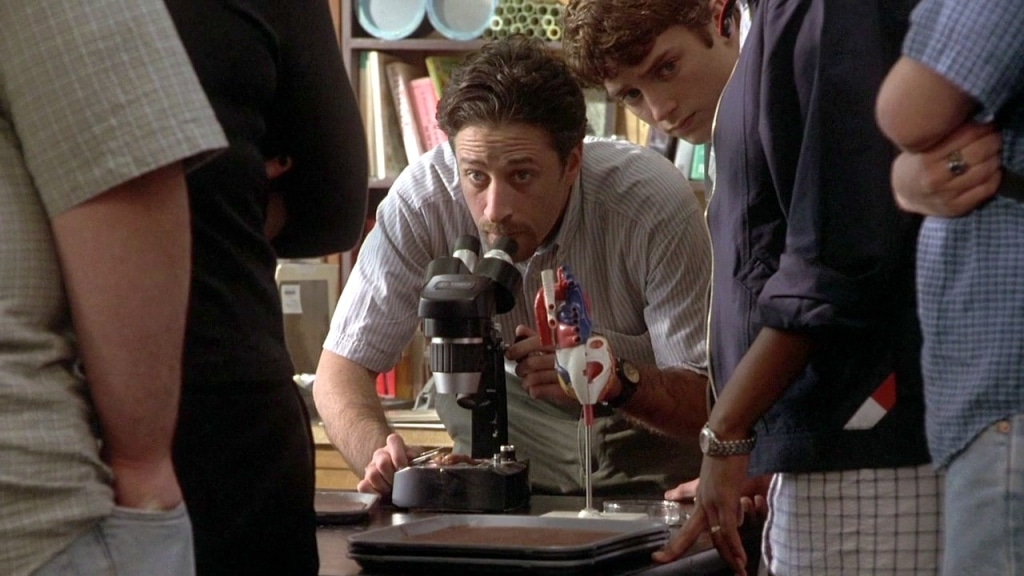
Zeke’s dissection of an infected rat tells us that this extraterrestrial organism can’t completely assimilate, is part of a much bigger organism, and needs a moist environment to survive.
The parasite as a character has an interesting backstory: she came from a place with limitless oceans but they dried up, so she came to a new watery planet and noticed immediately that there was something wrong with humanity. Slavery and control through a hive mind is a gift because then there is no rejection or hatred. Everyone is happy, but nobody is free.
Humanity has serious issues; being controlled by something else like Marybeth takes away what makes us human: choice. She also picked an interesting place to begin the infection: a town that worships football and players like gods, spreading her hive slowly to the outside world.
Isolated people or those who isolate themselves are sought out for company because they would be the least likely to be noticed while at the same time, she employs her more popular assimilated ones to pull more people into her hive. A coverup could easily happen like this because who really believes teenagers?
Conspiracy theories are only a conspiracy until they’re proven to be true.
Hierarchical Control
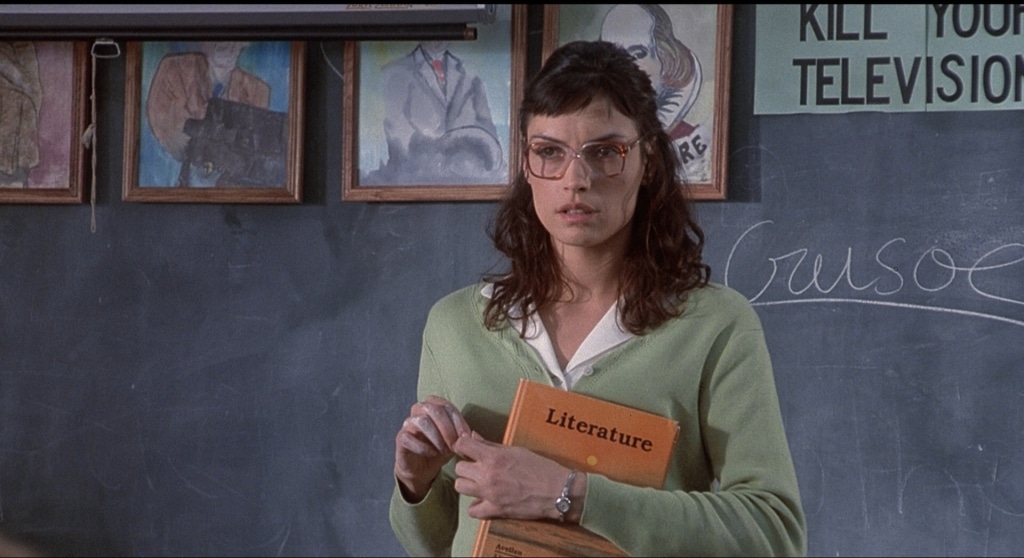
High school as a system doesn’t encourage free thinking; it is merely brainwashing for the masses. College is much more liberal, but high school encourages one to think like their parents or the town at large. Individuality is largely squashed or downtrodden so that escape from the town is inevitable, pushing out the unwanted energy of rebellion.
The Faculty is making the point that high school is ultimately a system of control, even down to the way that teachers “command” the room at the front, ferrying wandering students to where they need to be.
Places like schools operate like panopticons, a prison idea constructed by Jeremy Bentham in the 19th century; at any given time, the prisoner could be watched, but the prisoner could not see whether the guards were watching them or not. This gives way to a sense of paranoia so powerful that the prisoners need not be watched so often.
Schools are like this because they teach you that somebody is probably watching you, so you should behave correctly whether you’re being observed or not.
The alien is just mirroring another system of hierarchal control in the hive mind, asking the question: are we already part of a hive mind?

Are we trading one form of cruel systematic oppression for another?
High school is merely a reinforcement of hierarchies within society. Even the faculty ends up kissing certain students’ asses and ignoring others who aren’t seen as valuable or talented in some way. Funding also reigns when it comes to what’s important and what isn’t; the Board that grants funding is determined by the parents, who worship football.
It’s cyclical and a problem, but a bigger problem is mind slavery to a hive that controls everyone into sameness and absorbs the water of our planet. That’s when we band together, and our humanity shines through in the face of a common enemy.
None of the kids in The Faculty would have looked at each other twice had it not been for this alien invasion, but now they’re all inextricably linked by the events that unfolded at Harrington High that year.











Follow Us!