


Whether he’d be keen to admit it or not, rising genre star Fede Alvarez seems continually drawn to films that share a lot of Lovecraft DNA.
No time to read? Click the button below to listen to this post.
WARNING: I will frequently use the term “nerd” in this article as it relates to the title. This is in no way derogatory towards fans or fanbases; it does, however, apply to me.
Fede Alvarez is directing the new Alien film, Alien: Romulus. To my knowledge, Alvarez has never once cited H.P. Lovecraft (HPL) as one of his major influences. However, I’d like to argue that he is a closet HPL nerd.
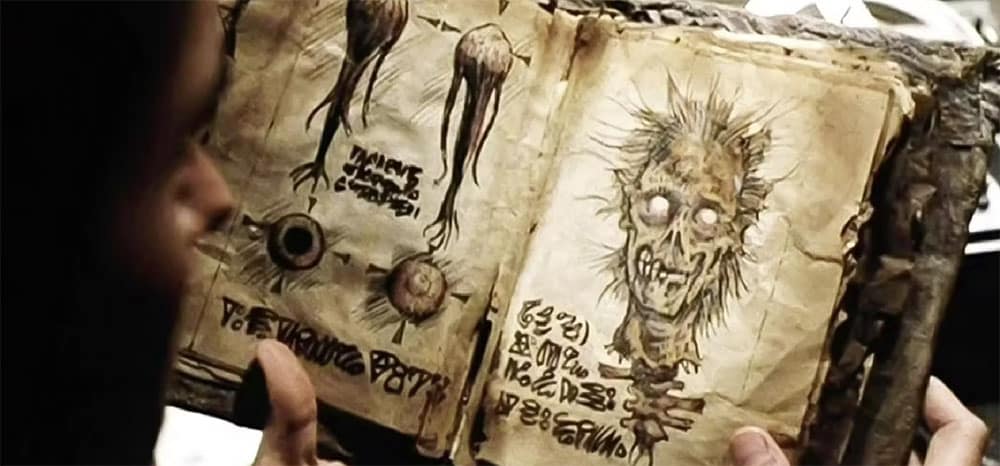
Let’s start with his first feature film, the highly impressive remake of The Evil Dead, simply titled Evil Dead. As most horror nerds, or at least Evil Dead nerds, understand, the centerpiece of the Evil Dead franchise is a cursed book known as The Necronomicon. Neither Raimi, the director of the original The Evil Dead, nor Alvarez mentions the origins of the book according to its creator. But HPL nerds know.
Writer and Lovecraft historian Donald R. Burleson argued that Nathaniel Hawthorne conceived the idea for a book like this. However, Lovecraft wrote and published his own Necronomicon origin and coined the name itself. In 1927, he wrote a brief pseudo-history in History of the Necronomicon.
According to these writings, the fictional Necronomicon was written by “the Mad Arab Abdul Alhazared” after visiting the ruins of Babylon, Memphis, and the “Empty Quarter of Arabia.” Alhazared wrote the book itself while living his last years in Damascus. He died suddenly and mysteriously in 738 C.E.
There’s your first clue.
Alvarez’s second feature was Don’t Breathe.

Although it was never cited in the credits, this film directly pulls inspiration from one of HPL’s short stories, The Terrible Old Man.
There may be more than a few films or stories that seem very similar, but there are moments and characters in Don’t Breathe that conjure up images straight from the story.
“…so old that no one can remember when he was young, and so taciturn that few know his real name.”
The plot for the short story is also very similar to the film, at least in concept. The film strays away from the story’s ending, but the setup is almost identical.
Three burglars believe that a frail old man is hoarding ancient treasure in his house in the fictional town of Kingsport. They plan to break in and easily take from the defenseless old man, who is thought to be useless and unable to defend himself. One of the robbers is the wheelman, nervously waiting outside in the car for his comrades in crime. After some time, longer than he was told to wait, he hears screams coming from inside the house. Moments later, the old man comes out the front door and smiles at the wheelman. The story ends with police finding three corpses on the beach.
“…horribly slashed as with many cutlasses, and horribly mangled as by the tread of many cruel boot-heels.”
Alvarez’s third feature, the upcoming Alien: Romulus, could be considered cosmic horror.
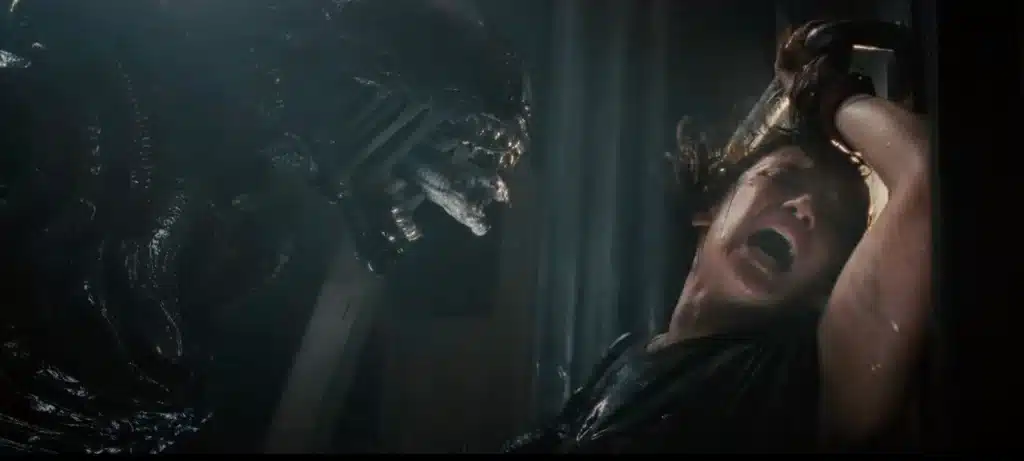
Lovecraft, the father of cosmic horror, describes cosmic horror as relating to themes of cosmic dread, forbidden and dangerous knowledge, madness, non-human influences on humanity, religion, superstition, fate, inevitability, and the risks associated with scientific discoveries.
Not all of these themes are present throughout the Alien saga, but certainly some of them are, especially the notion of potential horrors associated with scientific discovery. Thus, it’s not unreasonable to argue that Alien is Lovecraftian horror. The plot of the 1979 film even shares some plot elements with At the Mountains of Madness, a novella by HPL in 1931.
Another sci-fi horror staple takes elements from that same novella, a little film known as John Carpenter’s The Thing.
I believe it’s safe to say numerous horror films since The Thing, released in 1982, have been influenced by Carpenter’s Practical Effects, a sci-fi horror masterpiece. Like the novella, the film takes place in Antarctica, and descriptions of the setting in the novella work perfectly for the film. For instance, this is an excerpt from At the Mountains of Madness:
“I could not help feeling that they were evil things– mountains of madness whose farther slopes looked out over some accursed ultimate abyss. That seething, half-luminous cloud-background held ineffable suggestions of a vague, ethereal beyondness far more than terrestrially spatial; and gave appalling reminders of the utter remoteness, separateness, desolation, and aeon-long death of this untrodden and unfathomed austral world.”
I understand why one wouldn’t want to necessarily name-drop HPL as an inspiration because of his complicated views on people different from him or who he deems foreign.

“Foreign” to Lovecraft could mean anything from non-American to non-anglo, depending on how hateful he felt at the time. HPL was so afraid of foreigners taking the jobs he didn’t even want or taking some nostalgic, old-fashioned, already dead values from the country that he wrote many of his villains as “foreigners.”
In the previously mentioned The Terrible Old Man, the thieves are described as outsiders with names Lovecraft considered foreign, like Ricci, Czanek, and Silva. His ignorance and fear of others often overshadow his more endearing qualities. I’m sure Alvarez is well aware of this, being a Uruguayan filmmaker now living in the States. Thus, it’s utterly understandable that Alvarez might not want to mention HPL as an inspiration, even if that fact seems readily apparent.
The love of the Lovecraftian is present in every feature film, whether it is a conscious decision or not.
Perhaps this is a case of wishful thinking or projecting on my part as a Lovecraft nerd. I’m aware of confirmation bias. I’ve even considered that it might be a coincidence; his literary reach travels far after a hundred years, and anyone creating modern horror can’t help but draw some inspiration from Lovecraft’s work.
I would never assume to know Alvarez’s influences and inspirations, nor do I think it’s something he should go around announcing to the world; it’s a fun thought and interesting to think about whether it’s intentional or not.
In your head… no one can hear you scream.
(P.S. – I’m looking forward to seeing Alien: Romulus.)








Follow Us!