Final Girl on 6th Ave: A Clockwork Orange (1971)


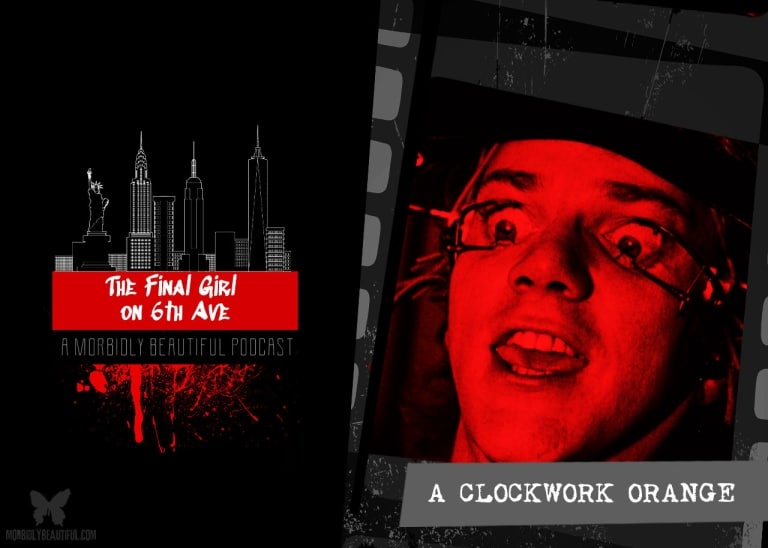
Show host Carolyn Smith-Hillmer takes a deep dive into A Clockwork Orange, widely regarded as one of Kubrick’s greatest works and a cornerstone of 20th-century cinema. Despite its controversial reception, the film’s boldness in tackling difficult social issues like violence, free will, and state power has solidified its status as a cultural and cinematic landmark.- Stephanie (Editor-in-Chief)
SHOW NOTES FROM HOST CAROLYN SMITH-HILLMER:
Editor’s Notes:In this episode, I take a deep dive into Stanley Kuckbrick’s controversial classic, A CLOCKWORK ORANGE, exploring the controversy of free will, societal control, and violence. Whether you are a longtime fan of the film or a first time viewer, this episode will challenge and shape your perception.
Directed by Stanley Kubrick, A Clockwork Orange is based on the 1962 novel by Anthony Burgess. It is a dystopian science-fiction film that explores themes of free will, state control, violence, and the nature of humanity.
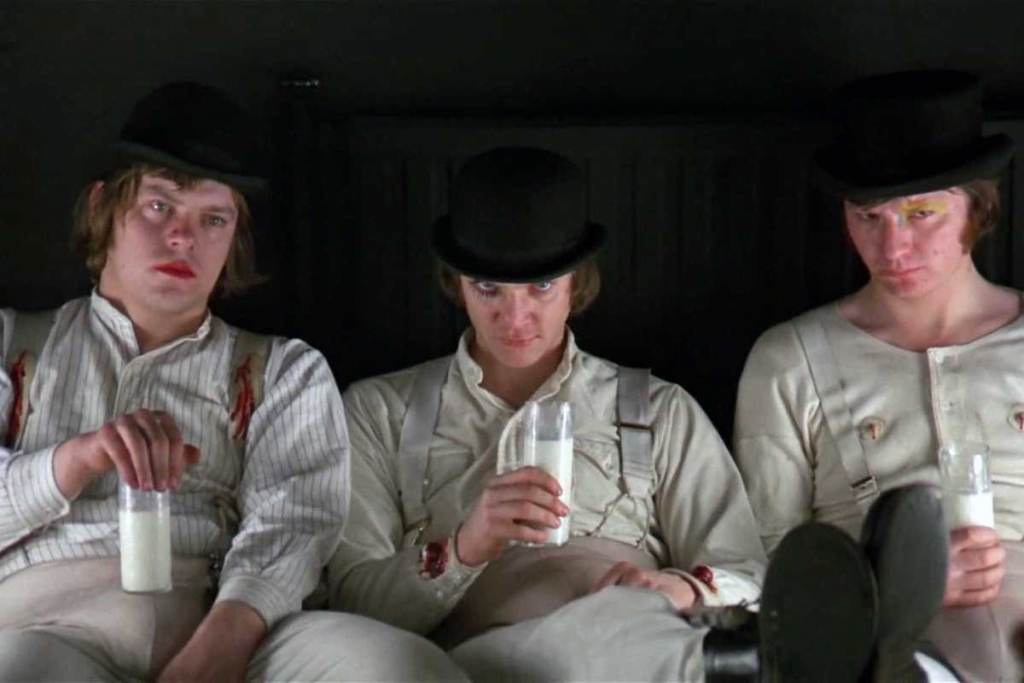
The film is set in a futuristic society plagued by lawlessness, and it centers around Alex DeLarge (played by Malcolm McDowell), a young man who leads a gang of “droogs” in committing brutal acts of violence and delinquency.
Kubrick’s presentation of violence through Alex’s eyes, coupled with his use of dark humor, sharp visual style, and iconic use of classical music, creates a deeply unsettling and thought-provoking cinematic experience.
Upon its release, A Clockwork Orange sparked widespread controversy for its explicit violence and disturbing depictions of rape. The film’s UK release led to public outcry, and some believed it inspired copycat crimes. Kubrick, facing intense media scrutiny and pressure, eventually withdrew the film from circulation in the UK for over two decades. In the U.S., the film received an X-rating (later reclassified as R after cuts were made) and polarized critics.
Despite the controversy, A Clockwork Orange went on to receive four Academy Award nominations, including Best Picture and Best Director for Kubrick.

Kubrick’s visionary style, characterized by meticulous shot compositions, striking visual imagery, and the blending of music with violent imagery, influenced generations of filmmakers, from Quentin Tarantino to Darren Aronofsky.
Kubrick’s use of classical music, particularly Beethoven’s Ninth Symphony, became iconic and is now inextricably linked to the film’s portrayal of chaos and madness.
Its influence also extends beyond the technical aspects of filmmaking. The thematic content—its exploration of state control, psychological conditioning, and the loss of individual agency—has inspired countless films, books, and academic discussions about the role of society in controlling human behavior. Its influence on dystopian films, from Brazil (1985) to The Hunger Games franchise, is evident, and the film continues to be studied for its psychological and sociopolitical implications.
In many ways, A Clockwork Orange was ahead of its time, and its ability to provoke and disturb viewers decades after its release speaks to its timelessness and its capacity to force audiences to confront uncomfortable truths about human nature and societal control.
This episode contains spoilers, so if you haven’t seen this essential cinematic classic, watch before listening unless you want to be spoiled.

The Final Girl on 6th Ave is a weekly show where host, Carolyn Smith-Hillmer, dissects an arthouse/elevated horror film. Each episode includes a detailed play-by-play of the film itself and a subsequent deep dive into the thematic elements and symbolism. Because elevated horror is sometimes viewed within the horror community as pretentious, Carolyn makes sure to use her down-to-earth tone and unique perspective to make these films less intimidating for the casual horror viewer and less ostentatious for the genre lover.
Listen to more episodes on the show’s website here.
The Final Girl on 6th Ave is a bi-weekly podcast where host Carolyn Smith-Hillmer reviews arthouse horror films in a non-pretentious way.
Lars von Trier has been called a visionary, a sadist, and a self‑mythologizing provocateur—sometimes all in the same breath. In this episode, we unpack how an anxious kid from Copenhagen became one of the most controversial figures in world cinema, and why his work looms so large over modern horror and “extreme” art‑film. Focusing on Antichrist, Melancholia, Nymphomaniac, and The House That Jack Built, we explore von Trier’s “Depression Trilogy,” his use of grief, sex, and violence, and the ongoing debates about misogyny, ethics, and audience complicity. Along the way, we bring in film scholarship, critical essays, and production histories to ask a simple but uncomfortable question: when von Trier pushes horror this far, is he revealing something profound about suffering—or just building a house out of pain?
SOURCES/INFORMATION
Biographical and career overviews
“Lars von Trier.” Wikipedia.wikipedia
“Lars von Trier – Simple English Wikipedia.” Simple Wikipedia.wikipedia
“Lars von Trier.” Encyclopaedia Britannica (biography, awards, filmography).britannica
“Lars von Trier filmography.” Wikipedia.wikipedia
“Lars von Trier – IMDb.” IMDb.imdb
“List of awards and nominations received by Lars von Trier.” Wikipedia.wikipedia
Context and Danish film culture
“Lars von Trier and Cultural Liberalism.” Danish Film Institute.dfi
Excerpt from Regional and Global Dimensions of Danish Film Culture and Film Policy (on Dogme 95 and Danish film branding).catalogimages.wiley
Critical profiles and interviews
“Lars von Trier: Behind the Curtain.” The New Yorker (profile on von Trier’s persona and controversies).mubi+1
“Lars von Trier: A Problematic Sort of Ladies’ Man?” NPR radio piece and transcript (Pat Dowell, with Caroline Bainbridge).npr+1
“The Many Faces of Lars von Trier.” BFI feature.bfi
“Lars von Trier: An Overview.” Film Festival Today (career overview).filmfestivaltoday
Horror‑specific and film‑specific sources
“The Immersive Examination of Depression and Grief in ‘Antichrist’ [Unveiling the Mind].” Bloody Disgusting.bloody-disgusting+1
“Antichrist (2009)” – film entry and production details. IMDb and Wikipedia.imdb+1
“The House That Jack Built (2018).” IMDb (plot, reception).imdb
“Manically Macabre: Lars von Trier as Horror Icon.” Horror Obsessive.horrorobsessive
“‘Terrifier 2’ and 9 Other Horror Movies Which Famously Made Audiences Sick.” Collider (section on Antichrist).collider
Scholarly / analytical work
“Lars von Trier – The ‘Sex’pression Ideology.” Academic essay (via Academia.edu PDF).academia
Caroline Bainbridge, The Cinema of Lars von Trier (discussed in NPR and academic contexts).npr+1
Career primers
“Notebook Primer: Lars von Trier.” MUBI Notebook.



She’s a lover, he’s a fighter. Together, they’re CHEER AND LOATHING. Tune in to hear your hosts, Stephanie (Cheer) and Casey (Loathing), clash over the films they love — and the ones they love to hate.
In this holiday extravaganza episode of Guilty Pleasures, join hosts Stephanie, Kelly, and our newest addition, Jonathan (Jack was tied up in tinsel and couldn't join us), as they unwrap the bizarre and unhinged world of holiday cinema. They dive into the depths of Elves, a film that's as chaotic as it is entertaining. It's a sleigh full of questionable decisions, diabolical dialogue, absurd plot twists, wildly offensive antics, and unhinged holiday mischief.
And that's not all! In the second half of the podcast, join your festive cinephile friends for a look at four more ”nutty as a fruitcake” holiday treats: A New York Christmas Wedding, Elf Bowling, A Medea Christmas, and Jack Frost. Plus, we each offer a bonus Christmas flick guaranteed to make you say, ”Ho, Ho, HO-LY Hell!”
Expect laughter, disbelief, and a spirited debate about what truly makes a movie a guilty pleasure. Don't miss this festive journey through the weirdest corners of holiday films!







Follow Us!