

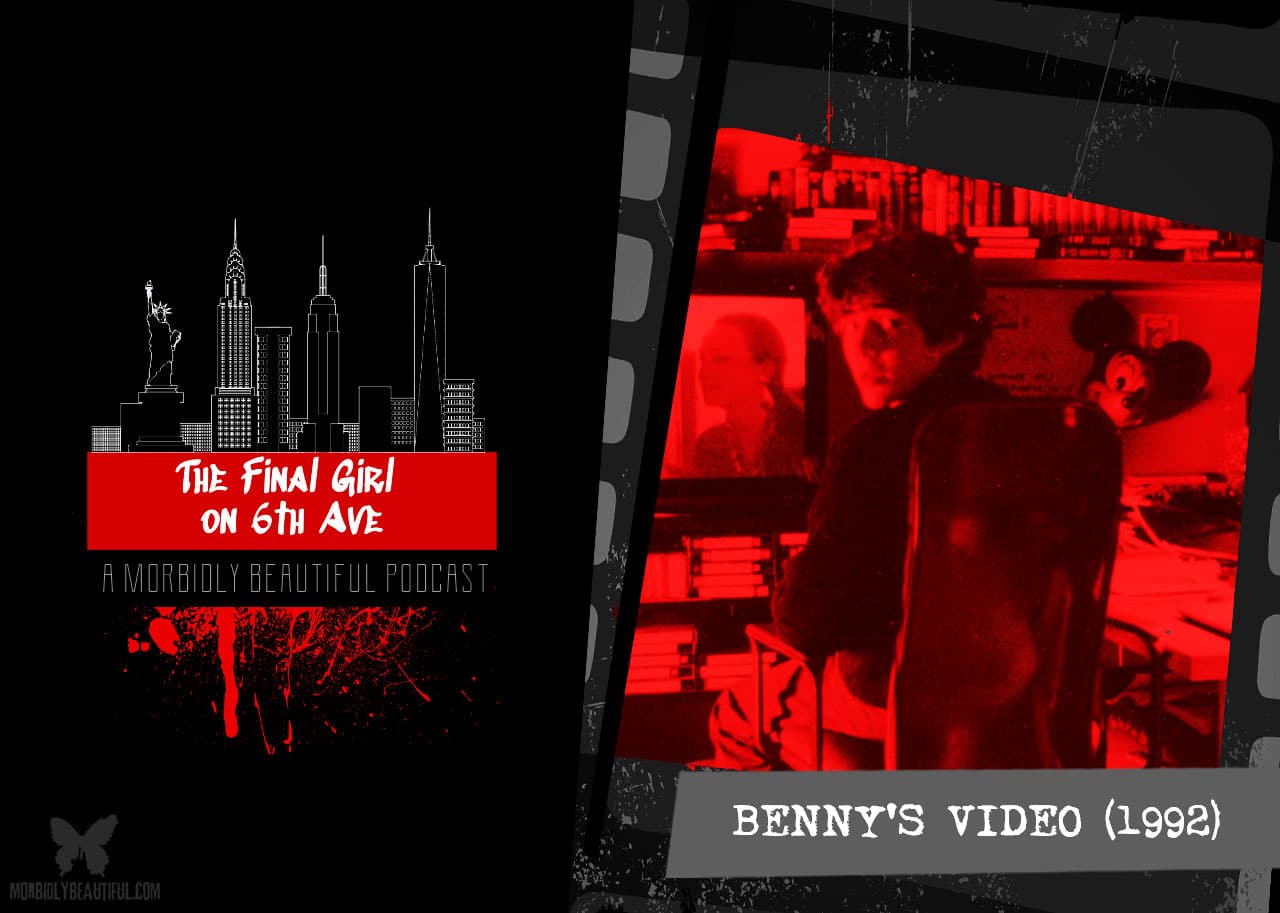
“Benny’s Video” is a chilling portrait of media-fueled detachment and the ways violence loses moral weight when consumed through a screen.

Show host Carolyn Smith-Hillmer takes a deep dive into Benny’s Video—a chilling critique of the numbing effects of media saturation (a theme that has only grown more prescient in the digital age). This disturbing detachment echoes Haneke’s broader concerns about how violence, when mediated through a screen, can lose its moral weight, a theme he would later revisit in Funny Games (1997, 2007). – Stephanie (Editor-in-Chief)
SHOW NOTES FROM HOST CAROLYN SMITH-HILLMER:
In 1992, BENNY’S VIDEO would have absolutely rocked my world. I can tell you that today, it still does. This timeless and gut-wrenching film highlights what it means to be a person in the world today of continuous and increasingly violent media. If nothing else, watch this film to learn about yourself.
This episode contains spoilers, so if you haven’t seen this haunting modern masterpiece, consider watching before listening; you can watch it on Max or The Criterion Channel.
Editor’s Notes:
Michael Haneke’s Benny’s Video (1992) is a chilling meditation on media violence, detachment, and the consequences of a life filtered through screens. As the second entry in Haneke’s unofficial Glaciation Trilogy—preceded by The Seventh Continent (1989) and followed by 71 Fragments of a Chronology of Chance (1994)—the film dissects how desensitization to violence, particularly through media consumption, can manifest in horrifying real-world actions.
Haneke, known for his unflinching approach to human cruelty and societal decay, constructs a deliberately clinical narrative that forces the audience into the cold, distant perspective of its protagonist, a teenage boy whose obsession with recorded violence leads him to commit an unspeakable act.
The film’s central character, Benny, is a privileged adolescent who experiences the world through his video recordings rather than direct interaction.
His voyeuristic relationship with reality culminates in an experiment: he invites a girl to his home, records their interactions, and, without hesitation, executes her with a captive bolt pistol—the same method of slaughter he had previously watched on tape.

Instead of displaying horror or remorse, Benny continues to observe the footage as if the act itself were just another recording to be consumed and rewound.
Beyond its commentary on media and violence, Benny’s Video remains deeply relevant in conversations about privilege, parental neglect, and moral apathy.
Benny’s parents, rather than confronting the horror of their son’s actions, opt for cold, calculated damage control—an eerie parallel to how institutions and individuals often prioritize reputation over morality. The film’s effectiveness lies in its stark minimalism, lack of manipulative scoring, and Haneke’s signature use of long, static takes that implicate the audience as passive observers, much like Benny himself.
The result is a profoundly unsettling experience that lingers long after the credits roll, reinforcing Haneke’s place as one of cinema’s most ruthless chroniclers of modern alienation.
SOURCES/INFORMATION:
IMDB: https://www.imdb.com/title/tt0103793/
Narcissus: https://www.worldhistory.org/Narcissus/
Time-Image Discussion: https://www.reddit.com/r/askphilosophy/comments/r1z7u0/deleuze_time_image/
Supermodernity, Capital, and Narcissus: The French Connection to Michael Haneke’s Benny’s Video by Mattias Frey: https://citeseerx.ist.psu.edu/document?repid=rep1&type=pdf&doi=cb14102e47fbec4eafe9a94d2ceb5cc710d74e89
Airplane Game: https://en.wikipedia.org/wiki/Airplane_game
ABOUT THE SHOW:

The Final Girl on 6th Ave is a weekly show where host, Carolyn Smith-Hillmer, dissects an arthouse/elevated horror film. Each episode includes a detailed play-by-play of the film itself and a subsequent deep dive into the thematic elements and symbolism. Because elevated horror is sometimes viewed within the horror community as pretentious, Carolyn makes sure to use her down-to-earth tone and unique perspective to make these films less intimidating for the casual horror viewer and less ostentatious for the genre lover.
Listen to more episodes on the show’s website here.
The Final Girl on 6th Ave is a bi-weekly podcast where host Carolyn Smith-Hillmer reviews arthouse horror films in a non-pretentious way.
Lars von Tier and Horror
Lars von Trier has been called a visionary, a sadist, and a self‑mythologizing provocateur—sometimes all in the same breath. In this episode, we unpack how an anxious kid from Copenhagen became one of the most controversial figures in world cinema, and why his work looms so large over modern horror and “extreme” art‑film. Focusing on Antichrist, Melancholia, Nymphomaniac, and The House That Jack Built, we explore von Trier’s “Depression Trilogy,” his use of grief, sex, and violence, and the ongoing debates about misogyny, ethics, and audience complicity. Along the way, we bring in film scholarship, critical essays, and production histories to ask a simple but uncomfortable question: when von Trier pushes horror this far, is he revealing something profound about suffering—or just building a house out of pain?
SOURCES/INFORMATION
Biographical and career overviews
“Lars von Trier.” Wikipedia.wikipedia
“Lars von Trier – Simple English Wikipedia.” Simple Wikipedia.wikipedia
“Lars von Trier.” Encyclopaedia Britannica (biography, awards, filmography).britannica
“Lars von Trier filmography.” Wikipedia.wikipedia
“Lars von Trier – IMDb.” IMDb.imdb
“List of awards and nominations received by Lars von Trier.” Wikipedia.wikipedia
Context and Danish film culture
“Lars von Trier and Cultural Liberalism.” Danish Film Institute.dfi
Excerpt from Regional and Global Dimensions of Danish Film Culture and Film Policy (on Dogme 95 and Danish film branding).catalogimages.wiley
Critical profiles and interviews
“Lars von Trier: Behind the Curtain.” The New Yorker (profile on von Trier’s persona and controversies).mubi+1
“Lars von Trier: A Problematic Sort of Ladies’ Man?” NPR radio piece and transcript (Pat Dowell, with Caroline Bainbridge).npr+1
“The Many Faces of Lars von Trier.” BFI feature.bfi
“Lars von Trier: An Overview.” Film Festival Today (career overview).filmfestivaltoday
Horror‑specific and film‑specific sources
“The Immersive Examination of Depression and Grief in ‘Antichrist’ [Unveiling the Mind].” Bloody Disgusting.bloody-disgusting+1
“Antichrist (2009)” – film entry and production details. IMDb and Wikipedia.imdb+1
“The House That Jack Built (2018).” IMDb (plot, reception).imdb
“Manically Macabre: Lars von Trier as Horror Icon.” Horror Obsessive.horrorobsessive
“‘Terrifier 2’ and 9 Other Horror Movies Which Famously Made Audiences Sick.” Collider (section on Antichrist).collider
Scholarly / analytical work
“Lars von Trier – The ‘Sex’pression Ideology.” Academic essay (via Academia.edu PDF).academia
Caroline Bainbridge, The Cinema of Lars von Trier (discussed in NPR and academic contexts).npr+1
Career primers
“Notebook Primer: Lars von Trier.” MUBI Notebook.

Episode play icon
Lars von Trier has been called a visionary, a sadist, and a self‑mythologizing provocateur—sometimes all in the same breath. In this episode, we unpack how [...]
May 1, 2026
Episode play icon
In this episode, we explore why we willingly scare ourselves — unpacking the neuroscience of fear, the psychology of personality and anxiety, and the surprising [...]
March 1, 2026
Episode play icon
The Final Girl looks a little different for 2026… in the best way! Join in for the first episode of 2026 where we uncover what [...]
January 21, 2026
Search Results placeholder










Follow Us!