

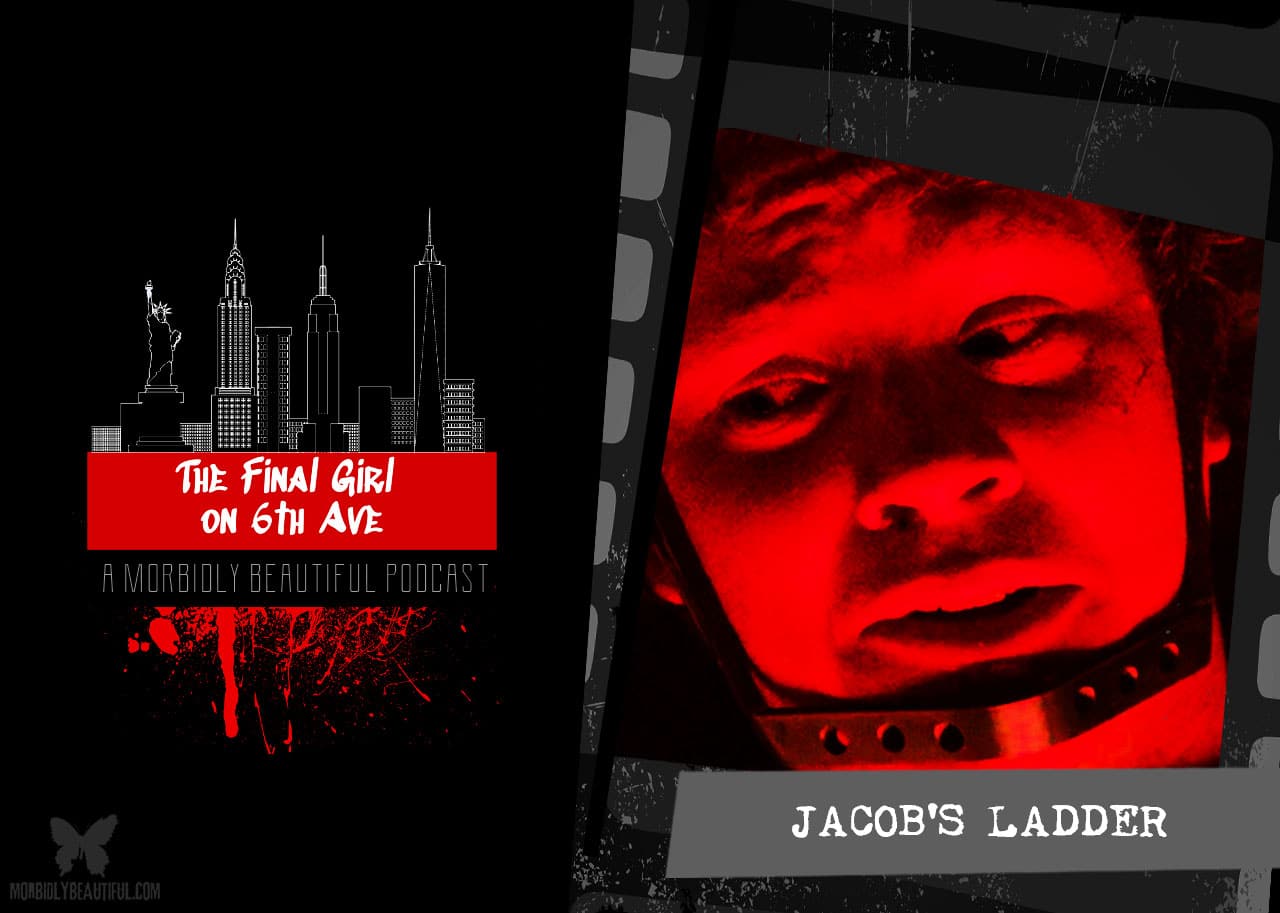
Although some of its initial shock value may have subsided, “Jacob’s Ladder” remains the pinnacle of psychological horror.

Show host Carolyn Smith-Hillmer takes a deep dive into the 1990 psychological horror film Jacob’s Ladder, an influential and deeply haunting exploration of madness, grief, and confusion. With chilling visuals that inspired the Silent Hill video game and film franchise, it’s a masterclass in unnerving audiences by placing them in an eerie environment where it’s impossible to differentiate between hallucinations and reality. If what the film has to say about the pain of life and the inevitability of human damnation doesn’t shake you to your core, I urge you to please check your pulse. – Stephanie (Editor-in-Chief)
SHOW NOTES FROM HOST CAROLYN SMITH-HILLMER:
Editor’s Notes:If you have already seen this film, my sincerest apologies in advance to make you relive it with me today. Listen in as I discuss the absolute horror of JACOB’S LADDER and Tim Robbins’ harrowing journey to death.
Jacob’s Ladder was directed by Adrian Lyne and written by Bruce Joel Rubin. It stars Tim Robbins as Jacob Singer, an American postman whose experiences before and during his military service in Vietnam result in strange, fragmentary visions and bizarre hallucinations that continue to haunt him. As his ordeal worsens, Jacob desperately attempts to figure out the truth.
The film’s title refers to the Biblical story of Jacob’s Ladder, or the dream of a meeting place between Heaven and Earth (Genesis 28:12). Its little-known alternative title is Dante’s Inferno, a reference to Inferno by Dante Alighieri.
Screenwriter and co-producer Rubin was inspired by his spiritual upbringing and his practice of meditating, which showed him that the world is really different from what it appears to be. Before writing the script, he spent two years in a Tibetan Buddhist monastery in Nepal. His work on Jacob’s Ladder began in 1980, sparked by a nightmare about being trapped in a New York City Subway station.

Lyne, who downplayed Rubin’s Old Testament themes, said that he prepared for making the film by watching “endless” documentary films about the war in Vietnam and reading “countless” chronicles of near-death experiences.
All of the film’s special effect sequences were filmed in camera, with no use of post production effects. Lyne and Rubin used the works of the artist H. R. Giger and the photographers Diane Arbus and Joel-Peter Witkin for inspiration for their nightmarish imagery. According to Lyne’s audio commentary, test screenings indicated that the initial version of the film was overwhelming for the audience. In response, about 20 minutes of disturbing scenes, mostly from the last third of the film, were removed from the final cut.
Despite only being moderately successful upon its release, the film garnered a cult following, and its plot and special effects became a source of influence for various other works, such as the Silent Hill video game series.
Spoilers abound in this episode, so make sure you watch before listening unless you want to be spoiled.
ABOUT THE SHOW:

The Final Girl on 6th Ave is a weekly show where host, Carolyn Smith-Hillmer, dissects an arthouse/elevated horror film. Each episode includes a detailed play-by-play of the film itself and a subsequent deep dive into the thematic elements and symbolism. Because elevated horror is sometimes viewed within the horror community as pretentious, Carolyn makes sure to use her down-to-earth tone and unique perspective to make these films less intimidating for the casual horror viewer and less ostentatious for the genre lover.
Listen to more episodes on the show’s website here.
The Final Girl on 6th Ave is a bi-weekly podcast where host Carolyn Smith-Hillmer reviews arthouse horror films in a non-pretentious way.
Lars von Tier and Horror
Lars von Trier has been called a visionary, a sadist, and a self‑mythologizing provocateur—sometimes all in the same breath. In this episode, we unpack how an anxious kid from Copenhagen became one of the most controversial figures in world cinema, and why his work looms so large over modern horror and “extreme” art‑film. Focusing on Antichrist, Melancholia, Nymphomaniac, and The House That Jack Built, we explore von Trier’s “Depression Trilogy,” his use of grief, sex, and violence, and the ongoing debates about misogyny, ethics, and audience complicity. Along the way, we bring in film scholarship, critical essays, and production histories to ask a simple but uncomfortable question: when von Trier pushes horror this far, is he revealing something profound about suffering—or just building a house out of pain?
SOURCES/INFORMATION
Biographical and career overviews
“Lars von Trier.” Wikipedia.wikipedia
“Lars von Trier – Simple English Wikipedia.” Simple Wikipedia.wikipedia
“Lars von Trier.” Encyclopaedia Britannica (biography, awards, filmography).britannica
“Lars von Trier filmography.” Wikipedia.wikipedia
“Lars von Trier – IMDb.” IMDb.imdb
“List of awards and nominations received by Lars von Trier.” Wikipedia.wikipedia
Context and Danish film culture
“Lars von Trier and Cultural Liberalism.” Danish Film Institute.dfi
Excerpt from Regional and Global Dimensions of Danish Film Culture and Film Policy (on Dogme 95 and Danish film branding).catalogimages.wiley
Critical profiles and interviews
“Lars von Trier: Behind the Curtain.” The New Yorker (profile on von Trier’s persona and controversies).mubi+1
“Lars von Trier: A Problematic Sort of Ladies’ Man?” NPR radio piece and transcript (Pat Dowell, with Caroline Bainbridge).npr+1
“The Many Faces of Lars von Trier.” BFI feature.bfi
“Lars von Trier: An Overview.” Film Festival Today (career overview).filmfestivaltoday
Horror‑specific and film‑specific sources
“The Immersive Examination of Depression and Grief in ‘Antichrist’ [Unveiling the Mind].” Bloody Disgusting.bloody-disgusting+1
“Antichrist (2009)” – film entry and production details. IMDb and Wikipedia.imdb+1
“The House That Jack Built (2018).” IMDb (plot, reception).imdb
“Manically Macabre: Lars von Trier as Horror Icon.” Horror Obsessive.horrorobsessive
“‘Terrifier 2’ and 9 Other Horror Movies Which Famously Made Audiences Sick.” Collider (section on Antichrist).collider
Scholarly / analytical work
“Lars von Trier – The ‘Sex’pression Ideology.” Academic essay (via Academia.edu PDF).academia
Caroline Bainbridge, The Cinema of Lars von Trier (discussed in NPR and academic contexts).npr+1
Career primers
“Notebook Primer: Lars von Trier.” MUBI Notebook.

Episode play icon
Lars von Trier has been called a visionary, a sadist, and a self‑mythologizing provocateur—sometimes all in the same breath. In this episode, we unpack how [...]
May 1, 2026
Episode play icon
In this episode, we explore why we willingly scare ourselves — unpacking the neuroscience of fear, the psychology of personality and anxiety, and the surprising [...]
March 1, 2026
Episode play icon
The Final Girl looks a little different for 2026… in the best way! Join in for the first episode of 2026 where we uncover what [...]
January 21, 2026
Search Results placeholder



Follow Us!