

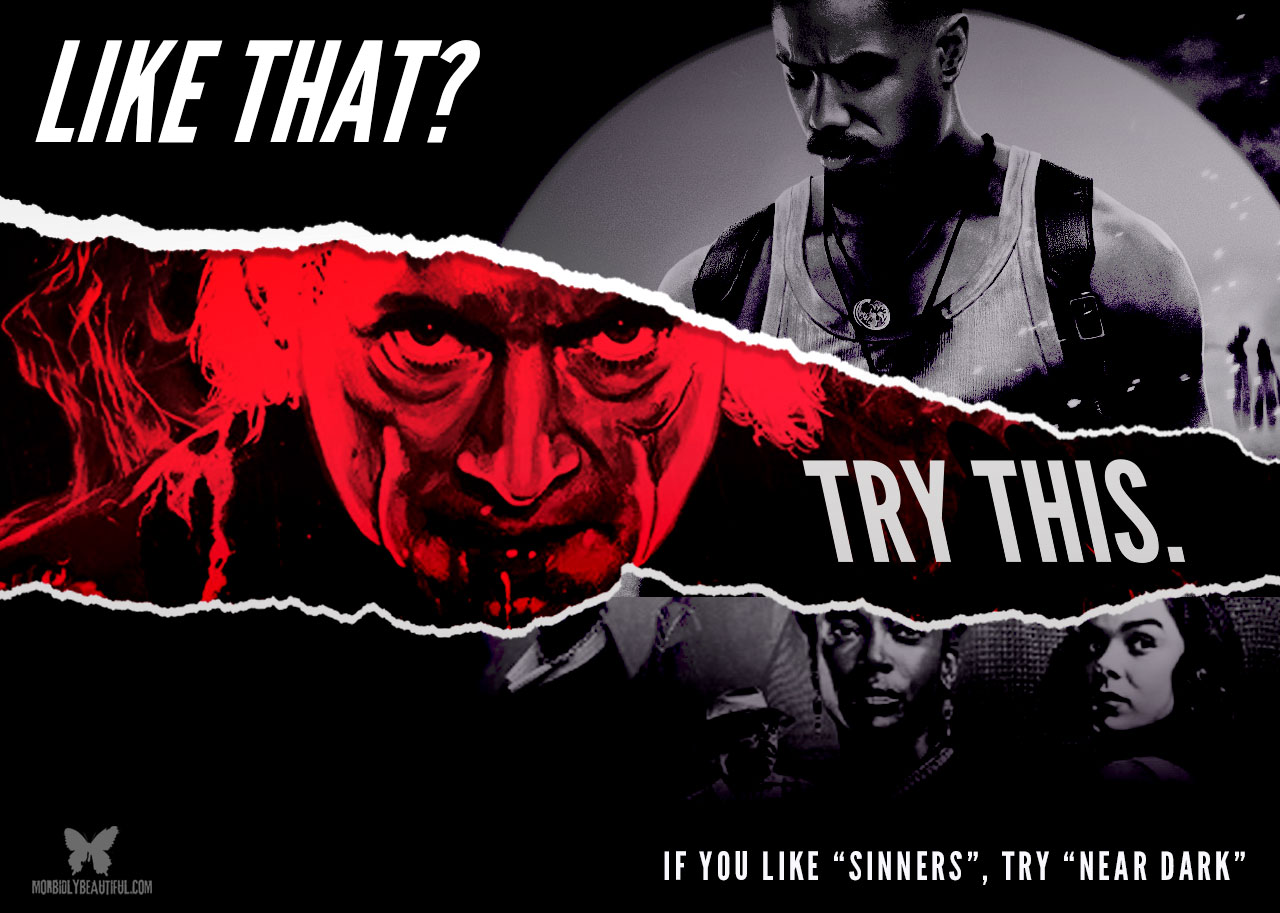
Before “Sinners” redefined vampire mythology for a new generation, there was “Near Dark”—a horror-western that still bites hard decades later.

No time to read? Click the button below to listen to this post.

The critically acclaimed Sinners dominated the box office in 2025 (becoming the ninth-highest-grossing film of the year), and the film gets its physical release today (July 8). Thus, I thought now would be the perfect time to explore another movie that presented a new and unique spin on the Vampire subgenre during its respective release.
Join me as we ride off into the sunset and consider the cultural influence of a little-known horror-western, and how it has shaped modern filmmakers’ approaches to and depictions of vampires in contemporary cinema. Let’s saddle up and dive into Kathryn Bigelow’s Near Dark, and its shared connective tissue with modern genre films like Sinners.
Near Dark had an unfortunate start in life; it premiered in US theaters on October 2, 1987, a mere eight weeks after another vampire movie stole the hearts of teens and young adults across the globe: The Lost Boys.
Ultimately, Near Dark is the scrappy Punk cousin of The Lost Boys. Its small budget is belied by its gnarly and incredible special FX and lightning-in-a-bottle cast. If The Lost Boys was the feel-good vampire movie of the summer, then Near Dark was the apathetic feel-bad horror of the winter.
Due to a misfire in advertising, the film wasn’t given the press run it deserved, and the original poster featured a man with beams of light piercing his palms in a stigmata-like or Christ-like pose. The poster also cited Near Dark as being from the same production team as Witness (1985) and The Golden Child (1987)—both movies with themes built around religious mysticism.
This miscommunication, making it unclear which genre Near Dark fell into, undoubtedly contributed to the film’s initial lack of success.
That’s a shame because it remains one of the most unique and envelope-pushing vampire movies to this day.

Near Dark opens with a young Cowboy named Caleb who has joined his friends for a night of beer and flirting with girls in their small midwestern town when an alluring figure appears onscreen.
It is here that we are first introduced to Mae: an ethereal waif of a girl who glides into view enjoying an ice cream cone despite the late hour (trivia: while the story unfolds during summer, the production actually took place during winter therefore, the actors resorted to holding ice cubes in their mouths despite the bitter cold to ensure that their breath would not be visible in shots) and Caleb is immediately transfixed.
Herein lies the problematic element of the film: its toxic, archaic, misogynistic depictions of heterosexual love remain woefully outdated, but we’ll get into that later.
While relentlessly pursuing Mae, she reluctantly allows Caleb into her world for a brief few hours; the pair drive around country backroads, flirting before Caleb tells her that he wants to surprise her (yep, no red flags here!)
Caleb introduces Mae to his beloved horse, who is immediately spooked by Mae’s presence. She sadly states, ‘’Animals…they just don’t like me,’’ before growing anxious about the late hour of day, demanding that Caleb drive her home.
It is here that the ‘Cinderella Trope’ is introduced when the pair kiss.

Mae’s increasing anxiety and demands around returning home signal a familiar Fairytale plot vehicle wherein the mysterious young female must return home before midnight.
Similarly, in Sinners, the character of Mary represents the Cinderella figure; a beautiful yet peculiar young woman who, throughout the film, is told that she must return home to ‘’her own people’’ before it is too late because she does not fit into this world.
Both Mary and Mae symbolise the ‘forbidden female’ whose mere presence brings death along with her seduction; through no fault of her own, destruction is intrinsically tied to her very nature or to her position in society.
In Near Dark, Mae suddenly and without warning bites Caleb’s neck before running off into the night to join her cryptic family.
Confused and injured, Caleb attempts to return to his own home however, the love bite from Mae appears to have triggered an illness in him and before he can reach the borderline of his farming property, an SUV speeds into frame; its doors opening before a hooded figure pulls him inside the van which speeds away.
It is here where we are introduced to half of the cannibalised cast of Aliens: Lance Henriksen, Bill Paxton, and Jenette Goldstein, who Bigelow hired hot off the production of her then-husband’s gargantuan Action-Horror movie.
Paxton gives a truly unhinged performance and welcomes Caleb by threatening him with, ‘’I’m gonna separate yer head from yer shoulders! Hope ya don’t mind none’,’ before Mae throws herself onto Caleb to protect him, claiming that, ‘’You might as well just kill me then. He’s turned.’’
The ingenuity of Near Dark lies in the director’s confidence in her script.

The term ‘’Vampire’’ is never explicitly said, not once, and Bigelow’s vampires are closer in nature to a pack of wolves than to Nosferatu or Dracula.
Near Dark drops the Gothic eloquence and sharp-fanged theatrics in lieu of a subdued character piece, which instead focuses on Nomadic families and people who live on the fringes of society.
Bill Paxton’s Severen does not use fangs to kill his victims; he employs an old Western era six-shooter or his feral, brute strength, but we never see the classic elongated canines, glowing yellow eyes, or deformed features which warp the vampire’s face as we’re used to seeing in other genre films.
The Patriarch of the strange family, Jesse (played by Lance Henriksen), tells Mae that Caleb has ‘’one night. One night to prove he’s one of us’’ and this is our breakneck introduction to this bizarre world where a family of apparent serial killers prowl the forgotten backroads of America; to kill and to feed.
In Ryan Coogler’s Sinners, the vampiric figure of Remmick finds himself in a land where he is not welcome; a land where his kind are hunted.
Remmick is searching for family and kinship, and in Near Dark, our ruthless vampires also share the same, very human urge to bring people into their fold; to share blood and memories, because their own relatives are no longer around.
I think this is why Near Dark appealed to me on such a deep level during my late teens to early twenties; I also felt rejected by my own family, and in response, I chose a very Nomadic lifestyle where I adopted new members into my own little tribe as I lived on the road.
In Near Dark, we have a group of people who are anachronisms; they exist in the wrong time, and everyone they once knew is long dead.

Jesse is the stern father figure who wears the Confederate flag sewn inside his jacket; this is not a comment upon his misguided beliefs but rather, a direct link to his own history, which no longer exists. He comments to Caleb, ‘’ I fought for the South…we lost,’’ when the young man enquires about his real age.
Severen wears a 1980s biker jacket covered in various emergency services pin badges and cloth patches, subtly hinting at trophies he collected from previous victims. He also wears very old-looking leather chaps, a sheriff’s badge from another era, and a Bolo-tie. This attire, coupled with his ancient-looking six-shooter, hints at his time in the ‘Wild West’.
Modern audiences often comment on the ‘problematic’ elements of the script.
Our likeable bad guys have ties to the Confederacy as well as implications around the American Expansion, which saw OG cowboys like Severen likely force Indigenous Americans off their land.
However, I believe that this is the filmmaker’s intent. Bigelow presents us with flawed, unlikeable characters because she knows that despite being vampires, her characters are first and foremost serial killers.

In real life, Serial Killers don’t have strict ethical boundaries.
This is the basis of sociopathy and psychopathy. Serial Killers are amoral and often target minority groups whom they believe won’t be missed. They aren’t focused on appearing woke; they are focused on hiding in plain sight long enough to make their kill before swiftly exiting.
Bigelow does not seek to glamourise these ghouls but to show what a sad, vacuous existence they lead, killing innocents to continue living.
The Vampires in Near Dark are serial killers who just happen to be vampires.

They live a parasitic lifestyle, just like the Bundys and Dahmers of the world, and they employ the appearance of being a family to their full advantage.
The rest of the family consists of the Mama Bear figure, Diamondback (played by Jenette Goldstein), a Pinup girl with faded glamour from living on the road, and the snarky Homer, a man in his 30s who is suspended in time, trapped in the body of a twelve-year-old child.
The echoes of Near Dark run throughout Sinners; both films present deplorable racists as the villains, both films centre around outsiders searching for family, and both stories share characters desperately seeking connection with a modern tribe of their choosing.
What makes Near Dark original is its inversion of the ‘sexy vampire’ trope. Its vampires are animalistic and feral in their hunger.
During the greatest bar scene in cinematic history, our gang has taken to showing Caleb how to hunt. Like adult dogs, the family tries to provoke bar patrons into attacking Caleb in the hopes that he will finally learn to kill. When Severen rips the throat out of a biker, he hisses before grunting, ‘’I hate ‘em when they ain’t been shaved!’’ before greedily slurping blood from the wound, making repulsive gulping and guttural animal noises as he drinks.
After finishing his ‘meal’, Severen greedily licks blood from his fingers while exclaiming ‘’it’s finger-licking good!’’ as The Cramps’ rendition of Fever lazily blares out from the jukebox.
Gone are the dreamy boyband-looking vampires of The Lost Boys; here are your feral, wandering Hobo-vamps who chew each scene like exposed flesh.

In Sinners, the music was a character in its own right, and in Near Dark, we are treated to a synth-heavy, Electronic OST from Tangerine Dream, who imbue each scene with tracks that sound at home in Goth clubs like the Batcave.
Tangerine Dream lends the film its ticking clock element alongside the urgency of Caleb trying to return home to a family who now mourn his loss despite his growing sickness courtesy of Mae’s bite.
What I love about this film is that it doesn’t romanticize vampirism; it is the first film, to my mind, where vampirism is approached like an incurable disease rather than some mystical, supernatural gift.

Near Dark grounds its vampires in a reality where eternal life is treated like a curse. Both Jesse and Diamondback show disdain and apathy for their cursed existence, whereas Mae romanticises it as a relationship with ‘the night’ itself.
Severen is the only character who clearly takes pleasure in his lifestyle, appearing at times like an enthusiastic puppy who feels most alive when he’s at his most feral.
In Sinners, Remmick represents the snake of Eden. He is temptation made flesh who hides his true form, offering life eternal, and a bond born of pure love. In Near Dark, Mae symbolises the figure of Eve. Her forbidden fruit is the temptation of infinite night; however, its price is death, and Caleb steps into the shoes of Adam when he agrees to eat.
Caleb’s refusal to adopt Mae’s lifestyle of eternal night triggers the fall of the vampire group, just as Sam’s refusal to join Remmick in Sinners ends the vampire’s curse and frees his people.
Like Sinners, Near Dark has strong Western elements, such as the stranger riding into town to stand his ground against unimaginable evil and a face-off with the villains as dawn bleeds into the horizon.

Taking Wild West characters and transplanting them into an alternative, modern timeline was a pretty rare genre twist at the time, and it also lends the despicable characters an air of sadness as they are thrust into a world that does not want them.
The vampires in Near Dark scurry like rats every night as dawn approaches. They black out their vehicle windows and hide indoors during daylight. Their fear of sunlight is palpable, and we pity them when the law hunts them despite their murderous actions.
While the romance of NEAR DARK is certainly toxic, the drama surrounding a family of Travellers, outcasts from society who will always fight for their own, still resonates with viewers almost forty years later.

There is nothing quite so tragic as a man who has lost all his known relatives, who now finds himself in a strange land where he must evade society in order to survive.
This feeling of ‘othering’ our villains speaks to our empathy as viewers because many of us can relate to feeling left behind by our own communities through something we cannot control, such as our sexuality or chosen lifestyle, which may be deemed strange.
If you enjoyed Sinners, believe me when I tell you that Near Dark is also finger-licking good.
Overall Rating (Out of 5 Butterflies): 4.5
WHERE TO WATCH:
Unfortunately, this one has been darn near impossible to watch in the U.S. for a while now. It can be rented in the UK, Australia, and Canada, allowing you to access it with a VPN. Otherwise, your best bet for now is YouTube, where you can (as of the time of this posting) find the full movie and a version with the engaging Director’s Commentary.





Follow Us!