


Amid an isolated backdrop of ecological and technological horror, “In Vitro” finds its most haunting terrors in the face of human frailty.
No time to read? Click the button below to listen to this post.
In Vitro is chilling from its opening scenes, immediately creating a sense of foreboding dread.
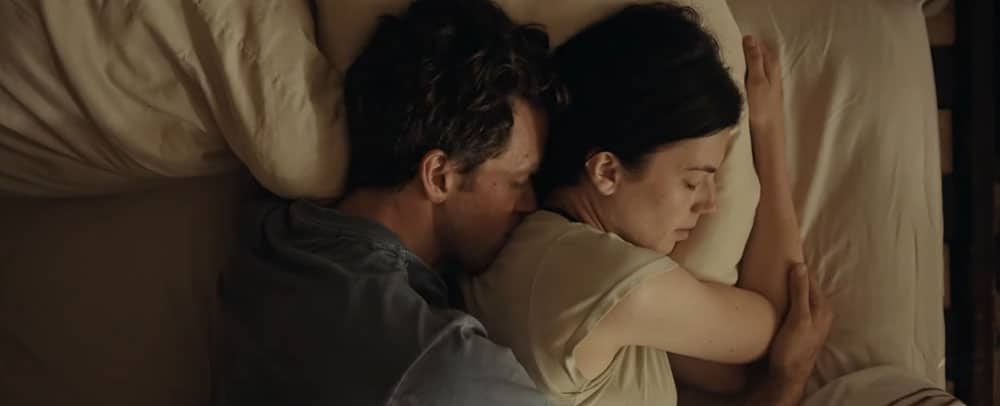
There’s something bleak and ominous about the isolated cattle ranch in a near-future Australia where Layla (Talia Zucker) works alongside her husband, Jack (Ashley Zuckerman; Succession).
In an unnerving portend of our potential future, natural resources have become scarce, and meat is produced in factories rather than farms. Farmers turned bioengineers like Jack attempt to clone cattle for a hungry market. Only the clones keep failing, risking their livelihood and amplifying tensions.
A cold chill seems to course through the veins of their union, a pervasive air that something is not quite right. Perhaps it’s the overwhelming loneliness and isolation, Layla’s longing to be reunited with her son away at boarding school, or the financial stress of a struggling business.
Or, perhaps, there’s something more sinister poisoning the well of marital bliss.
When Jack is injured, Layla makes a startling discovery that makes her question everything she thought she knew about her husband and the life they have built together.
In Vitro offers an intriguing combination of atmospheric folk horror, dramatic mystery thriller, and speculative science fiction.

The film was written and directed by Tom McKeith (Beast) and Will Howarth (who also stars as one of the only people besides Jack and Layla to appear onscreen), with star Talia Zucker co-writing.
Given that it involves advanced, morally gray technology in a crumbling society, it’s not hard to guess that the film explores the cataclysmic intersection of man’s genius with his hubris and the consequences of world-changing tech wielded for selfish pursuits.
Set in a world that feels all too real and a future perhaps perilously close to our own, In Vitro is a tension-filled reminder of why the current technological landscape is so disconcerting. It’s the same reason technological advancements have always terrified as much as they’ve excited; humans often make bad choices when their self-interest is at stake.
We’re facing a moment in history where technological capability is outpacing societal readiness, creating a potentially dangerous gap between what we can do and what we should do.
In Vitro asks thought-provoking questions about the current state of our fragile and over-exploited ecosystem, our treacherous path, and the ramifications of our unchecked power to play God.
As our knowledge evolves, we get smarter… but rarely wiser, content to repeat humanity’s mistakes and horrors—only with more monstrous weapons of mass destruction.
In Vitro is a story about control: the control we wield (or attempt to wield) over nature and the control we exert over others to get what we need.

It’s more than a story about eco- and tech horror. It’s also a compelling drama about co-dependent and abusive relationships, manipulation, and the ways we take advantage of love for our own gain.
The film examines how Jack subtlety controls Layla, exploiting her vulnerability and isolation to keep her in line as a business and domestic partner.
Conversely, it uses tech to tap into one of our greatest fears: the loss of control that’s core to our anxiety over technological advancements and the speed by which our world is continually changing and outpacing our ability to adapt.
It’s about being helpless in the face of events you can’t control or escape.
Despite its stripped-backed narrative, the script is thoughtful and intelligent, with a well-paced evolution from atmospheric dread to thrilling action.

Zucker and Zukerman are both outstanding, wringing tension and pathos from every scene and effectively conveying a depth of fear and desperation. The cinematography is simultaneously stark and beautiful, conveying the thin line between peaceful tranquility and solitary emptiness.
This haunting and meditative thriller is punctuated by a potent, ethically challenging ending that gives audiences plenty to chew on and debate.
Overall Rating (Out of 5 Butterflies): 4
The film enjoyed its world premiere at the Sydney Film Festival in June 2024 and had its North American premiere at the 2024 Austin Film Festival, where it was screened for this review.






Follow Us!