

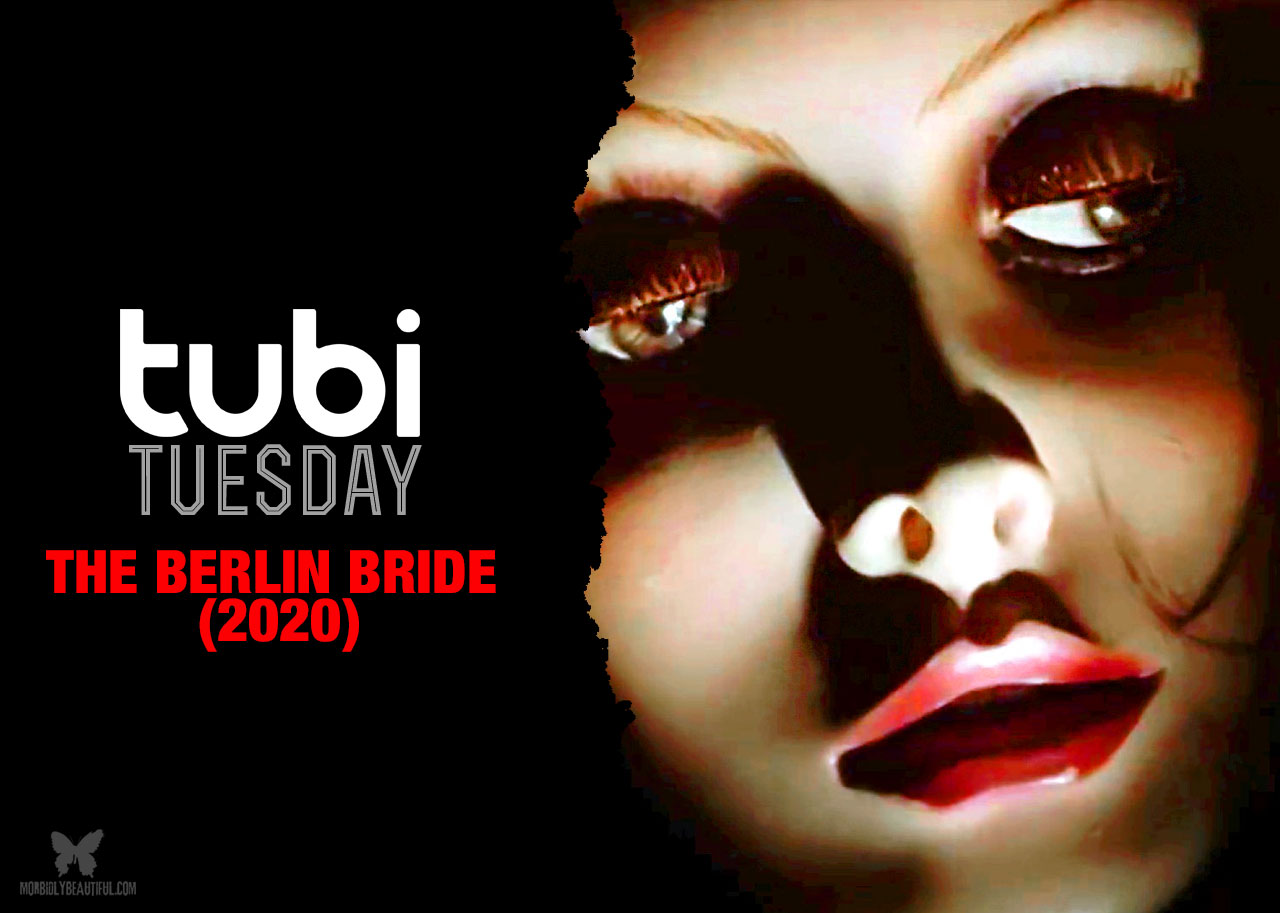
Decades in the making, “The Berlin Bride” reimagines past work into a surreal, haunting oddity set against late-80s Berlin.

No time to read? Click the button below to listen to this post.

It’s always fascinating when an artist decides to revisit their old work.
We like to think that when a piece of art is shared with the world, that means it’s finished, but that’s hardly ever truly the case. Much of the art we consume, especially when things like money and deadlines enter the mix, is made with a great deal of compromise and concession. Rarely does a film, an album, a novel, or a painting turn out exactly the way the artist envisioned it in their head.
Sometimes, this revisitation yields positive results, like Ridley Scott stripping away the voiceover narration from Blade Runner in his director’s cuts. Other times, the original is better off left alone, flaws and all. As most fans can attest, hardly any of George Lucas’ additions to the original Star Wars trilogy over the years have offered much in the way of improvement.
One such case of belated artistic reinvention is today’s Tubi oddity.
Coming from Portland by way of Berlin, it’s a film more than 30 years in the making.

The Berlin Bride is the work of Michael Bartlett, a Portland-based filmmaker and an overall pretty fascinating guy. Bartlett’s entry into the arts actually came via music, when he studied at Juilliard before getting hired to perform in two different orchestras in Berlin.
During his time in the orchestras, Bartlett made his first film, Konzert für die rechte Hand (Concerto for the Right Hand), which played at the Berlin Film Festival in 1987. It was well-received enough to help Bartlett gain entry to the American Film Institute, bringing him back to the good old US of A. He’d return to Germany in the 90s to make a couple of music documentaries for German TV, as well as a thriller called The Little Girl Who Fell from a Tree in 1998.
After that, it was back to the states, where he wouldn’t make another film until 2013’s House of Last Things.
The Berlin Bride is essentially a recut of Konzert, reusing footage from the film to tell a new story, augmented by some digital compositing. It isn’t always seamless, but that’s somewhat to be expected without Hollywood-level resources. Having not seen the original, I’m not sure how different it truly is, but based on Bartlett’s social media posts, it seems like this is the movie he wanted to make all along.
So how does Bartlett’s decades-long vision stack up?
The Berlin Bride is an odd little number, but a fascinating one, a compelling fusion of old and new.

Bartlett’s old footage takes us back to Berlin in the late 80s, shortly before the fall of the Berlin Wall, but as the Cold War was very much winding down. Seeing this historical footage is one of the movie’s biggest pleasures.
Miklos Königer plays a solitary sanitation worker, stuck cleaning up after the messy, mostly nude visitors of a local park. One day, he finds the top half of a mannequin seemingly abandoned in the bushes, and the loner takes it upon himself to bring his new companion home. On the way to his shabby apartment, he buys the mannequin a dress from an aesthete, one-armed shopkeeper (Henry Akina).
He gets back to his apartment, but realizes he’s lost one of the mannequin’s arms along the way, which is discovered by the shopkeeper.
The film often operates with a sort of fairy tale logic, particularly when the mannequin’s arm merges with the shopkeeper’s body to replace his lost appendage, while still exhibiting a mind of its own. The arm can even control the shopkeeper while he sleeps, using his voice to order a piano in the middle of the night from a befuddled salesman played by Bartlett himself.
Things continue to grow stranger and more abstracted as the film progresses, and these two lonely souls become bound together by their strange circumstances.
The Berlin Bride doesn’t tip its hand towards any one particular interpretation, but seems to comment on the toll that repression can take on a person and society at large.

Berlin in the late 80s was at a crossroads, slowly shedding the Cold War-era paranoia in favor of a freer form of expression, and the film seems to reflect this shift.
Until the wall came down in 1989, Berlin was literally divided between the Communist East and the Capitalist West, and the film’s fractured characters reflect life in the shadow of these larger forces. Both the sanitation worker and the shopkeeper use the mannequin to fill some kind of hole in their lives, in an effort to feel whole.
In a way, Bartlett’s decision to revisit his old work feels in line with this idea.
Clearly, something about this story continued to resonate with him. In finally completing his vision more than three decades later, hopefully, he found a way to feel complete within himself as well.
Overall Rating (Out of 5 Butterflies): 4










Follow Us!