


“Fast Times at Ridgemont High” birthed a teen movie renaissance, where a very young Nicolas (pre-) Cage got his start in a barely-there role.
No time to read? Click the button below to listen to this post.
It’s Cameo Cage this week, as we check off films that our man is technically in… but just barely. It started with a “gift” from the Random Number Generator, Cage’s directorial debut, Sonny, in which he makes a small but memorable cameo. We then put two films up for a vote by our audience: his film debut in 1982’s Fast Times at Ridgemont High and his short but splashy role in Rob Zombie’s fake trailer for Grindhouse, Werewolf Women of the S.S.
It was another 50/50 split, so we’re once again covering both films, starting with the iconic and influential Fast Times.
IN THIS CORNER: KELLY MINTZER
The Lowdown
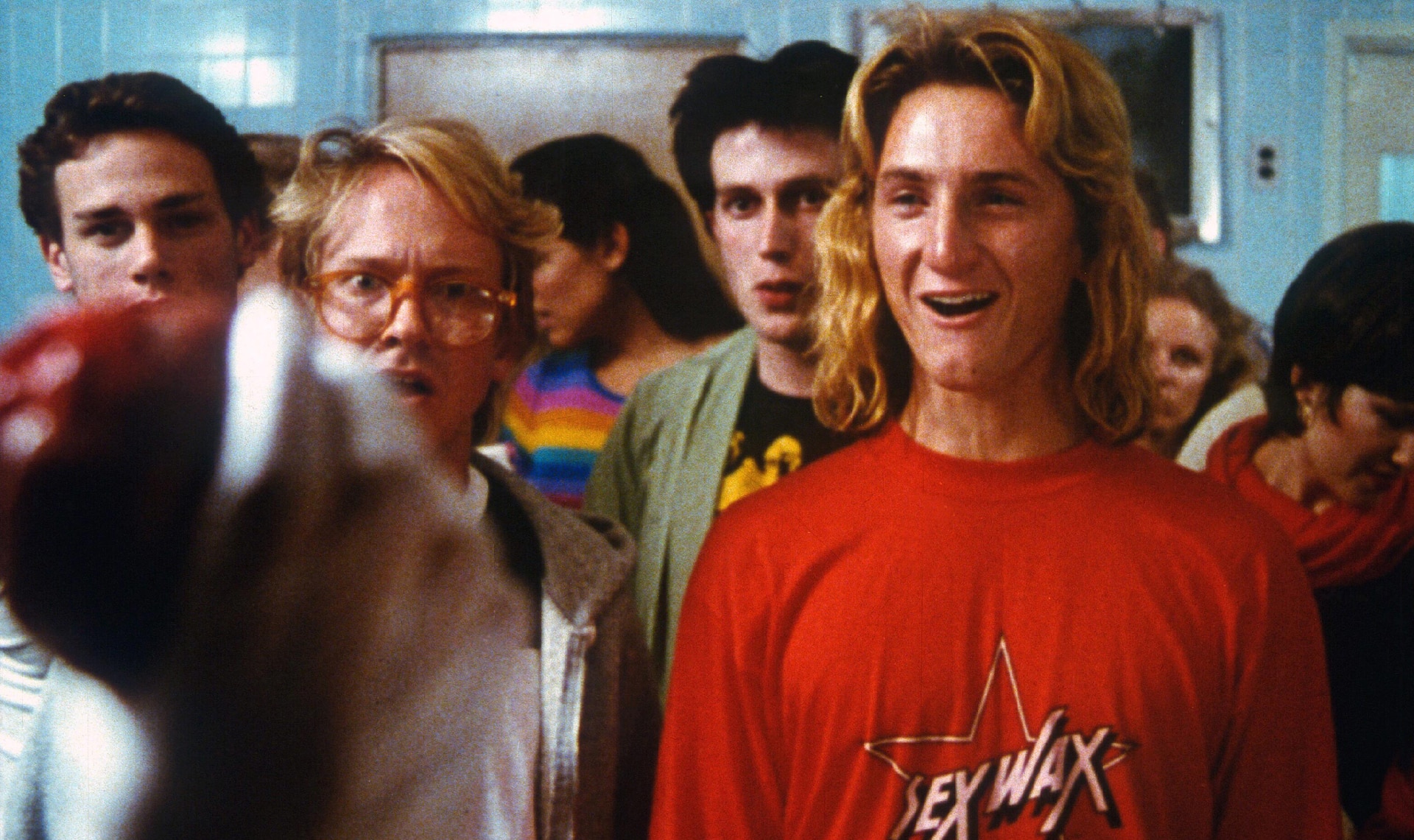
There is a strange and difficult-to-define reality about the Cage Match that comes into starker and starker relief as the series progresses. Which is: the worse a movie is, the more I have to say about it. The better it is, the more I just kind of throw my hands up and say, “It was good!” (excluding profound pieces like Dream Scenario, and—god help us when we get to it—Pig).
This is my way of letting you know in advance what to expect. I realize last week I wrote a fucking thesis on the garbage can that was Sonny. I just don’t have nearly that much to say about Fast Times at Ridgemont High because… I get it; it’s a great movie.
We are very clearly dealing with an embarrassment of riches here.
This was the great Amy Heckerling’s debut, and Cameron Crowe wrote it. It stars an irritatingly charming Sean Penn, and a murderer’s row of co-stars support him at his goofiest and most delightful. (I want a quick nota bene here: I know we have to reconcile with Penn’s upsetting history of domestic violence with Madonna, and I have not forgotten it. He is an excellent actor who is, by every reasonable metric, also kind of an asshole).
Fast Times is one of those quintessential high school movies, alongside its sister Heckerling film Clueless (which I admit, I am a bit more fond of; it is perfect) or even American Graffiti. And why not? It is really hard NOT to root for Penn’s Spicoli as he sort of bumbles through high school. It’s sharp, it’s funny, it’s charming.
Did I feel, perhaps, like I should have seen it younger? Yes, I did. I think, much like Goonies, Fast Times may hit harder if you see it (for the first time) when you’re closer in age to the teens involved than their parents. But still, I had a good time watching it, and it’s hard for me to dock it for anything.
The Cage Factor:
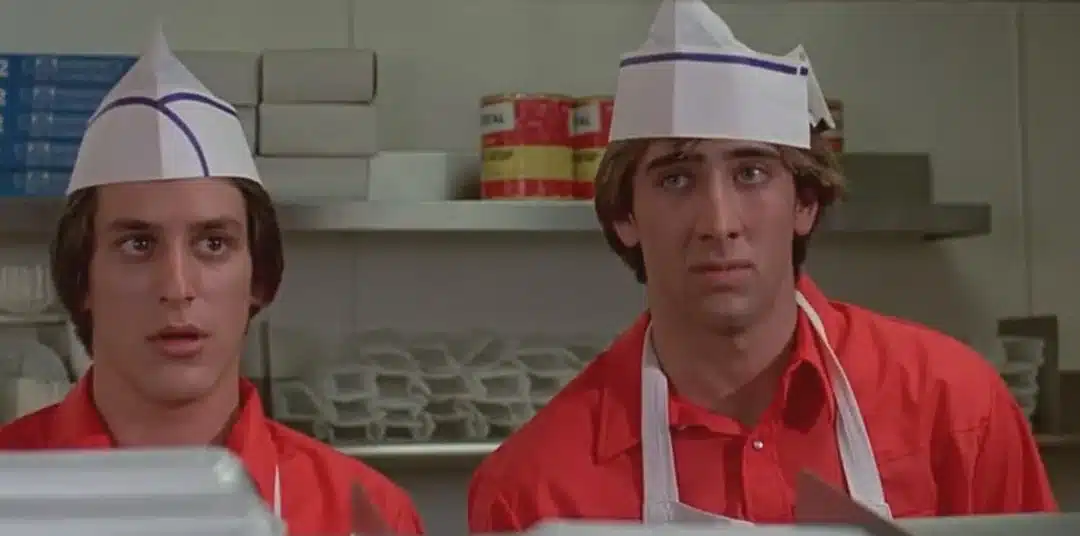
Look, he’s barely in it. So I have to go with Cautious Cage, not because I don’t think you should watch this movie, but simply because its space in the Nicolas Cage oeuvre is non-essential—because he is non-essential. It is required Sean Penn viewing, however.
AND IN THIS CORNER: STEPHANIE MALONE
The Lowdown
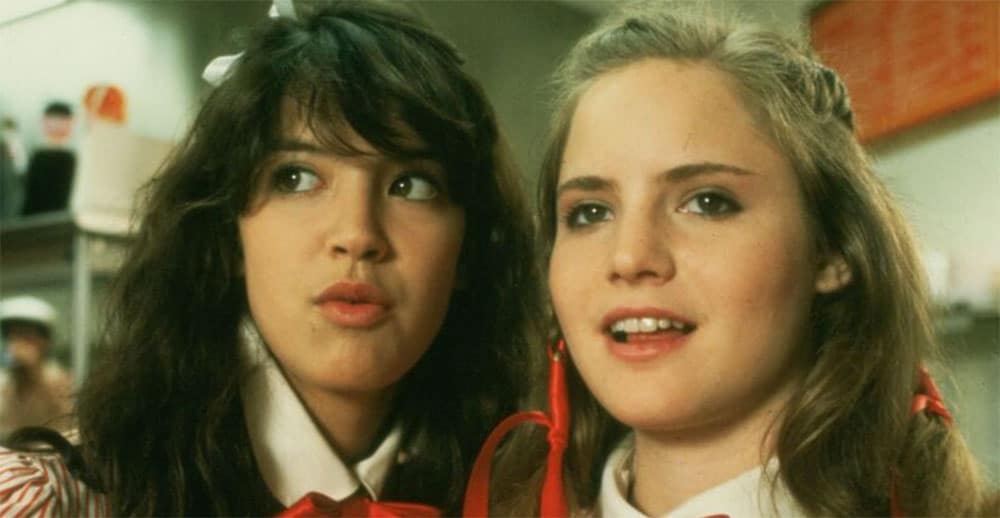
Buckle up, babies, because I have a LOT to say about this coming-of-age cinematic touchstone.
Before John Hughes reigned over the halls of adolescent heartbreak and cafeteria cliques, Fast Times at Ridgemont High had already handed in its homework early — a wickedly smart, emotionally astute, and unexpectedly compassionate teen dramedy that told the truth about high school with both clarity and comedy.
Directed with empathetic precision by Amy Heckerling of Clueless fame and adapted from Cameron Crowe’s undercover exposé of high school life, Fast Times isn’t just a time capsule of early ’80s American youth; it’s a blueprint for every honest teen film that came after it.
And buried among the food court chaos and stoner-wisdom is a blink-and-you’ll miss-it moment of cinematic history: the film acting debut of a then-unknown Nicolas Cage, still going by the name Nicolas Coppola. That name would soon be dropped like a bad elective, and a legend would rise in his place.
Where most teen comedies of the era were content to mine laughs from locker-room fantasy and lowbrow hijinks, Fast Times at Ridgemont High dared to do something radical: take teenagers seriously. Crowe’s screenplay, rooted in his real-life experience posing as a student at a California high school, rings with a rare authenticity.
In a genre dominated by the male gaze, Heckerling brought an essential female perspective that reframed the teen narrative. She allows young women the space to explore desire, make mistakes, and recover without shame. Where other films punished girls for the same sexual curiosity boys were celebrated for, Fast Times offers a rare sense of parity.
For that, it remains radical even today.
The film also launched a who’s who of future Hollywood heavyweights: Forest Whitaker, Eric Stoltz, Anthony Edwards, and, of course, a young man credited as Nicolas Coppola. Though his role amounts to little more than a few fleeting frames—a background burger flipper with a thousand-yard stare—his name in the credits marks a before and after.
This is the only time you’ll see him using his birth name on screen (he used it only once before in the 1981 television pilot The Best of Times). Shortly after, he’d rechristen himself Nicolas Cage, choosing to forge his path apart from uncle Francis Ford Coppola’s shadow.
The rest, as they say, is history.
The Cage Factor:
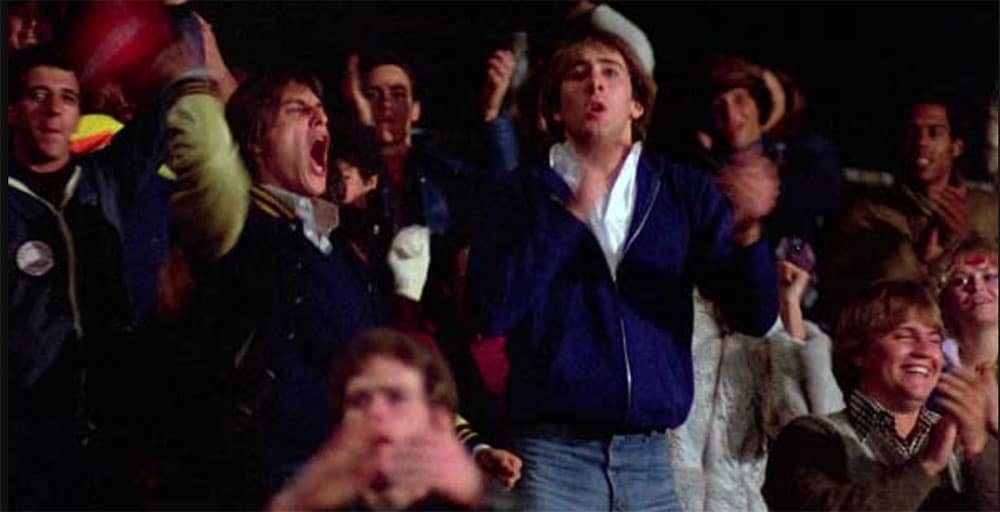
Let’s not pretend Fast Times is a Nicolas Cage film. It’s DEFINITELY not. But in the sacred text of Cageology, it is Genesis. His role may be minor (like really, really minor), but this is a pivotal artifact for completists. You won’t see the charisma and unpredictability that would explode a year later in Valley Girl and Rumble Fish, but you’ll know it’s there… simmering with fiery intensity just below the surface.
The youngest cast member and the only one actually under high school age, he desperately wanted to play the lead role of Brad but was relegated to the background. He originally had a couple of bit-speaking parts, but you’ll have to check out the deleted scenes from the film to see them (watch here). He also famously hated filming this and was constantly razzed by the cast about his famous uncle.
There’s something poetic about Cage starting here, in a film that champions individuality, awkward honesty, and bold choices—qualities he would come to embody with operatic fervor across a five-decade career.
The future Oscar winner, buried in the background of burger joint chaos, waiting his turn to unleash the full Cage.










Follow Us!