

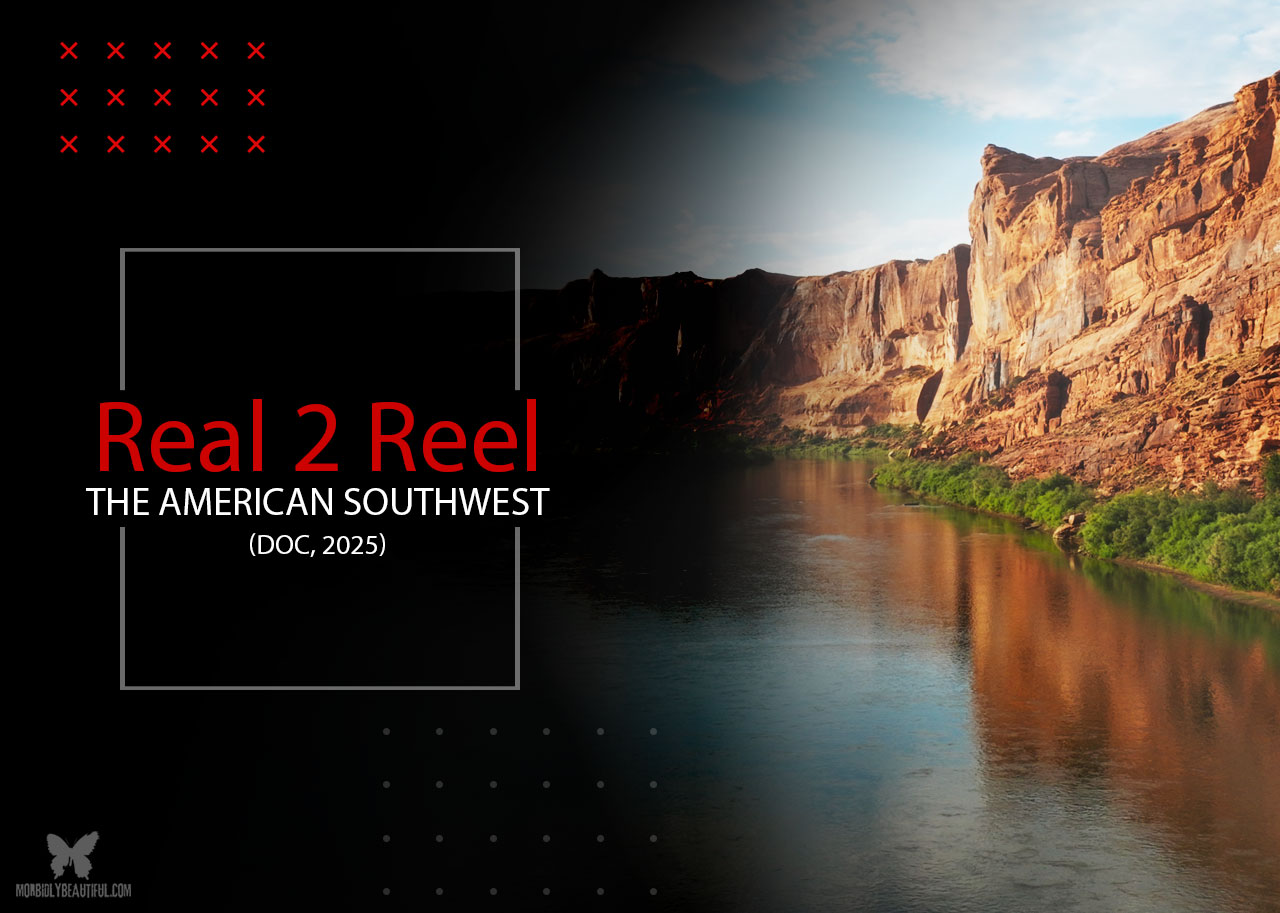
A lush, immersive nature documentary that captures the American Southwest in all its glory—while quietly asking how long it can survive us.

No time to read? Click the button below to listen to this post.

The scariest thing I’ve seen on screen this year isn’t a masked killer, a demonic possession, or a flesh-eating monster. It’s a river running dry.
I know, a nature documentary might seem like an odd pick for a horror site. But The American Southwest is ecohorror in its purest, most unsettling form. There’s no beast to vanquish, no supernatural curse to reverse. There is only a very real, rapidly approaching apocalypse: the slow death of one of the most important rivers in North America, and the loss of the wild beauty, cultural history, and life-giving power it sustains.
The horror here is human: greed, shortsighted policy, and the casual, relentless exploitation of a resource we treat like a faucet instead of a living system.
And like the best horror, The American Southwest forces us to confront an uncomfortable truth: the monster is us.
Directed by veteran nature photographer and filmmaker Ben Masters, The American Southwest is an immersive journey down the Colorado River, tracing its path from snowy headwaters in the Rocky Mountains, through the carved bones of the Grand Canyon, all the way to its heartbreakingly diminished delta in Mexico.
Narrated by environmentalist, model, and actress Quannah Chasinghorse, the film balances awe and alarm.

It’s part love letter, part elegy, part rallying cry.
Masters structures the film around two intertwined storylines: The physical journey of the Colorado River itself, as it winds nearly 1,500 miles through some of the most iconic landscapes on Earth, and the evolving human relationship with that river and its wildlife—from Indigenous stewardship thousands of years ago to modern dams, diversions, and a climate-changed future that’s only getting hotter and drier.
What makes this especially compelling is that Masters doesn’t treat humanity as a faceless villain lurking off-screen, the way many nature documentaries do. Instead, The American Southwest is explicitly a social documentary. It looks at how people live with, depend on, damage, and work to restore the river and its ecosystems.
This is the rare “family-friendly” nature film that doesn’t flinch from harsh realities. It trusts viewers of all ages to handle the truth.
On a purely visual level, The American Southwest is staggering.

Shot across multiple states, the cinematography revels in vast, sculpted canyons, sheer red cliffs, shimmering water threaded through stone, and clouded skies that make you feel small in the best, most cosmic-horror kind of way. Sweeping aerial shots place the Colorado River like a glowing artery across an immense, ancient landscape.
It’s the kind of beauty that hurts a little. You fall in love with what you’re looking at, even as the film quietly reminds you how fragile it all is.
The wildlife sequences, though, are where the film truly sinks its hooks in. Masters and his collaborators capture rare and intimate moments that feel almost unreal in their proximity.
We meet beavers methodically building wetlands, literally reshaping their environment into resilient refuges that help cool and store water; bugling bull elk standing against forests and valleys that feel both eternal and precarious; a den of desert-adapted rattlesnakes; a young California condor struggling to find its way home; the region’s apex predator, the jaguar, gliding through the night.
We also get a surprisingly riveting spotlight on the salmonfly, the largest aquatic insect in North America—a mini epic of metamorphosis, emergence, and vulnerability that quietly underlines how even the smallest creature holds up entire ecosystems.
These scenes are more than pretty interludes; they personify the river’s story.

Masters frames these animals as “characters” with agency, history, and futures hanging in the balance.
For horror fans, there’s something deeply unsettling in watching these nonhuman lives unfold in real time, knowing that their survival hinges on decisions made in boardrooms and policy meetings far away.
The sound design doubles down on that immersion. Masters leans into amplified nature sounds. The result is almost meditative, a soothing sensory cocoon that makes the film feel like a guided trance into the wilderness. That tranquility is precisely what makes the pending loss feel so monstrous.
Narration can make or break a documentary like this, and Quannah Chasinghorse is nothing short of transformative. Her voice is steady, warm, and deceptively gentle, wrapping the film in a tone that feels like a story passed down rather than a lecture handed down.

Chasinghorse brings deep authenticity to a documentary that is acutely aware of whose land, stories, and struggles it’s engaging with.
We learn that this river, nearly 1,500 miles long, quite literally feeds the country. Roughly a quarter of its water is diverted to California farmland, growing crops that wind up on plates across the United States. Cities, farms, and entire economies are built on its back.
It’s not hyperbole when the film likens the river to a circulatory system: it pumps life into communities, fields, and ecosystems far beyond its shores.
Which makes the damage feel all the more obscene.
Masters doesn’t shy away from the grim realities of dams, irrigation systems, and chronic overuse.

The film shows water held back in colossal reservoirs, evaporating under unrelenting sun. It shows dry, cracked riverbeds and choked stretches where the Colorado fails to reach its own delta. It contextualizes the frightening math of a region becoming hotter and drier while water demand continues to grow.
This is where the ecohorror really sinks its teeth in. There’s an almost body-horror quality to seeing this grand river—this living artery—dammed, sliced, siphoned, and bled dry. The film’s language is restrained, but its imagery is visceral.
At the same time, The American Southwest is careful not to paint an entirely nihilistic picture.
It makes space for scientists, conservationists, Indigenous leaders, and organizations like American Rivers, the Northern Jaguar Project, and The Peregrine Fund, all working to reshape policy, restore habitats, and rethink water use.
The film is unambiguous: humans broke this system. But humans also have the tools—and moral obligation—to help mend it.
The American Southwest is, ultimately, a film about grief and possibility.

Grief for what’s already been lost; possibility in what might still be saved.
Masters has crafted something extraordinary. Quannah Chasinghorse’s narration, the amplified soundscape of water and wind and wings, the painstakingly captured wildlife, the honest reckoning with human impact.
It all comes together into a documentary that lingers like a specter long after the credits roll. For horror fans, this is ecohorror stripped of metaphor. No rubber suit. No CGI storm. Just us, our history, and the river that keeps us alive.
If you’ve ever felt your chest tighten at the idea of an irrevocably changed climate, vanishing species, or a world your children and grandchildren will inherit in pieces, The American Southwest will haunt you—and hopefully push you to do something with that fear.


Overall Rating (Out of 5 Butterflies): 4.5







Follow Us!